Committee member, Lorraine Eagling, reviews the agenda item relating to the plan for the Carrington Relief Road, which was discussed at Trafford’s Scrutiny Committee on 13th March 2024. A link to the recording (from 47:49 minutes) can be found here and the report is available here.
The new part of the relief road will be constructed across farmland, parallel to the A6144 between Isherwood Road and the Carrington Spur. In the presentation to the Scrutiny Committee the new road was described as ‘not a big road’ (despite previous suggestions that it would be a dual carriageway). The main carriageway that carries motor traffic will be 7.3 metres wide and there will be 5 metres on either side for active travel (2.5m for pedestrians and 2.5m for cyclists), so a total of 17.3 metres wide.
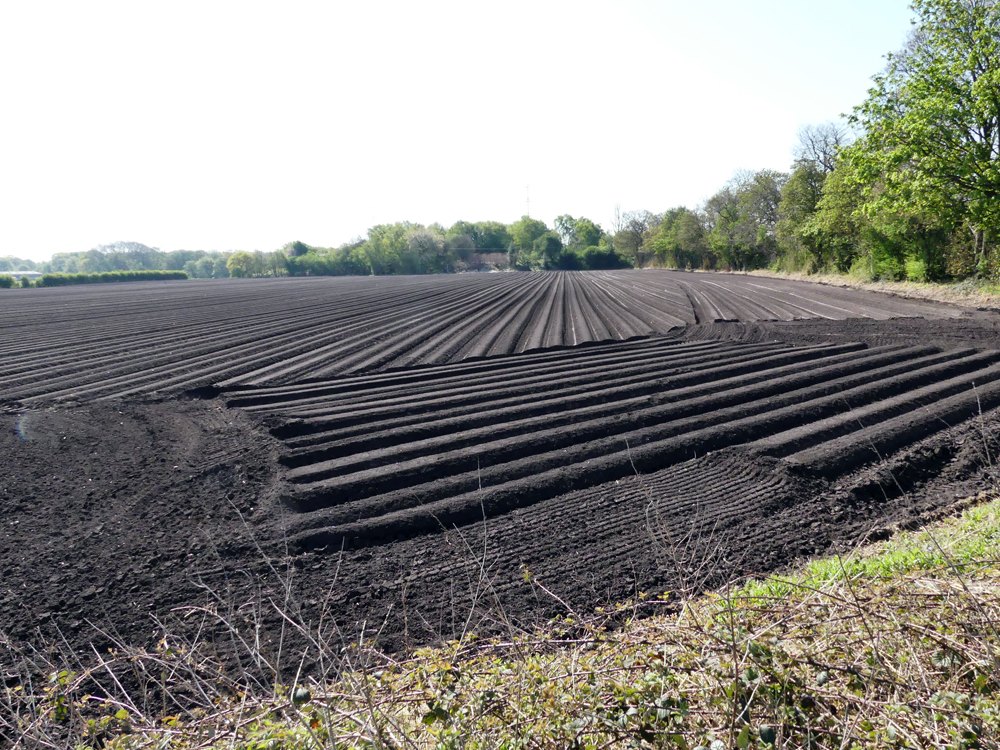
This field, which grew potatoes last year, will be sacrificed for the road and for housing
It is really encouraging to see that pedestrians and cyclists are given so much consideration, but would residents want to walk, let alone cycle beside a major road that carries over 3,000 heavy goods vehicles a day, along with a huge number of cars?
Would an active travel corridor that runs parallel to the existing road be a better option? We think it would!
And what about horse riders, we have over 1,000 horses stabled on and around Carrington Moss! We have repeatedly raised their needs with Trafford and yet they still don’t even get a mention in this presentation! At least one of the stables provides services to children with special educational needs. Those children will not be able to ride near to the thousands of motor vehicles that will be travelling along the Carrington Relief Road every day, the noise alone will be an issue. They currently have lots of options for circular routes along the very safe and very quiet public rights of way, short circuits or longer rides. The road is going to fracture their routes and reduce the opportunities for these very vulnerable members of our community.
The Scrutiny Committee were given a presentation on the history of New Carrington, which showed that since the closure of the railway line in the 1980’s, Partington and Carrington have become increasingly isolated and car dependant. Several Councillors raised the question of why sustainable options aren’t being re-introduced like re-opening the old railway bridge to allow for a light rail or full rail link between Irlam and Timperley. Councillor Holden explained that this idea has been around for some considerable time because a bridge was built in Broadheath so that this train line would remain viable. We know that former MP, Kate Green, with the backing of the residents of Partington and Carrington, lobbied Parliament about re-opening the line, so it is not new to Government.
Now that HS2 has been scrapped, shouldn’t this be something the GMCA and Trafford Council actively pursues? Especially when New Carrington is the largest development in the Greater Manchester Spatial Framework (frustratingly, New Carrington is described by executive members as ‘one of the largest brownfield sites in Greater Manchester’, which is highly misleading given the majority of the brownfield land already has planning approval and 169 hectares of greenbelt will be released for the development of housing, warehousing and roads, affecting a 335 hectare peatmoss, Grade 2 agricultural land, woodland and wetland habitats).
Interestingly, Stockport Council, which pulled out of GMCA’s Places for Everyone (PfE) Plan in order to protect its greenbelt, is now in talks with TfGM and GMCA to have the Metrolink extended to their new transport interchange.
So, as the largest site in the PfE Plan, why isn’t New Carrington being prioritised for such sustainable transport investment, especially when it is described as the ‘Western Gateway’?
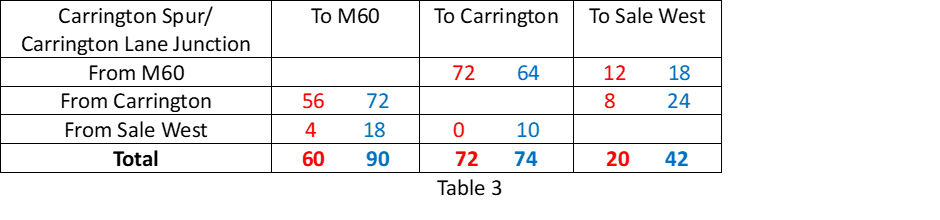
In a recent traffic survey, carried out by Friends of Carrington Moss, during peak times we recorded approximately 50% of the traffic coming from the M60 going towards Carrington and less than 50% of the traffic from Carrington headed towards the M60. In fact, approximately 50% of the traffic coming from the M60 is headed towards Sale West and over 60% of the traffic from Carrington and Partington headed towards Flixton. Full details of our survey can be found in my previous blog here.
During term time, peak time traffic increased by approximately 500% and there was significant traffic queuing from the M60 to Sale West and from Sale West to the M60. There was no queuing traffic in other directions or at other junctions.
In essence, only half of the traffic surveyed used the existing A6144, which the new road aims to relieve! It is evident that the main cause of congestion is school traffic which could be reduced by reviewing Trafford’s school admissions policy and providing school buses. Shouldn’t the Council tackle this issue instead of spending £76.5 million on a road that only 50% of existing traffic will use and that will offer no relief to the residents of Partington and Sale West as explained in my previous blog?
At the Scrutiny meeting, Councillors also raised the issue of how the Council will raise in excess of £54 million of public money for the relief road. The Council’s Director of Growth & Regulatory Services, Adrian Fisher, acknowledged the risks and explained that when the planning committee addressed all of the infrastructure needs of New Carrington, which includes all roads, schools, playing fields etc, they decided that in theory there is enough funding from developers to meet needs. He explained that the main issue is with the sequencing of the funding, that where the main risks arise is getting the first bit of infrastructure up and running.
Sequencing is definitely an issue, as it’s the chicken or the egg scenario. Developers’ contributions are based on all development completed, but they won’t develop all sites unless the relief road is built! Mr Fisher describes the site as the biggest in Greater Manchester and it will not able to deliver houses unless the road is built!
So, at what point will the developers make their contribution? Trafford have recently had their fingers burnt when it comes to developers Section 106 contribution. Also, as mentioned in the meeting, the developer contributions are not only for this road, but for other roads that will be needed for this huge site, for schools and other community facilities. Will the developer contributions be enough for all this infrastructure? The answer is a definite NO!
Councillor Carter asked how the new road would impact the peat land to the south of the proposed carriageway, in particular relating to drainage. Mr Fisher acknowledged that there is significant peat in the south part of the site and that this will be an issue when it comes to development in that area and will be an important consideration.
We know how important peat moss is, so much so that the Government is investing in peat restoration to fight climate change. With this in mind, why would Trafford Council give planning permission to build on this precious habitat? The answer is that they are wedded to building a road, rather than advancing more sustainable options and, if they don’t give planning permission, they will not get the developers’ contributions towards the costs of the road.
Councillor Holden raised the issue of extensive contamination, and now there is the recent discovery of PFAS (Per-and polyfluoroalkyl substances) on the site. Mr Fisher acknowledged that this will be addressed when building the new road and this is why the costs of the road has increased significantly. He explained that a separate drainage system is needed to avoid contamination of groundwater as a result of run off from the road. It was confirmed that the Council will be working with the land owner/developer and the Environment Agency to come up with a solution that avoids flushing out contaminants into local watercourses and environment. We know that this area is particularly sensitive for the water environment given its location above a principal aquifer and nearby surface waters including the River Mersey and Sinderland Brook, so it is vital any contamination risks are appropriately remediated.
So, what will the true cost of the Carrington Relief Road be? Not just in financial terms but in relation to the ecology and biodiversity of the area, in relation to the health and wellbeing of residents and in relation to climate mitigation issues that will impact future generations, our children and our grandchildren?
Lorraine Eagling looks at what the Strategy means to residents given today’s traffic volumes!
It’s without question that a transport strategy is desperately needed by the residents of Carrington, Partington, Sale West, Warburton and Ashton on Mersey even before the plans for New Carrington get underway, so it was encouraging when Trafford Council published The New Carrington Transport Strategy but very disappointing that no residents had been involved in its development.
The residents of these isolated and poorly served towns have long been promised and waited for a plan that provides the transport solutions they deserve, that are sustainable and will provide long term options for existing residents and for future generations.
The Strategy describes all the sustainable options (scenario 3) that would provide residents with regular and reliable connectivity to the rest of Manchester. Solutions that would provide the residents with access to trains and trams and reduce traffic on local roads. The Strategy goes on to explain, however, that these long-awaited public transport services are not an option because they are too expensive to implement and the only affordable option is a relief road, now expected to cost a minimum of £76.5m (and that is before any resident requirements such as additional junctions, crossings and traffic calming measures, for example are included in the design). Reminiscent of Bullseye’s infamous phrase ‘look at what you could have won!’, residents have once again been let down.
The proposed relief road will run along the existing A1 Road, which starts opposite the Saica paper factory, to Isherwood Road. From here a new road will be constructed adjacent to the peat moss and across the farmland to meet the Carrington Spur Road at the junction with Carrington Lane in Sale West. The new section of the road will have massive implications to the environment. More details about the impact of the CRR can be found at this link, where you can look at our many previous blogs about the Carrington Relief Road by scrolling down the web page.
It’s a very disappointing outcome and it is questionable when the following is taken into consideration:
There is no mention of HGV traffic anywhere in the report. As we know, the huge number of HGVs is the main concern for residents in Carrington Village and beyond.
The traffic data used in the report is taken from TfGM 2017 base year, which is outdated and pre-covid. Considering the implications of this Strategy, the data should be current. It is not clear whether any actual traffic monitoring has been done at key locations in order to access what road interventions would have the greatest benefit.
In addition to the outdated TfGM data, the Strategy interpreted daily travel modes from evidence of what it describes as ‘comparable brownfield’ development sites in South Gloucestershire, including areas of Stoke Gifford, Bradley Stoke, Patchway and Filton, on the northern edge of Bristol. These sites have their own train stations and are home to industries such as aerospace and hi-tech engineering. This is hardly comparable to New Carrington, Partington, Warburton and Sale West, where there are no train stations and the main industry is HGV intensive warehousing and logistics. Also, New Carrington is not just brownfield, it is green belt, comprising peatmoss, woodlands, wetlands and grade 2 agricultural land.
What about the traffic data?
We have been collecting our own traffic data at key junctions in Carrington and Sale West for several years, but to verify the figures in the report, we collected some specific data in February and March 2024. The results of our survey are as follows:
Cars and Vans
Table 1 shows the average number of cars per hour, during peak times, at the junction of the Carrington Spur and Carrington Lane in Sale West. The red data was recorded during school term time and the blue data was recorded during school holidays.
As expected, the number of cars increases around this junction during term time. The data shows during term time there are almost four times as many cars travelling from the M60 to Sale West. Also, the number of cars travelling from Carrington to Sale West is more than double during term time and the number of cars travelling from Sale West to Carrington is more than tripled.
On average, a total of 2,728 cars pass through this junction during peak times. During term time, 48% of the car traffic from the M60 is heading towards Sale West and 43% of the traffic heading towards the M60 is from Sale West. Additionally, 39% of the traffic from Carrington is heading towards Sale West and 47% of the traffic from Sale West is heading towards Carrington.
Other observations at this junction are:
Traffic queuing along the Carrington Spur Road from the M60.
Traffic queuing along Carrington Lane towards the M60.
Other routes were flowing freely.
2 buses maximum during the survey period.
Table 2 shows the average number of cars per hour during peak times at the junction of the A6144, Flixton Road and Isherwood Road in Carrington. The red data was recorded during school term time and the blue data was recorded during school holidays.
As expected, car traffic increases during term time, with the exception of those vehicles headed towards Isherwood Road. During term time the car traffic from Carrington to Flixton increases by almost five times. 62% of the car traffic from Carrington is headed towards Flixton. It is also interesting to see that 36% of the traffic headed towards the M60 is from Flixton.
Other observations at this junction are:
All traffic was flowing and there was no queuing at any junction.
Some traffic was travelling at excessive speeds, including HGVs.
3 buses maximum during the survey period.
According to the data in the Transport Strategy, 875 cars travel from Partington and Carrington to Urmston (the report does not mention Flixton) on a daily basis. We recorded 678 in one hour during one peak time and 282 and hour during non-peak time. It suggests that the data in the report is an underestimation for traffic moving in this direction.
The data in the transport strategy is not as specific as the data we collected but assuming the traffic from Carrington and Partington heading to ‘Sale West’ and ‘10km inside GM’ is the traffic headed towards M60, then their data suggests there are 10,587 cars per day travelling along the A6144 between Isherwood Road and the Carrington Spur Road. Our data shows 663 cars during peak time and 502 cars during non-peak time per hour. Assuming two peak times and 10 hours of non-peak traffic, that is a total of 6,346 cars travelling along this route. This time, the data in the report seems an over-estimation for cars travelling along this section of the A6144.
We will repeat our traffic count in the coming months, to test the validity of this result.
HGV Traffic
The data shows that during peak times there are approximately 152 heavy goods vehicles at the Carrington Spur junction and 213 at the Isherwood Road junction per hour. At non-peak times, there are 208 and 206 respectively. This suggests that HGV traffic is consistent irrespective of peak or non-peak times and is in excess of 2,000 per day. This figure will increase significantly as the proposed new warehousing is built.
Conclusions
Our data shows that:
The A6144 Carrington Lane in Sale West has as much car traffic as the A6144 in the direction of Carrington, as 48% of the traffic from the M60 turns towards Sale West during peak times.
The A6144 between Isherwood Road and the Carrington Spur has less car traffic than that suggested in the report.
There was no queuing traffic at the junction of the A6144 and Flixton Road during peak time. There was, however, significant queuing on the Carrington Spur and on Carrington Lane.
There is a massive increase in car traffic during term time indicating that there is insufficient public transport for students to get to school and a large proportion of students are travelling to schools from either outside the catchment area or from outside the borough.
Considering the findings of this data, how will the relief road reduce the traffic issues highlighted?
The biggest issue for the residents of Carrington Village has always been the large number of heavy goods vehicles that pass their front door every day. The existing A1 Road could be opened immediately to redirect HGVs away from the village. This would be a quick win (if the businesses in Carrington are willing to use that road).
Partington is experiencing housing development on a huge scale. The new developments on Lock Lane, Hall Lane, Oak Road, Heath Farm Lane and the Greyhound will create another 1,291 dwellings. Despite these developments increasing the number of houses in Partington by 38%, the routes in and out of Partington will remain the same. Only after the cars and buses have contended with the congestion in Partington itself, can they access the proposed relief road further along the A6144.
For residents in Sale West and Ashton on Mersey to benefit from the proposed relief road to Carrington, they will have to access it from Carrington Lane which is already heavily congested even before the new relief road joins this junction.
In essence, residents in Carrington Village will only benefit if HGV traffic moves onto the existing A1 Road. Residents in Partington, Sale West and Ashton on Mersey will have to queue in traffic in their towns before they can access the relief road. The new relief road, which will cost at least £76 million offers no relief to these residents who will see the population in their area increase significantly as a result of the Places for Everyone Plan. There will be an additional 2,260 houses in Partington and Warburton, 1,443 in Sale West (in addition to the 263 already with planning permission) and 603 in Carrington Village.
So how can this Transport Strategy justify such significant expenditure on a road that offers no solution to traffic issues that already exist?
There are other considerations here too:
Why hasn’t the A1 Road already been opened to HGV traffic to resolve the issues in Carrington Village?
Why are so many students being driven to school?
Do the school admissions policies in Trafford need reforming?
Does the Education authority or TfGM need to look at providing school buses?
The data shows that it is school traffic and heavy goods vehicles that create the congestion along the A6144. These are the issues that need addressing rather than spending £76 million on a scheme that will not solve the transport issues that have plagued this area for decades. This money could contribute towards the ‘scenario 3’ solution in the Transport Strategy and should be invested in long term, sustainable passenger and freight transport interventions.
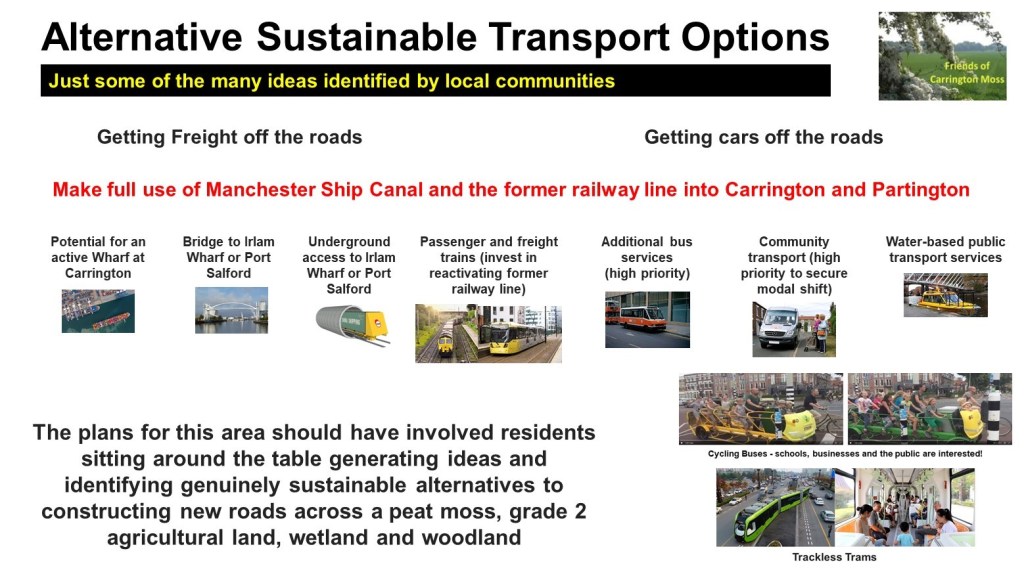
There are several options that could be considered, such as:
opening the railway bridge between Irlam and Partington to give residents access to trains
opening up the ‘greenway’ and the former railway line from Partington to Altrincham to give residents access to trams
revisiting the 2012 Local Plan option to build a bridge from Carrington to Port Salford.
These are long term sustainable options that will reduce congestion and open up Greater Manchester and the rest of the UK to residents of these local areas.
What we need is a Transport Strategy that meets residents’ requirements, why isn’t Trafford talking to us about it?
We had hoped the collaborative way the New Carrington Masterplan is being managed would prevail for other aspects of development in the area, but sadly, no! Once again, we have a “strategy” that has been agreed by Trafford’s Executive without any input from the residents who will be severely impacted by its implementation (not only by what is in the “strategy” but also by what is not)!
On the positive side, the Council has begun an open and transparent process for developing the Masterplan for New Carrington (the details are on their website here). This is good news, because, it is clear that residents have a lot to bring to the table in relation to what is needed in the area.
The Executive report itself is actually a marked improvement on previous documents created by Trafford about the Carrington Relief Road. It does acknowledge some of the issues that have arisen (and continue to be identified). In view of Trafford’s declaration of a climate emergency back in 2018 and its carbon neutral goals, set out in 2020, the accompanying Transport Strategy document, however, remains unambitious and has several major omissions.
Interestingly, that “strategy” document was produced in September 2023 but has been kept under wraps until after the Places for Everyone (P4E) Modifications Consultation was completed, which is rather disingenuous of Trafford’s politicians and officers, given that its contents signal concerns about whether the huge list of “Necessary Transport Interventions” set out at Appendix D (page 708) of the P4E Plan can, or will, be delivered.
Resident Priorities?
Whilst the production of this “strategy” is to be welcomed, there has been no involvement of the community in determining the Vision, or the aspirations, and there is nothing in the document that suggests that communities will be engaged as the “strategy” evolves in the future! It is, therefore, not a surprise that it merely continues to promote car/HGV-dependency, leaving a legacy of huge levels of air, noise, light, vibration and water pollution (to say nothing of the carbon emissions), that will result in poorer health outcomes for residents and higher costs to the public purse. There is a reference to a specific consultation about one initiative, the Carrington Relief Road, but that was supposed to commence in January 2024, so is already behind schedule.
HGV traffic on the A6144 is, by far, the biggest concern for residents, yet there are no figures in this document which identify the size of the issue (either now or in the future), nor does it explain how Trafford proposes to address this problem. The “strategy” confirms that the new road will be the panacea for freight transport! Yet, we know that businesses are not in favour of restricting HGV use on the A6144, as was confirmed in a response to a planning application. There is no indication about how the proposed route changes will be agreed with businesses and implemented so that travel through Carrington Village can be limited to local resident movements.
So, what we have now is a “strategy” which:
does not address any of the issues related to the huge number of HGVs that are travelling on local roads, there are no references to sustainable freight transport solutions and no aspirations to even consider them – is this really a strategic document?
does not estimate the anticipated induced traffic that will arise from the construction of the proposed new roads (causing more congestion, much higher levels of pollution and increased travel incidents), particularly for Partington, nor does it reveal the ultimate aim, set out in the GM Transport Strategy 2040, to create a link between the M60 and the M62 via Carrington (page 124/125), which will undoubtedly induce immense volumes of motor vehicle traffic through the area
does not even mention the importance of local travel routes to horse riders (there are more 1,000 horses stabled in and around the area – source British Horse Society) – this is a huge gap as horse riders need specific surfaces (to reduce the potential for the animals to slip in wet weather, for example, and specific crossing points) – it would be inappropriate to consider active travel routes here without including their considerations.
The background facts are rather selective, there is no reference, for example, noting that Partington has a much lower rate of car ownership (27.2% of households with no cars or vans according to Census 2021) compared to the rest of Trafford (19.3%). Neither is there any mention of the likely changes arising from the increased charges on the Warburton Toll Bridge. There are no figures highlighting the difference in traffic volumes during school term times and school holidays (there is a marked variation in numbers which we have observed in our traffic counts that could be addressed through increased school bus services, cycling buses and other initiatives).
Because the proposed new road will be constructed adjacent to and beyond Carrington, it is more likely to induce additional traffic into Partington than to relieve traffic for residents there. Other initiatives are needed to improve transport options for Partington residents, such as community transport and the reopening of the former railway line between Timperley and Irlam. This latter scheme would be highly beneficial to the people of Partington and would enable sustainable passenger and freight transport to be fully examined. Given the lack of consideration for this option from Trafford, Partington Parish Council has begun to explore opportunities to raise the funding needed for a feasibility study for the initiative.
What about the funding?
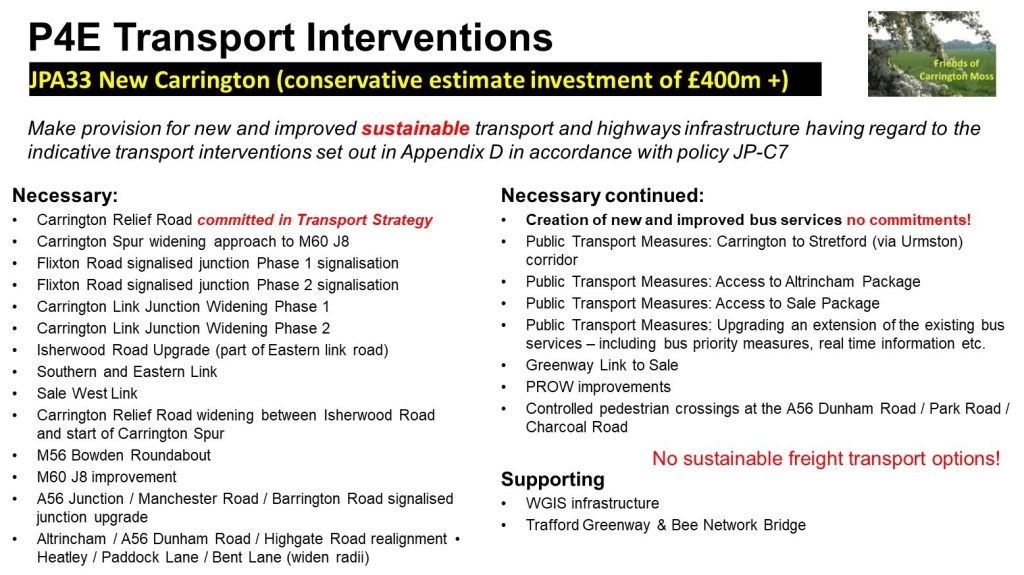
There is very little information in the document about the costs/funding of the overall “strategy”. There are only figures related to the Carrington Relief Road (£76.5m) and the overall Greater Manchester Transport Strategy 2040 (£1.1b). Our own very conservative estimate puts the overall cost of the “Necessary Transport Interventions” for the New Carrington development to be over £400m, see Appendix D (page 708) and listed in the graphic above.
That GM Transport Strategy 2040 aims to reduce car use to no more than 50% of daily trips by 2040 and reduce demand on road space from freight, moving freight traffic onto rail and water-based transport by the same date. The associated Transport Delivery Plan states that “The Right-Mix aim is for 50% of trips to be made by sustainable modes across GM. This will require zero net growth in motor vehicle traffic between 2017 and 2040, and non-car mode share to increase from 39% of all trips in 2017 to 50% of trips in 2040”.
With the strategic aim to significantly reduce motor vehicle traffic by 2040 (just 16 years away) in mind, along with the requirement for zero net growth in motor vehicle traffic, there is surely no business case for public money to be invested in a new road, that will impact the borough’s and the region’s carbon neutral ambitions, and generate huge levels of air, noise, light, vibration and water pollution.
Given the very marginal viability of the allocation, especially taking into consideration the contamination issues raised at the Executive Committee meeting, we believe that the public purse will be required to pick up the vast majority of these funding requirements and/or local residents will be forced to accept a huge development without the benefit of the Necessary Transport Interventions to make it, not only sustainable, but also tolerable.
The Committee Report particularly highlights (paragraph 5.9) the long-elapsed time of the funding period for the Carrington Relief Road (a 9-year funding programme). Consideration should be given to alternative options that may reduce the cost impact for the public purse and make sustainable transport solutions a reality. This could include upgrading the existing routes (A6144 and the A1 currently private road in Carrington), along with significant enhancements to the public rights of way across Carrington Moss, making them suitable for extensive active travel, horse riding and, possibly, bus services only. This would be a much more attractive option for encouraging modal shift as walking and cycling next to huge numbers of HGVs and other motor vehicle traffic is unpleasant, unhealthy and unsafe.
At the Executive Committee meeting a number of insightful questions were raised by Councillors, including Councillor Welton, who asked why there is no analysis of the costs of not achieving Scenario 3 (which is the most sustainable option). As Councillor Welton highlighted, not achieving that scenario will lead to higher costs in terms of carbon emissions, poorer public health outcomes, increased traffic incidents and congestion and higher costs of road maintenance.
More Missing information – Carbon Emissions!
The Transport Strategy does not include any information about the carbon implications. There are no calculations that estimate what impact the different scenarios could have on Trafford’s carbon neutral ambitions.
Interestingly, the “strategy” references the Greater Cambridge Local Plan to support its assertions in relation to compable sites. In the P4E assessment work we have done with partner organisations, including Steady State Manchester (who produced an excellent document which calculates the carbon emissions resulting from P4E), our responses to the Planning Inspectors included reference to the Greater Cambridge Local Plan. Their plan, unlike P4E, incorporated a Strategic Environmental Assessment that calculated the projected carbon emissions for each spatial option being considered (and they were comparable to the spatial options set out in P4E). Cambridge discovered that coupling residential development and public transport leads to approximately 20% lower carbon emissions than a strategy that promotes car-dependent development in the Green Belt!
Given Trafford’s climate emergency declaration and carbon neutral ambitions, the document should be very clear how such a large development, and the associated road infrastructure, will impact both Trafford’s and the region’s carbon neutral goals. The lack of sustainable freight transport options is a key consideration here because the carbon implications of the huge numbers of HGVs will be significant.
Comparing New Carrington with similar areas?
The “comparable” areas mentioned in the document are not actually analogous with New Carrington. The benchmark sites (such as Filton, which has the UK’s largest Aerospace Area – BAE Systems, Rolls Royce, Airbus to name a few) are home to a Global Technology Centre and companies such as Filton Systems, Hewlett Packard and Viridor. These industries are not like those businesses that are currently operating in (or are proposed for) New Carrington, which are predominantly warehousing/logistics units that generate extremely high numbers of HGV journeys.
Additionally, Filton and the surrounding areas of Stoke Gifford, and Patchway each have their own train station, whereas Carrington, Partington, Sale West and Warburton have no train stations and non are proposed in this “strategy”. Another “comparable” site, Waterbeach, is a new development but, unlike New Carrington, it is getting its own train station. There are no large warehousing sites proposed for that location. It will have flexible workspaces and hubs (more cottage industry makers and creators) and, therefore, limited HGV traffic! It is a real challenge to understand how these sites can be considered to be “comparable” to the New Carrington location!
The Executive Report states (paragraph 9.1) that “New Carrington will be the main growth point in Trafford for the next decade or more” but the New Carrington allocation is not even comparable to Trafford’s other major warehousing location – Trafford Park does have sustainable freight transport solutions!
What about the deep peat deposits on Carrington Moss?
At the P4E Examination in Public, Natural England’s contributions included the following:
Natural England (NE) wrote to the planning inspectors in June 2023 (OD42), stating that there is extensive and restorable deep peat within allocation JPA33 (New Carrington), that the deep peat should be considered to be an irreplaceable habitat, and that “the combination of the location and the extent of development proposed by the allocation policy means the proposed development is incompatible with avoiding the deterioration of this irreplaceable habitat”
NE’s view, set out in OD23, is that the development will not only prevent future restoration but “will cause irreversible damage to the body of peat directly under the developed land and the wider peat mass, which depends on the continuity of the flow of water”. They go on to recognise that the degradation of the peat mass will also result in significant greenhouse gas emissions
NE confirmed (in OD42) that their position is in line with the England Peat Action Plan, that there should be no development on (restorable) deep peat, and that peat should be kept wet and in the ground. NE drew attention to their “extensive experience of peatland restoration projects” which provides considerable credibility to their professional judgement in this matter.
So, for Trafford to conclude in the report (paragraph 7.7) that “peat is not considered to be a significant constraint on future infrastructure provision” demonstrates a huge lack of understanding of the impact of hydrology on the main body of peat, which Natural England estimates to be around 335 hectares. This is not a surprise, as it is recognised that Natural England are the experts, not Trafford, and their advice should be followed.
Even More Omissions from the “Strategy”!
Whilst the 29th January Executive Committee report mentions that the 2006 Unitary Development Plan (UDP) included a safeguarded route for the road and that the 2012 Core Strategy significantly underestimated the cost of such a route, it does not explain why the land that was safeguarded for the Manchester Ship Canal bridge is not included in the Transport Strategy. This was also a Proposal E15 requirement in the 2006 UDP and one of the Implementation Projects listed in the 2012 Core Strategy (p80). This initiative would reduce the number of HGVs (and other vehicles) on local roads significantly. It is clear that the majority of the actions set out in previous local plans have not been delivered in this area and the potential benefits of the most sustainable solutions, particularly for freight, (such as bringing the former railway line back into use and/or transporting goods via the Manchester Ship Canal) have been totally ignored by Trafford for almost two decades.
The Carrington Relief Road appears to be going through a name change to the A1 Link Road. The recognition that this road will not “relieve” anyone is welcome but we do wonder where the road will link from and to! The government’s announcement about the funding to be made available as a result of cancelling HS2:states that “more than £500 million in funding will be provided for 2 major road schemes around Manchester. These include a new link road between the M62 and the M60”. Whilst this initiative is set out in the Greater Manchester 2040 Transport Delivery Plan, and we assume the A1 link road is ultimately being proposed to provide the first stage of this scheme, the “strategy” makes no mention of this longer-term proposal.
More information:
There are many tables full of confusing information throughout the document. The calculations about the number of trips do not include the current traffic numbers, the HGV movements and there is no estimate about the expected level of induced traffic. So, effectively, there is no assessment of the expected overall traffic levels on the new road.
The “strategy” states (page 18) that “Employment provision in the area should offer a wide range of employment types” and (page 15) that currently 6% of car journeys and 7% of public transport journeys are internal (within Carrington and Partington). This suggests few residents currently work in the Carrington area, an assertion borne out by our own research. The current and proposed employment development does not offer a diverse range of job opportunities (despite the assumption on page 38). It is predominantly warehousing which requires a small, low paid workforce. There should be more evidence to show how the target of 17% of internal journeys can be achieved.
The current conditions (set out on page 14) focus on Carrington and Partington, without referencing the issues related to Sale West or Warburton, which will be impacted significantly by this “strategy” and, as mentioned above, totally omits any reference to the huge number of HGV movements in the area.
What next?
We have requested a meeting with Trafford to discuss the contents of the “strategy” further and will provide an update to residents as soon as we are clearer about the implications.
Trafford has a website page dedicated to the Carrington Relief Road, you can access it here.
You can find our previous blogs about the Carrington Relief Road by scrolling down at this link.
(They say on their website that “Once the initial design plans are completed, we will hold a public consultation“)
Rather than moving to the more appropriate Engage, Deliberate, Decide method, which would fully involve communities in the design.
We were very disappointed to discover, from another organisation, that Trafford is holding workshops to design the logo for a “project relating to people who work, live, and travel within Carrington, Partington and Sale West“, but they are not engaging with the communities who are supposed to be benefiting.
Neither the Parish Councils, nor ourselves, nor other community organisations in the area have been consulted or invited to these workshops. In fact, we have not heard from the CRR project team since October and have had no information about progress in the plans for the Carrington Relief Road, nor the consultation that was supposed to be happening last year.
This is a very poor approach to communicating with communities. We were not even informed that the Council’s webpage has been updated, although this is, once again, an opportunity for Trafford to be less than accurate with their information. We note, for example, that the webpage states that the “Carrington Relief Road is one part of the Places for Everyone Plan” yet the Planning Inspectors at the P4E Hearings were told by a Trafford representative that it is not being considered as part of that Plan!
The website also states that “We continue to have conversations with the local community and others to understand their priorities”. We have asked our partners in the Parish Councils and other local community groups. None are aware of any communication. So, we have asked for information about how the CRR team are engaging with the local community and will send out an update when we receive a response!
Looking at the Council’s webpage, Trafford suggests that the A6144 is heavily congested by both cars and HGVs – this is a direct consequence of the Planning Applications that have been approved by Trafford’s Planning Committee, despite the lack of sustainable passenger or freight transport options proposed for the area.
Whilst Trafford are proposing to build new roads (4 are planned to be constructed across Carrington Moss), local residents will not see any benefits because of the huge volume of traffic that has been approved. Air, noise and light pollution (along with carbon emissions) will also increase substantially in this area.
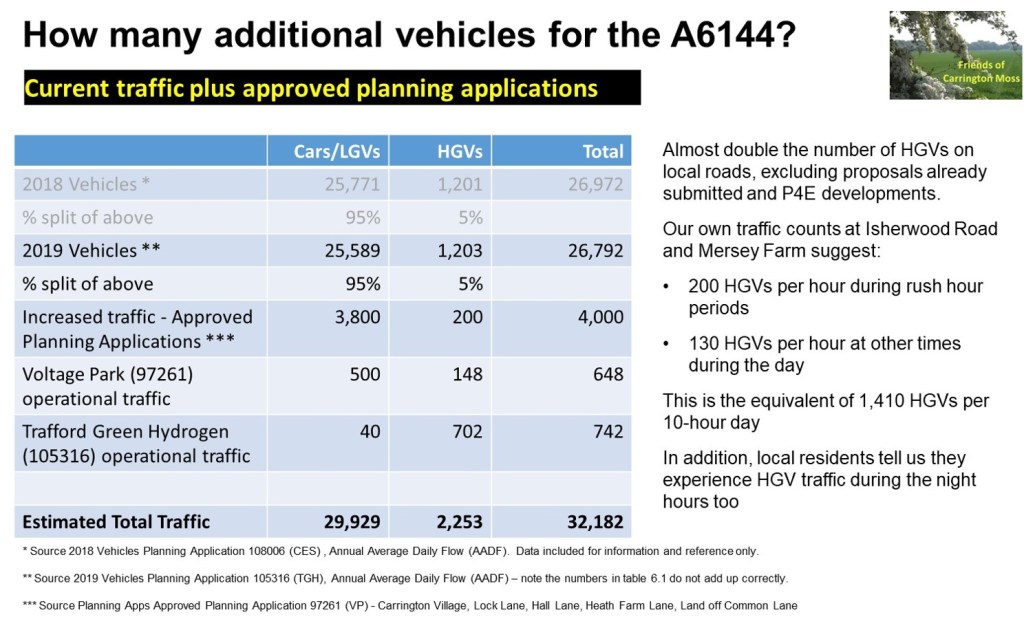
Trafford has refused to provide information about increased traffic levels, despite our repeated requests, and Carrington Parish Council’s formal Freedom of Information Act request, but we have reviewed recent planning applications and have extracted some information to help us understand the numbers.
These figures will rise significantly if the Places for Everyone proposals are approved by the Planning Inspectors.
In the meantime, Trafford suggests that the Carrington Relief Road will provide:
a new convenient route to encourage HGVs to divert away from the congested A6144
but with so many HGVs, almost all going to and from the Carrington Spur, drivers will continue to use the existing road (in fact some businesses have said that they need to use the A6144 through Carrington)
deliver improvements to make travelling by bus easier and safer
we do not believe constructing a new road across Carrington Moss will have any impact at all on bus travel, especially given the number of additional vehicles on local roads
provide new routes to enjoy when travelling by foot, bike and horse.
there are no funding commitments for new routes for active travel users and there are currently no plans (and no funding) for crossings for the Carrington Relief Road – this will leave active travel users facing unhealthy, unsafe and unpleasant journeys that will be discouraging due to the lack of circular routes for recreation and the unrealised expectation that active travel commuters can safely use a deserted A6144.
Trafford states that there will be a “combination of travel improvements that will open opportunities to accessing local jobs and new homes. Improving access to both local businesses and new developments in the area” but there are no plans for trams or trains, no additional bus services, and no community transport to employment areas. What their documents seem to suggest is that local commuters will be encouraged to cycle or walk!
The website continues by confirming that “new routes for walking, cycling and horse riding will be provided”, yet, as mentioned above, there is no confirmed funding for these improvements and construction on a peat moss will be complex and expensive, with developers being required to contribute to the Relief Road, affordable housing, green spaces and school places – so we are sceptical about their ability to fund active travel routes as well.
We will welcome the opportunity to review the results of the surveys and assessments that are being carried out. Trafford states that they “look forward to sharing more information on how the moss will be cared for in 2023”, yet the moss will be all but destroyed by the volume of development proposed.
We worked with our partners to create an Alternative Transformation Strategy for Carrington Moss some time ago, see the short video on our you tube channel here. It is a pity Trafford are not listening to the advice they have had from Natural England, to the information shared by specialist organisations, such as Cheshire and Lancashire Wildlife Trusts, and to the feedback from their local communities.
Trafford state that “Once the initial design plans are completed, we will hold a public consultation”. This means that they will have spent public money on developing a design using consultants who have not spoken to anyone who lives in the local communities!
Given their plans for extensive development in the area, Trafford should have consulted with residents about the implementation of sustainable passenger and freight transport options, before deciding on a new road (across a peat moss, grade 2 agricultural land, woodland and wetland habitats).
Trafford is progressing the least sustainable of all the options available.
The website suggests that our feedback will be “considered and where possible the design will be reviewed and updated where appropriate” but the Council has not conscientiously considered our previous inputs (see our blog about our struggle to secure genuine consultation).
Finally, Trafford has included a documents library on the webpage. Do take a look at our previous blogs which analyse those reports in detail. They are factually incorrect, misleading and biased as we set out in the following:
This report specifically related to proposed consultation about the CRR, with the report clearly demonstrating that Trafford are not aware of the meaning of consultation (see graphic below)!
This did not happen!!!
The report suggests that “Once feedback has been collated and categorised, the project team will then host online feedback sessions which tackle individual areas of interest or concern such as traffic congestion, environmental impact, drainage and flooding, and so on”.
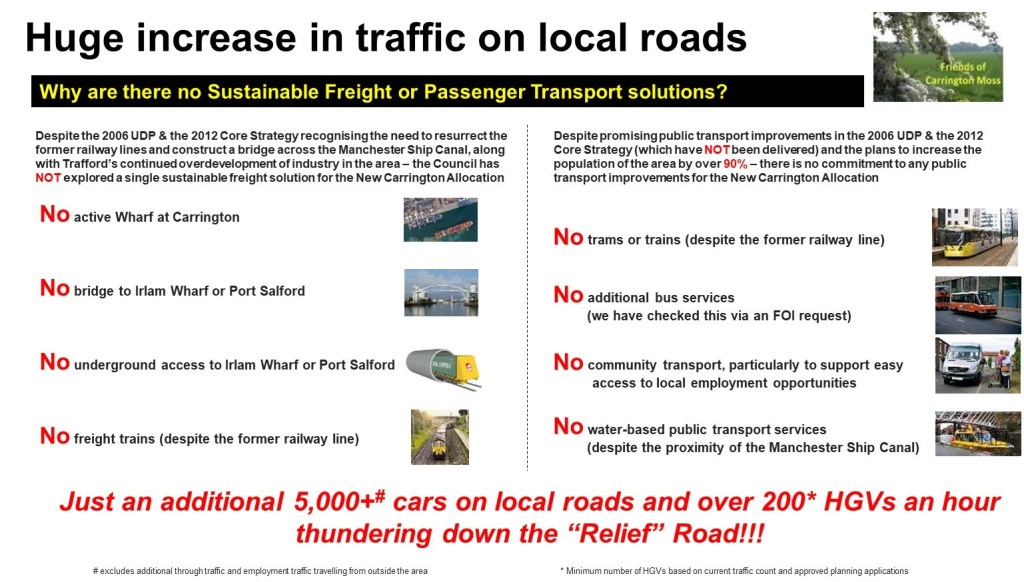
Discussed on the Carrington Link Road page of our website Much of the information in these early reports was totally inaccurate (see our letter to Trafford’s CEO) and there was no consideration of the more sustainable alternatives set out in our graphic above.
Sadly, as the Decide, Announce, Defend approach endures, community input looks set to continue to be woeful, which is not how Trafford is addressing change in other parts of the Borough!
The Carrington Relief Road, which IS going to impact irreplaceable habitats and the lives of residents in Carrington, Partington and Sale West, is being pushed ahead at speed.
Don’t be fooled by the spin as Trafford promote their plans for this road. It is not going to bring benefits to any resident any time soon. In fact, quite the opposite – read on.
We would encourage you all to watch the recording of Trafford’s Scrutiny Committee on 21st September (the CRR item starts at 30:04 and only lasts for around 20 minutes). You will find the papers here (go to page 47 of the pack).
It is interesting that paragraph 4.2 of the report states that, due to its regional significance, community and stakeholders should be as fully involved in the scheme as possible.
If that is the case, why didn’t residents have the opportunity to give our views on which of the options from the Core Strategy 2012 would bring the most benefits?
Given that Trafford totally missed out that first step in the process – why wasn’t there a consultation that gave residents the opportunity to provide their views on the preferred route option?
At the Scrutiny Committee meeting Councillor Williams confirmed that the response rate for that previous exercise was poor and that the recent meeting between Ward Councillors and the project team was focused on how participation can be increased.
Councillor Williams expressed his concern that there are a lot of responses from outside the Bucklow St Martins Ward.
As there has been NO consultation to date, we assume his comments relate to that March 2021 initiative and can confirm that our inputs certainly did include feedback from Bucklow St Martins residents.
In addition, whilst FOCM membership covers all the above Parishes and Sale West (and includes many residents who live in the Bucklow St Martins Ward), when we met with the project team we invited those Parish Councils to join us, along with Positive Partington and Peak and Northern Footpaths Society. This has always been our approach and, when we responded to the previous exercise, it was collaborative feedback from all those groups.
So, has Councillor Williams been misinformed?
In addition, it must be emphasised that Sale West residents will be significantly and negatively impacted by this road. Bucklow St Martins extends into the Sale West area, so when, as mentioned at the meeting, Councillor Williams goes “door to door” it would be useful for those who live in Sale West to also have a voice.
Let’s look at the reality of previous consultations related to this area!
Trafford does not have an impressive record of engaging with our communities and when residents do provide their views about the CRR or New Carrington, they are studiously ignored (see our previous blog for more information). This 2 minute video shows how differently local residents are treated when compared to others in Trafford.
The Scrutiny Committee heard, following a question from Councillor Butt, that the overall parameters of the scheme have already been decided, so any future consultation must be clear about what views are actually being sought.
Whilst it is heartening that the Council wish to undertake some specific consultation about the selected route (Councillor Williams suggested this would include giving our views about the vegetation at the side of the road), it seems resident influence will be limited to a few design features.
Scrutiny Committee members raised a number of concerns about the contents of the report. Councillor Axford, for example, asked how, given residents needed to understand the environmental impact (paragraph 7.2), Trafford would balance those messages (relating to increased pollution and carbon emissions) with the promotion of the road.
Councillor Coggins highlighted that only the positive aspects of the implications (page 2 of the report, page 48 of the pack) have been revealed (just like a sales brochure). So, no mention of the increased carbon emissions caused by the road, and also no mention of how vulnerable groups will be targeted in the consultation, no mention of how the road will support sustainable development (or not), no mention of the risks to local residents of increased surface water flooding and no mention of the increased air, noise and light pollution that will impact the health and wellbeing of local residents and threatened bird/wildlife species!
Paragraph 1.4 states that the road will bring significant benefits to Carrington and Partington communities. We disagree! Trafford’s own documents state that only 60% of the traffic (including HGVs) will use the new road. Traffic volumes will increase significantly due to Trafford’s plans to approve developments for 5,000 homes and 350,000 m2 warehouses in the area. This will leave Carrington surrounded by roads (an island in a sea of air, noise and light pollution and, of course, the issues caused by excessive vibrations from HGVs). We do not perceive any benefits for Partington from this road, especially as a large number of new homes have already been approved, which will result in more traffic on existing routes, a situation that could be exacerbated further by the decision on the increased toll charges for Warburton Bridge, which comes before the Planning Inspector in November.
There is, as always, no mention in the report of the negative impact on Sale West residents of increased air, noise and light pollution and increased risk of significant levels of surface water flooding.
Given their declaration of a climate emergency, Trafford should be aiming to reduce vehicles on existing roads. There is no justification for building more roads, which will encourage even more traffic.
The Council is keen to emphasise that Partington residents want to see the new road being implemented (paragraph 11.3) but we would encourage all residents in all communities to do their research – there is already a lot of evidence that new roads create new traffic, for example. The more sustainable solutions we mention above would bring more benefits to residents. Contact us if you’d like to discuss this further.
Councillor Thompson highlighted that key stakeholder events (including any with Friends of Carrington Moss) were missing from the future timetable (Appendix 2 -Outline Programme for Future Engagement and Consultation Events) and was advised that this is an oversight due to the meetings not yet being scheduled.
We are amazed that, once again, we are reviewing a report about the Carrington Relief Road (CRR) that is full of factual errors and fantasy proposals. Does Trafford think that, if they keep repeating such statements, they will morph into accuracy? See our Letter to Trafford’s Chief Executive back in February 2020, our multiple blogs (some of which are referenced below) and our more recent complaint (for which we are still awaiting a response).
This report to Trafford’s Executive Committee on 25th July 2022 (fast forward to page 443) includes erroneous, mistaken or just plain inaccurate statements, as set out below.
Consultation
On page 19 of the Executive Report, the author states that “There has been significant consultation and engagement carried out as part of getting to the current position.”
This is factually incorrect, see our recent blog. Our Councillors should be asking WHEN there has been ANY consultation. For the avoidance of doubt, this would have been when Trafford published it on their consultation portal, residents would have been given the opportunity to review detailed proposals and provide their views via a series of questions, posed by Trafford. The engagement exercise in 2021 simply asked residents to watch a video and raise any questions they had. This was NOT a consultation. The communications mentioned a next phase of engagement, but this did not take place and our questions and requests for workshops fell on deaf ears!
Paragraph 1.6 states that the project team has “taken on board the issues that have been raised by the community”. Which “community” are they referring to? FOCM, the Parish Councils and a number of other community groups, provided a detailed response to the public engagement exercise, but Trafford has not taken on board our concerns, they were not even mentioned in the Preferred Options Report. Neither have they taken on board the issues raised by Natural England.
The Executive report also makes a pretence of taking conscientious consideration of resident feedback! Paragraph 1.9 suggests that a significant package of public transport, road safety and active travel measures were proposed as a consequence of the public engagement exercise.
This is totally disingenuous and, once again, incorrect! We had already been told that these schemes were being proposed long before the exercise and this was confirmed at a presentation given by Trafford Officers on 3rd November 2020. Indeed, in a response to questions raised by FOCM in 2019, Trafford Council stated (8th March 2019) that: “it should be noted that all roads illustrated on the indicative masterplan are proposed as multi-modal routes and are therefore proposed to include bus and active travel routes”.
We will not hold our breath waiting for the Consultation set out at Section 6.!
Finance/Funding:
In 2012 the budget for this road was £3m, in 2018, it was £34m – it is now over £56m and rising!
It is clear that there is not only a shortfall in the availability of funds for this road but that the price could rise further and the suggested reliance on developers to fund the bulk of the shortfall from S106 monies is deceptive and risks derailing other ambitions, such as those related to affordable housing.
Now, we know Trafford has a huge development planned here but: 1: the spatial plan has not yet been approved, so it may not (or may not all) go ahead 2: when the planning applications come through they may fail on various grounds (including environmental (and many will certainly be challenged) 3: most importantly, will the developers try to reduce their contributions as much as possible – of course they will!
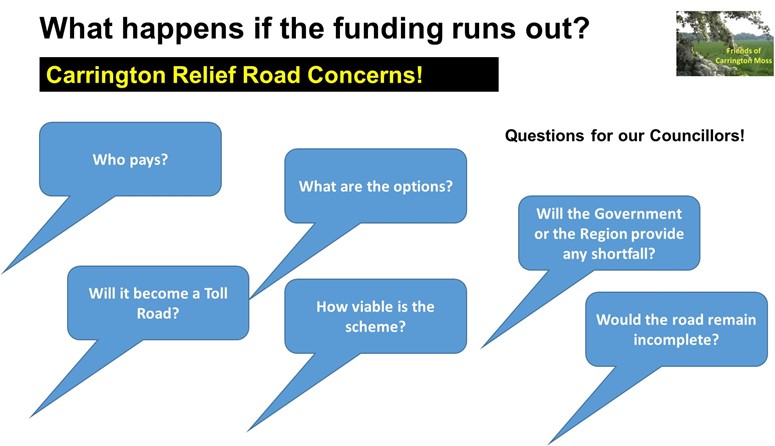
In addition to all of this, we anticipate costs will continue to spiral, so, what does happen if there is a shortfall in funding?
This week there has been news that another road scheme has been cancelled “due to Treasury funding pressures”. Other schemes nationwide have seen Government funding reduced, estimates increased (sometimes by almost 100%) and affordable housing becoming the sacrificial lamb!
What questions should we be asking our Councillors and the Trafford Leadership?
What should be recognised is that even Labour leaders in other GM boroughs are calling roads “an old world solution” and cancelled schemes can have high costs to the Local Authority (see Stockport here).
Are our Councillors happy about the approach to financing?
Even the Worst Case Revised Estimate (Table 2) looks very optimistic and the Contingency numbers look very low for a project of this nature!
Elsewhere, the document states that expenditure is being funded via capital receipts as one of the grants is “not receivable until full outline planning permission is obtained. What if full outline planning permission is not granted? What if permission is delayed significantly? Is this a sensible approach?
Public Transport:
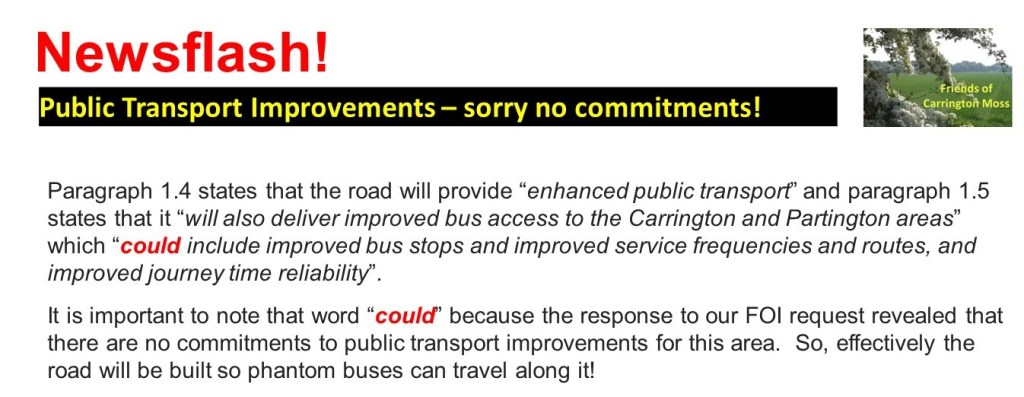
Despite being promised, in both the 2006 UDP and the 2012 CS, there have been no public transport improvements in this area (in fact bus services have reduced) and there are NO commitments in Places for Everyone for any public transport improvements (no trams, no trains and no new bus services) we have checked this via a Freedom of Information Act request, but, its ok, we will have a new road for phantom buses to run on.
Despite what is written in the report (see para 1.4 and 1.5), there is ZERO commitment to public transport improvements, NO promotion of sustainable passenger or freight transport and NO active travel improvements since 2012 either!
Nor will the CRR “assist in creating a safe environment for walking, cycling and public transport” (paragraph 1.3). Residents will not be encouraged to change their mode of travel to walking or cycling given how unsafe, unhealthy and unpleasant it will be to do so next to a busy major road (and that will be the case for both the new CRR and the existing A6144, which we understand will still be accessible by all vehicles, including HGVs and through traffic, contrary to the statement at para 1.2).
Of course, having two roads, instead of just one, will induce much more through traffic, increasing carbon emissions and air, noise and light pollution in the area.
So, another recurring theme of inaccuracies and deceit!
In the report they say (para 8.3) the scheme will be delivered in the context of the GM 2040 Transport Strategy, but that Strategy states that the GM Right Mix aim is for
zero net growth in motor vehicle traffic between 2017 and 2040,
which suggests there should be NO requirement to create capacity for increased traffic volumes. A new road is not the right solution to achieve the aims of the GM 2040 Transport Strategy!
Compulsory Purchase Orders (CPO)
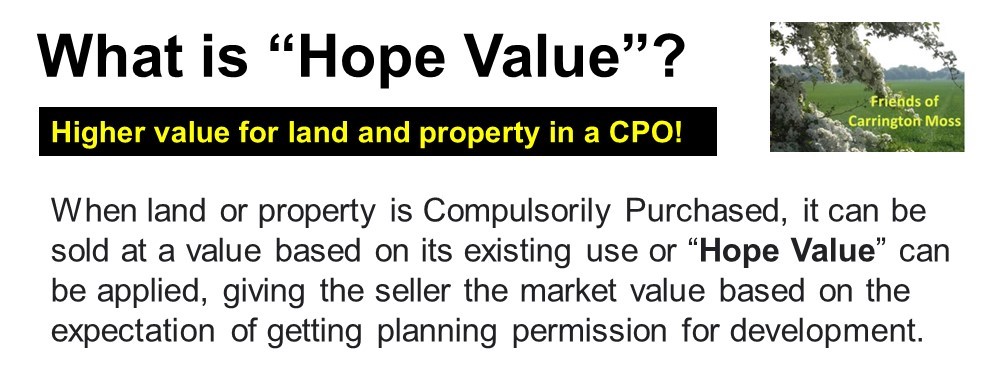
We recognise that the CPO process can include lengthy and often contentious negotiations, as set out in the Preferred Options Report of 8th August 2021 (POR), especially if “Hope Value” is expected by the landowner.
The POR states that “Negotiating with landowners will add significant risk to the programme and budget and CPO is a complex and lengthy legal process is a last resort option for Trafford”. Yet, there was no mention that CPOs would be needed if the route across Carrington Moss was chosen.
The POR went on to say “If the space required to construct a scheme to meet the scheme objectives is not available, or if it will lead to lengthy negotiations with landowners, it cannot be considered a suitable route.” Surely this statement is true of the A1 road, as much as it is for the Option A/F sections?
In relation to Option F, the POR said “A basis for dedication has already been discussed in principle with HIMOR for the land in their ownership that may be required for the relief road. This significantly reduces the risk of requiring compulsory purchase orders for this land”. We had assumed this statement related to all Himor (now Wain) land, including that in the area of the A1 road. It is clear that the POR was either badly worded or deliberately misleading!
The Preferred Options Summary in the POR, under the category Land Availability, says “Both Options A and F will affect the Green Belt, Option F [the route across Carrington Moss] is however more detrimentalto the Green Belt as the area will now be severed by two roads as opposed to one if Option A was constructed. However, Option A presents a major issue with the available width being constrained between residential properties which would require demolition of properties, land take of private residential open space and likely requirements for CPO unless the standard of the relief road was significantly reduced through the constrained sections. This would compromise the high-quality active travel provision the scheme is able to provide, which is one of the main scheme objectives. For this reason, Option A is seen as being an unrealistic route choice in terms of Land Availability.”
This is incorrect and is one of the key facets of bias that were deliberately introduced into the POR (see our blog for more detail). Option A would need NO additional CPOs as active travel could continue across Carrington Moss had that route been chosen.
Producing misleading reports, such as this, discredits Trafford Council. All Councillors should now call for the decision about the Preferred Route to be revisited.
Sustainability
There is no mention in the report about the impact of the loss of Grade 2, best and most versatile, agricultural land which the Council has previously (Core Strategy 2012 and UDP 2006) pledged to protect – this is surely even more important now we are in a food security crisis, caused by the pandemic and the war in Ukraine.
There is no reference to the Natural England concerns (again) and the Natural Capital Value of the site has not even been mentioned, yet we understand this is the way GM are assessing the value of their natural assets. The GM Wetlands initiative want to include Carrington Moss in their latest project, this is also not mentioned in the report.
There is no reference to either GM’s or the Government’s Environmental Plans – so we do have concerns about whether the CRR will be consistent with these? The GM 5 year Environment Plan highlights the importance of climate change mitigation, air quality, the importance of the natural environment, the aim to be carbon neutral by 2038. Given that plan aims to increase the use of public transport and active travel and shift freight to rail and water transport, shouldn’t Trafford be spending its finite resources on initiatives that will move those ambitions closer to reality, rather than building yet another road at huge cost to the public purse, the environment and the health and wellbeing of Trafford’s own residents.
The Government’s 25 year Environment Plan specifically mentions that “Our traditional farmland birds have declined by more than half since 1970.” Casually suggesting (Executive Report, paragraph 9.5) that “Mitigation for these species will be incorporated into the scheme design with the aim of maximising opportunities for enhancement” is just more blah, blah, blah! Destroying the habitats of red listed birds is not mitigation or enhancement!
The report’s response to Carbon Reduction does not say there will be carbon reduction! There is clear and recognised evidence that new roads bring new traffic – the carbon implications of this road are huge, not just in terms of the lost opportunities as a consequence of concreting over a vegetation-rich area that may include peat, but also in terms of the increased vehicle traffic using this route and, as mentioned above, there are no commitments to sustainable passenger and freight transport here! So, suggesting (paragraph 8.4) that this road will bring significant carbon enhancements to the area is pure fantasy.
Health and Wellbeing
The health implications have been significantly understated and the report is completely disingenuous to suggest that the construction of this road will improve the health and wellbeing of Trafford’s residents. As mentioned above, modal shift, using either of the two busy, toxic roads, is highly unlikely because active travel will be unsafe, unpleasant and unhealthy!
In addition, there will be a huge increase of air, noise and light pollution which will massively impact the health and wellbeing of local people, including users of Carrington Moss, the pupils and staff at All Saints Catholic Primary School, and the residents of Sale West (to say nothing of the wildlife and birds that breed and feed on the moss).
The document suggests (para 1.1) “local residents will have their quality of life improved”, which residents do they mean. Carrington residents will be surrounded by traffic (on two routes rather than one), Partington residents get no benefits at all from this route and Sale West residents will experience massively increased air, noise and light pollution, along with traffic congestion at Mersey Farm
Programme Risks:
Paragraph 4.2 (Table 4 Risks) – states that “The project team is working to a detailed programme of activities which takes into account all activities which are associated with preparing a complex major scheme planning application”. The document we have received in response to a FOI request, which is available here, is not detailed and does not include all the workstreams one would expect for a programme of this nature.
We are concerned that Trafford has not demonstrated that this road is viable and deliverable, especially given the funding issues mentioned above.
There is a huge risk that the Strategic Outline Business Case (para 3.1) will also include factually incorrect and misleading statements. This could mean the funding is not approved. In addition, the City Regional Sustainable Transport Fund states that “Bids must propose a programme of investments that reduce carbon and particulate emissions from transport”. We have been requesting this information for some time. Based on other information made available about the CRR, we are concerned that, when produced, it will not be accurate. This could again, impact funding approval.
The are no risks highlighted about National Highways inputs or Natural England’s environmental concerns. Nor are any risks highlighted about the potential for the planning application to fail due to community objections or legal action.
Trafford’s 2012 Core Strategy (CS):
In the Relationship to Policy section, the document states that the CRR “is a requirement of Trafford Core Strategy (2012)”. This is incorrect! A “link road” was certainly included in the CS but it was priced at £3m – clearly not the same type of road as the one now being proposed for almost 60m – see our blog confirming what was (and what was not) in the 2012 Core Strategy and the 2006 UDP here. The CS (and the UDP) also included, for example, provision for a bridge across the Manchester Ship Canal – but no work has been done to progress that scheme (we have checked via an FOI request). The documents also mentioned the potential for rail links, given the disused train lines to Carrington and Partington (but that has not progressed either).
Conclusion
This report continues to replicate the incorrect and misleading claims made in previous Trafford documents!
The decision of the Executive Committee on the route for the road was based on a flawed and biased Preferred Option Report – there are alternative options which would be much cheaper for the public purse, much less environmentally damaging and much healthier for Trafford residents.
It is clear that creating another road (rather than upgrading the A6144 and retaining active travel routes across Carrington Moss) will increase traffic, increase congestion and will increase the number of large polluting vehicles, such as HGVs using local roads!
In progressing this scheme, Trafford is prioritising the convenience of the car driver above a sustainable future for our descendants. It should be noted that those who do not drive, or cannot afford a car, will be breathing in the toxic air caused by traffic coming to or through the area, yet those residents will gain no public transport options to reduce their exposure!
Can Trafford (and its residents) really afford the financial, environmental and societal costs of a scheme that provides so few benefits?
I watched this short video from Trafford Council’s leader out of curiosity. It is only 2 minutes long so do have a listen. Concern is expressed about the climate crisis, the recognition that it will cost billions if not addressed, the acknowledgement of the extreme weather events that we are already seeing EVERY year.
It is interesting that Councillor Western focused on issues such as flooding, air pollution and the amount of carbon in our atmosphere. Yet, Trafford plans to decimate Carrington Moss, an area which generates a natural capital value of over £15m per annum (based on GM’s Natural Capital Account, figure 1, 2019 Natural Environment Topic Paper).
It plans to significantly increase air pollution and the risk of flooding for local residents here, and, of course, the loss of our peat moss will result in a massive carbon release event.
The climate change page on Trafford’s website provides links to examples of collaborative work “to reduce and mitigate carbon emissions as well as adapting to a changing climate”. One of these is labelled Nature and Biodiversity. Click on that link and you are taken to a Lancashire Wildlife Trust article (December 2020) announcing that “Nature is on the road to recovery in Greater Manchester”.
Councillor Western is quoted in the article stating that “The funding will help deliver some of the essential work being undertaken to safeguard wildlife habitats, develop natural flood management projects and peatland carbon stores, and teach families and young children about the natural world on our doorsteps”.
But he doesn’t mean here on Carrington Moss, where he is planning to unnecessarily release 169 hectares of green belt to build housing and employment space that could be located elsewhere in Trafford (or even elsewhere in GM, as residents keep being told we must consider the regional strategy, known as Places for Everyone, as a whole).
The article states “The aim is to fund natural flood management projects and peatland restoration transforming areas into carbon stores”.
Despite the huge numbers of additional residents and employees who will be travelling into and out of the area, there are NO plans for any sustainable passenger or freight transport options. Instead, Trafford plans to construct a road across the Grade 2 agricultural land, woodland, wetland and peatland habitats.
Stockport’s leadership appears to understand the issues as they rejected their controversial bypass. Council leader Elise Wilson said a new road that would “destroy wildlife and natural habitats” was an “old world solution“.
But Trafford is sticking with their “old world solution”!
Residents have ideas for alternatives to constructing a road across the Moss, but Trafford is not interested in even hearing about them, never mind exploring their potential!
Despite their declaration of a climate emergency in November 2018, and the creation of a Carbon Neutral Action Plan in December 2020 (a plan that does not even mention that Trafford has, not one, but two, peat mosses), Trafford appears confused about what sustainability actually means. Maybe they should take a look at our previous blog!
We have also recently produced our latest Carrington Lake video which, once again, shows just how much water is captured and retained by Carrington Moss. It’s less than 5 minutes long and highlights the level of hypocrisy we are facing from both GM and Trafford’s leadership. We’d love to hear just how many attenuation ponds you think we’ll need to capture all that water that is currently being contained by our irreplaceable mossland.
Nationwide, it is acknowledged that the UK is one of the most nature depleted countries in the world. The Government has an aim to leave the environment in a better state than they found it, setting targets to halt the decline in species, to improve air and water quality and increase our woodland cover. There is a recognition that we need to use our natural resources more sustainably and that it is critical to build up resilience against the impacts of a changing climate, to enhance our natural capital to support our food security, health and wellbeing, and economic prosperity.
Yet, here in Trafford, there is a plan to further diminish the already threatened populations of red listed birds and endangered wildlife that breed and feed on Carrington Moss and to sacrifice our best and most versatile agricultural land, that future generations may need to provide locally sourced produce to survive!
Trafford will be spending public money decimating existing nature-rich wetland habitats and will then spend more public money creating new, man-made, habitats, which will take decades to generate the same level of ecosystem benefits.
It is now clear that the biodiversity and climate emergencies are comprehensively interconnected and that there are compelling reasons why both should be considered together to create solutions that reduce the risks to all populations (both human and wildlife).
Greater Manchester’s leaders declared a biodiversity emergency on 25th March, with Mayor Andy Burnham talking about the “habitats being lost, destroyed and becoming less diverse due to the impact of development, climate change, pollution and invasive species”. Yet, he is presiding over a plan that will see huge levels of biodiversity loss across the region.
Perhaps his suggested “rallying cry” will signal a change of approach to the unnecessary loss and destruction of the region’s precious green belt!!!
Yet, while Carrington Moss is being sacrificed by GM and the local leadership, sustainability is out of the window, the biodiversity and climate emergencies are not being considered, neither is their accountability to future generations!
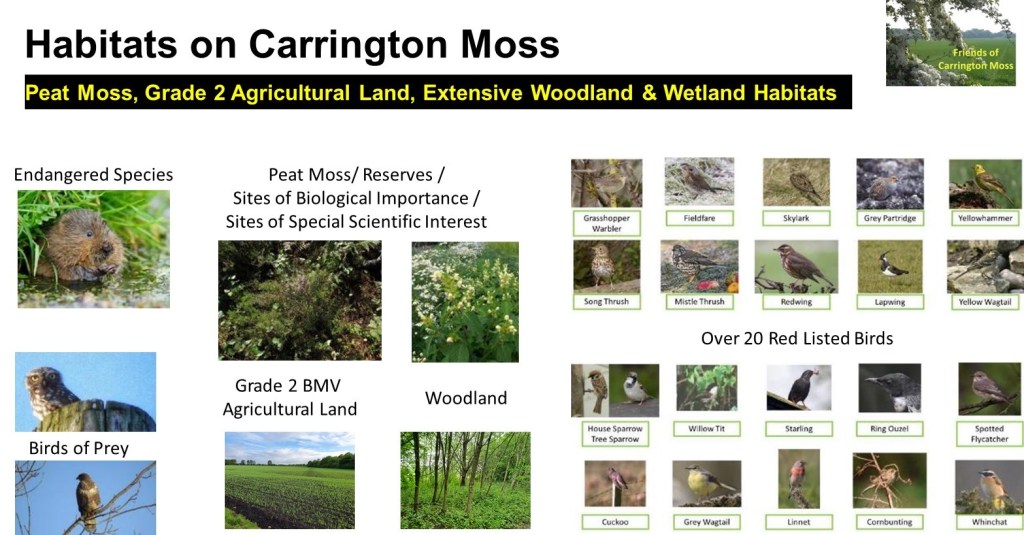
Carrington Moss provides a number of ecosystem services, including walking, cycling and horse riding routes, excess water capture (huge amounts of that), Grade 2 agricultural land (capable of growing locally sourced food), woodland, wetland and peat moss habitats, is the breeding and feeding grounds for numerous red listed birds and endangered wildlife species (including the willow tit and the water vole), has historical value, and brings health and wellbeing benefits to local communities and those who visit the area.
the carbon budget GM’s Combined Authority commissioned from the Tyndall Centre (University of Manchester)
the advice given by the Tyndall Centre about the pathway to reaching net zero
the alarming lack of progress that has been reported this month
the impact and importance of the separate category of Land Use, Land Use Change and Forestry (LULUCF).
They specifically highlight that the Regional plan, known as Places for Everyone (P4E), will involve significant levels of construction on green spaces. This means that the Region’s capacity to reduce the impact of additional emissions will decrease significantly, severely affecting GM’s aspiration to be carbon neutral by 2038!
In looking at the scale of planned development set out in P4E, much of which will result in green belt release across the Region, Mark and Matthew emphasise the loss of carbon capturing opportunities, as well as the huge level of carbon emissions generated.
Their findings suggest it is highly likely that, on housing alone, the P4E proposals will be disastrous for the Region’s ambition to be carbon neutral. Different choices could be made to meet housing need, options that do not rely so heavily on new construction! Here in Trafford, there are also alternatives to constructing new roads across the green belt too.
It is clear from Mark and Matthew’s research, however, that the GMCA has not fully assessed the carbon implications of the P4E Plan, and they believe that the Strategic Environment Assessment (SEA) has not been conducted to an appropriate standard, especially given the conclusions reached by the Authorities.
The lack of information provided by the GMCA about the carbon implications of their strategic plan is astounding, particularly as there were so many P4E documents (more than 150, with 14,000 pages to review), but, as we pointed out in our own response, some of those pages include evidence that is very dated and some, like the carbon emissions data, is not provided at all.
Mark and Matthew actually found that other Authorities do provide the data required to robustly assess the carbon emissions. Their example from the Cambridge Local Plan is enlightening.
We totally agree that one of the most shocking omissions from the SEA is the absence of GM’s key objective, the 2038 target for carbon neutrality. It must be remembered that it is this P4E strategic plan that must secure that target!
If you are interested in finding out more about the Tyndall Centre’s view of Trafford’s carbon emissions targets, you can find an interesting summary here. You will note that the final paragraph states “We also recommend that the LULUCF sector should be managed to ensure CO2 sequestration where possible. The management of LULUCF could also include action to increase wider social and environmental benefits“. Constructing roads, housing and employment space on a peat moss, grade 2 agricultural land, wetland and woodland will not support the achievement of that recommendation!
At Trafford’s Scrutiny Committee on 12th January 2022, members were given a presentation about the Carrington Relief Road, providing some background to the initiative along with some information about the Option Appraisal for the preferred route, the engagement with the public and the next steps.
A member of the Scrutiny Committee requested a more balanced representation of the facts. The Carrington Relief Road documentation does seem to be plagued by the sheer volume of misinformation (see our letter to Trafford’s Chief Executive in February 2020 about the Outline Business Case document).
This is the sixth in our series of blogs which addresses the gaps in the information given at the meeting, providing further details to help members of the Scrutiny Committee and others, when reviewing the proceedings.
This blog focuses on a review of the CRR Preferred Options Report (dated 7th August, 2021).
In this blog, we’ll review the CRR Preferred Options Report (7th August 2021), which was referred to within the Scrutiny Committee presentation (12th January 2022) and in the report to Trafford’s Executive of 27th September 2021 (Carrington & Partington Transport Infrastructure – Carrington Relief Road Update). Unless otherwise stated, references to “the document” or “the report” in this blog refers to that CRR Preferred Options Report.
We have reviewed the document in detail and, in common with previous documents about the CRR, it is crammed full of misleading information, inaccuracies, conflicting statements, bias and other issues.
At the Scrutiny Committee meeting, Trafford’s officer stated that the Preferred Options Report is a “very detailed analysis of the options and the benefits and disbenefits”. This is not correct. Some elements of the report are at a very high level and the benefits and disadvantages of the two options have clearly been considered with the aim of ensuring Trafford’s predetermined preference (Option F) was proposed to, and agreed by, the Executive Committee. As an example, the assessment of route option advantages and disadvantages does not take into consideration environmental impacts (air, noise and light pollution), active travel benefits, loss of grade 2 agricultural land, loss of bird/wildlife habitats, and more!
The level of bias is clear, not just from the content of this report but also from the statements set out in previous Option Appraisal (OA) documents. The link to the Outline Business Case (OBC) is included in the introduction to this blog. Click on the graphic below to go to the OA from October 2020.
Scrutiny Committee members rightly highlighted a number of issues with the CRR presentation, including whether the costs of this road can be justified, particularly in terms of the inevitable requirements of climate change and whether bolder alternatives should have been considered.
What about those Cost Implications?
The document states that, despite the pressure on the public purse, the difference in cost should be considered marginal, not impacting option selection. We disagree, especially as many of the Option F costs are excluded from the estimate and Option A (currently estimated at 10% less than Option F), if redesigned (see below), is likely to significantly reduce the costs of the route. The report also suggests that it is a requirement of the Core Strategy that the CRR is provided. This is highly misleading because the road proposed in the Core Strategy was priced at £3m (a much less intrusive plan than the current proposal).
There is confusion about the current costs though! The CRR Update report to Trafford’s Executive Committee (27th September 2021) states that the “current budget for the scheme is £29.4m”. Previous reports have quoted higher capital costs (£34m). We believe it is highly unlikely that, in the current market conditions, costs have come down and, in any event, this Options Appraisal (OA) suggests the cost of the preferred option would be £36m (albeit that this estimate excludes huge chunks of required expenditure). It is also unclear whether the costs include or exclude the active travel routes, bus lanes, traffic calming, crossings (both human and wildlife), flood prevention or biodiversity net gain requirements. In response to the public engagement exercise, we requested more information about these cost estimates. This request has not been fulfilled.
Whilst this OA does not analyse the cost benefits of the road option, this was done in the OBC (December 2019), which stated “Overall, the scheme produces significant benefits, about £132m over the 60-year appraisal period”. The OBC explains that the benefits are generated by travel time savings (£126m) and vehicle operating costs (£29m). This 60-year figure equates to £2.2m per year. As shown in the graphic above, we have estimated the Natural Capital Value of Carrington Moss, based on the GM Natural Capital Account (GMSF, Jan 2019, Natural Environment Topic Paper, figure 1). Our calculations suggest Carrington Moss achieves a Natural Capital benefit of around £15m per year. This certainly should have been considered as part of the decision-making process about the route!
In addition, the journey time saving for Option F is only expected to be “almost one minute”, with such savings possibly being totally eroded as a result of congestion caused by the induced traffic concerns highlighted by Transport for Greater Manchester (TfGM) – see next paragraph. When compared to the destruction of Grade 2 (best and most versatile) agricultural land, woodland, wetland and peatland, Trafford’s declaration of the climate emergency and the emphasis on nature’s recovery, we believe the benefits of this road scheme have NOT been proven.
One Scrutiny Committee member raised the issue about the evidence that a new road will alleviate congestion. In fact, TfGM raised this very issue in their Transport Locality Assessment (TLA), which highlighted their concerns (paragraph 12.3.3) that, as the capacity of the Option F route is increased, it becomes more attractive for road users (ie inducing additional traffic to the route, increasing congestion in the area). Despite this concern, the Preferred Option report quotes TfGM as suggesting that the CRR will result in lower traffic flows and better services for Partington. This is misleading given their comments in the TLA and, as the Option F route only serves a small Eastern section of the A6144, residents in Partington are unlikely to see any changes to their journey times!
The report also suggests Option A will result in a significant increase in traffic volumes at the Isherwood Road junction. Option F is likely to drive much greater use of this junction, as much more traffic from Flixton/Urmston will use the (supposedly) quieter A6144 between Isherwood Road and Banky Lane (another example of the CRR inducing yet more traffic onto the existing road).
No dispute about the A1 route – let’s get it started!
One common aspect of both route options is the plan to open the A1 route, end to end. This is something we believe Trafford could have progressed with landowners already, along with the implementation of traffic calming measures through the village of Carrington. It should be noted, however, that Trafford are NOT planning to close the existing road to HGVs and through traffic (the report states that, for Option A only 60% of the expected traffic will use the A1 route, for Option F only around 64% of the expected traffic will use the A1 route). This means high numbers of vehicles will continue to use the existing A6144. The commitment is only to “discourage through traffic from using this route”. This means that residents will be surrounded by the consequential air, noise and light pollution and bus timetables will continue to be disrupted by slow traffic during rush hour.
As there is no dispute about the A1 route, we will focus the rest of this blog on the analysis of the Eastern part of the CRR (Option A, using the existing A6144 between Banky Lane and Isherwood Road, and Option F, which constructs a new major road across Carrington Moss).
The Friends of Carrington Moss (FOCM) has previously raised issues with Trafford about the disingenuous documentation in relation to the plans for this road (which really should have another name as it is not going to relieve anyone). Our response to the OBC (December 2019) detailed our concerns about the lack of engagement with residents, the costings, the air pollution, the strategic aims for the road and also the misleading statements and factual errors that permeated the report (as well as other issues). You can find our letter to Trafford’s CEO here. We have still not had answers to the questions we raised.
The Spatial Framework has NOT YET BEEN APPROVED!
So, let’s start at the beginning, with the Scheme Objectives. As we pointed out in our previous blog, we asked why protecting the health and wellbeing of existing residents is not the number one objective. Not only did this suggestion not make it to number one on the list of objectives, it did not even make it onto the list itself! Trafford confirms that the design team discussed the proposals with TfGM to determine the current issues and future plans for public transport improvements in the area but there has been no response to our repeated requests for workshops with local communities to determine OUR requirements.
The primary objective, as confirmed in the GM Transport Delivery Plan, is all about supporting growth. Yet the spatial framework plans have not yet been approved and the Future Proofing section of the Options Appraisal covers just two proposals: dualling the route and giving access to the new Sale West developments. Despite these plans for the overdevelopment of this area, there has been no consideration of any alternative opportunities to support future growth, such as sustainable passenger and freight transport options. The lack of consideration for such solutions is imprudent and does not suggest Trafford is acting in the best interests of its existing and future residents, especially as the area is right next to the Manchester Ship Canal and incorporates two former railway lines which we understand are capable of restoration.
Given Trafford’s declaration of a climate emergency, and the GM Transport Strategy aims to significantly reduce car traffic and move freight to rail and water-based transport options by 2040 (less than 20 years away), it is astounding that Trafford consider a dual carriageway is a rational or cost-effective solution!
In addition, the document makes it clear that the A1 road cannot be dualled. It is questionable whether the Carrington Spur can be dualled (it was originally designed as a single lane motorway). This will lead to significant congestion (and the potential for accidents) at either end of any dual carriageway.
A very biased articulation of Option A!
It is clear that Option A was described in such a way that it could not be progressed. Back in March 2021, residents asked Trafford how their suggested improvements to the design of Option A could be fed into the process? There was no response and our requests for workshops were also ignored.
It is noted that, whilst some of the obstacles relating to Option F have been highlighted, they have not been considered a barrier to implementation (with, for example, mitigation being mentioned in relation to the ecology/biodiversity concerns, and an extension to scope being proposed, to address the current gap in active travel provisions along Isherwood Road). Yet, for Option A, constraints have been considered to be a total barrier to selection, without any consideration of alternatives to ameliorate the issues, despite resident feedback.
Trafford suggests that Option A is constrained by existing residential properties. This is not the case. It is impeded ONLY by Trafford’s lack of leadership on sustainable transport options. Growth is set out in the Places for Everyone Spatial Plan, which covers a 16 year period, starting at the point of approval (as mentioned above, this plan is not yet approved).
This gives Trafford and TfGM time to develop and implement sustainable passenger and freight transport solutions. Why isn’t this the priority, rather than focusing on increasing road traffic in the area?
So, given those timescales, the GM Transport Strategy aims and Trafford’s declaration of a climate emergency, there is no requirement for Option A to secure land (via Compulsory Purchase Order or otherwise) or to demolish existing properties.
In comparing the land needed for Option A and Option F, whilst Trafford emphasises the requirement for CPOs for their current articulation of Option A, they make no mention of the land status of Option F, which is Grade 2 (best and most versatile) agricultural land, wetland, woodland and peatland, all of which should have a measure of protection, according to planning guidance.
Trafford’s officer suggested to the Scrutiny Committee that Option F will provide much safer cycling provision. This is not the case. With Option F, existing walking, cycling and horse riding routes will be severely fractured, leaving residents and users unable to travel from one side of the moss to the other without crossing a major road or taking a long detour. There is nothing in the documentation which suggests there will be crossings, for humans or wildlife. This could lead to a significant increase in accidents and health related incidents.
In addition, Trafford suggests that Option A would “compromise the high-quality active travel provision the scheme is required to provide, which is one of the main scheme objectives”. This is, again, incorrect. If Option A was chosen, high-quality active travel routes can be provided across Carrington Moss. Public Rights of Way (PROWs), such as Carrington 1 (which runs in parallel to the existing A6144 between Banky Lane and Isherwood Road) should be upgraded to encourage modal shift. Trafford also suggests active travel commuters would prefer Option F. This is, once again, incorrect, as shown by the feedback to the WCHAR exercise. Active travel commuters would prefer Option A, so they have uninterrupted routes across Carrington Moss (which, as noted in the report, is the shorter route). This is also true for leisure users, as routes across the moss will be much more pleasant, healthier and safer (rather than walking, cycling and horse riding next to huge volumes of speeding traffic that creates significant levels of air, noise and light pollution). With this segregated active travel approach, the redesign would mean Option A does NOT require carriage widening.
The document suggests Option F would result in the A6144 becoming a more friendly route for active travel users “over its full length, on a quieter, reduced speed road”. This is also incorrect for three reasons. Firstly the A6144 runs from Sale to Warburton, Option F covers only a very short Eastern stretch. Secondly, the document confirms that only 64% of vehicle traffic is expected to use the new route (furthermore, as mentioned above, the Option F route is likely to induce additional traffic from Flixton/Urmston to the A6144 on this stretch of the road). And, thirdly, the document states that the A6144 is expected to have a design speed of 40mph (discussed below). All in all, a very misleading suggestion.
Those active travel routes will need to be maintained. The document suggests that this places a greater burden on Option A but, in fact, the greater burden is on Option F, which will need to provide crossing points and connections between existing PROWs. These do not appear to be included in the current costings.
The document states (page 6) that both options are expected to have a design speed of 30mph along the existing A1 route and 40mph elsewhere. This suggests that the A6144 route would be a 40mph road. We believe this would be dangerous for local residents, particularly because of the high volume of HGVs that will use both routes. Speed limits on the A6144 should be reduced to 30mph to decrease the risk of collisions, creating less pollution and less congestion.
Know your place! Only disruption for drivers is considered to be an issue!
Whilst we recognise that any work on an existing route (Option A) would be disruptive for vehicle users, if a redesigned Option A is considered, the disruption caused by addressing statutory services and road construction issues will be significantly less than currently estimated.
The document does NOT consider disruption for anyone other than those driving vehicles. So, the disruption caused by Option F to users of Carrington Moss, the adults and children who play and train on the sports grounds and the people who live in Sale West, is not even mentioned in the report. In addition, Trafford’s statement that access and egress for Option F will add minor disruption to Carrington Lane is a massive understatement given that there will be 30% more HGVs for this route option!
The document also suggests that there are minimal receptors to be affected by the noise, vibration and dust nuisance for Option F. This is also incorrect. The residents of Sale West will be significantly affected, as will the users of Carrington Moss, including those using the sports grounds. In addition, there will be a huge environmental impact. We have significant concerns about the populations of red listed birds and endangered wildlife that breed and feed on the moss.
We also recognise that the current design of Option A results in a preference for Option F from a fluvial flood risk perspective. It should be noted, however, that if Option A were redesigned in line with the resident views set out above, this would no longer be an issue. Our proposed Option A would also require fewer materials for construction. With this in mind, we believe a redesigned Option A would have significantly lower costs for the public purse (and much lower ongoing maintenance costs).
Inconsistencies in the Document!
Trafford do get very confused in their document, which has a number of conflicting statements. They suggest, for example, that, if Option A is progressed, the active travel facilities that could be provided along the A6144 Carrington Lane will be limited due to constraints but if Option F is chosen, the existing road (ie the A6144 Carrington Lane) will be upgraded to provide active travel provision. Surely, this would not be possible, due to those constraints! In addition, this would add to the costs.
Furthermore, Trafford suggest that, for Option F, active travel provision would be fully segregated from the carriageway. That is not how the images in Trafford documents show the provision (see the New Carrington Masterplan, figure 4.7 and the graphic above). In addition, the Options Appraisal document states that due to Option A being longer, Option F would be more desirable for active travel users. Yet, in confirming Option F is the shorter route, this suggests that active travel routes across Carrington Moss would be the most beneficial for such users, making the redesigned Option A the better solution in this category. In fact, Option F has far less flexibility for active travel users but this is not highlighted anywhere in the report.
Trafford describes Option F as removing “the majority of the through traffic from a long section of the existing A6144”. This is misleading to the extreme. It is a very short section of the existing A6144 (which runs from Sale to Warburton). Whilst, indeed, 64% is the majority of the traffic, the document does not highlight that over a third of vehicles will continue to use the existing route. In addition, the statement that Option F will reduce vehicle-to-vehicle collisions on the existing road is deceptive because there are likely to be collisions on the route across the Moss AND the existing A6144.
Still trying to understand the Carbon figures!
We have requested the detail behind Table 3 (Carbon Emissions Summary) but have not yet been provided with this input document. Trafford assert that Option F requires 30% more construction journeys, yet the carbon emissions for Option A are higher than those for Option F. In addition, we do not believe Option A requires the level of vegetation removal suggested by Trafford, which would significantly reduce the loss of sequestration figures (Table 4). Furthermore, Trafford does not appear to have captured the total loss of sequestration required for Option F.
Whilst Trafford states they have only found a “thin layer of peat in an isolated trial hole” the Government has a Strategy to restore England’s peat mosses and any drainage in the vicinity of the huge area of remaining peat on Carrington Moss (325ha in 1995, 3m in depth), could impact its ability to be restored, resulting not only in a loss of future sequestration opportunities, but also the loss of a recognised irreplaceable habitat.
We believe the peat moss at Carrington is capable of restoration and as such, should be treated as an area of high conservation priority. To propose a road option that could result in such restoration not being possible is, once again, imprudent, especially given Trafford’s declaration of a climate emergency.
More about those Environmental Issues!
We were shocked to discover that the ecological/biodiversity risk does not affect the route option selection, with the document asserting that the ecological impact of Option F can be mitigated and offset by careful planning and early engagement of ecologists. This is incredibly misleading, especially if the route does impact the irreplaceable habitats mentioned above.
In any event, the first step in the Government’s Planning Guidance relating to the Natural Environment is Avoidance, with the advice stating “Can significant harm to wildlife species and habitats be avoided; for example by locating on an alternative site with less harmful impacts?”
In this case, yes it can!
Furthermore, it is astounding that Natural England’s feedback is not even mentioned, never mind the document highlighting their view that Option F would be “considerably more damaging” than Option A. Given that they raise such major concerns about the findings of the desk top study not being fully reflected in the Option Appraisal, that there is “not an accurate representation” of the environmental constraints, that the “environmental risks have not been included“, creating an “inaccurate and unbalanced view of the constraints“,we believe this should have been highlighted, not only in the report but also to Trafford’s Scrutiny Committee!
Suggesting that both Options impact the green belt but not then providing the scale of that impact is also highly misleading. Constructing new carriageways across the green belt will result in a considerably higher level of green belt harm than upgrading the existing road.
The other environmental assessments are incomplete, inaccurate and misleading. There is no assessment, for example, of the air, noise or light pollution impact on the residents of Sale West, nor on the users of Carrington Moss, including those who train and play on the sports grounds and, specifically, there is no assessment of the impact on the ecology, biodiversity, the birds and wildlife, all of which will be considerably affected by the construction of Option F.
Referring to the ecological surveys, the document asserts “It is difficult to conclude which route option is more favourable until this survey work is completed”, then continues with confirmation that those surveys will be carried out early in the planning application preparation stage, after the route selection has been made. This appears to suggest that those ecological surveys will only be carried out on Option F!
There are other environmental issues too. We have a problem with the way Option A and Option F are described in ecological terms, and the claim that the proposed attenuation ponds and landscaping areas along the Option F route will enhance the ecological habitats in the area, is bizarre. Are Trafford aware of how much water will need to be captured? If not, take a look at our video. How large will these attenuation ponds be?
The document confirms that Option F requires 2.5 times more water storage than Option A. Unlike parts of the area required by Option F, the existing road (Option A) is typically not regularly under significant water levels.
The document suggests that mitigation measures could include installation of a ditch to reconnecting water to the current outfalls, further suggesting that Option F has more flexibility and would provide short-term volume storage for the existing overland flow. Given the existing ditch system does not contain the surface water, we believe this assessment is too simplistic and that Option F poses a considerable risk of future flooding to homes in Sale West.
A quick reminder of those consultation issues
The Public Engagement feedback was considered in detail in our previous blog which mentioned that there has not yet been any formal consultation on this road and the public engagement to date does not meet Trafford’s Statement of Community Involvement nor the Gunning Principles.
Furthermore, Trafford has not followed the approach set out in their own CRR Options Consultation Report (dated 18th December 2020), which stated (paragraph 3.4) that “Once feedback has been collated and categorised, the project team will then host online feedback sessions which tackle individual areas of interest or concern such as traffic congestion, environmental impact, drainage and flooding, and so on. There will then follow a period of analysis and design development work on the shortlisted options, which will seek to address issues raised. Following completion of this work a summary report will be produced setting out the recommended next steps.”
Given the information we have provided in this series of blogs, we believe strongly that there should now be a formal, genuine and robust consultation about the requirements and route of this road, which includes accurate, up-to-date, unbiased assessments of the alterative options (including information about the practical timescales for sustainable transport solutions).
In Conclusion
There are sooooooooooooooooo many other examples we could highlight about this Option Appraisal, but we think you will, by now, recognise that it is not a document that is capable of robustly supporting such an important decision, one which will have such wide ranging impacts on current and future generations of both humans and wildlife.
As has been shown above, there are a variety of contradictions within the Option Appraisal but there are even more when you consider this document against previous reports on the CRR. As just one small example, the OA talks about the importance of the directness of the route, suggesting this makes Option F the safer solution. Yet, in the Public Engagement exercise, Trafford highlighted that the long linear alignment of the A1 may result in speeding and over-taking issues. Surely this would also be the case for the Option F route across Carrington Moss!
Trafford also suggests that Option F provides greater potential for landscape treatments, creating recreational areas and more opportunities for active travel users. It will actually reduce all three, harming the existing open, rural, landscape features, fracturing routes across the moss and reducing the ability of local people to use the area for recreational purposes (it will not be pleasant, safe or healthy to visit green space next to a heavily trafficked major road, that is creating significant levels of air, noise and light pollution). And, all the while, having a substantial impact on bird and wildlife habitats and their populations.
This has clearly not been a genuine appraisal exercise. Option A was deliberately articulated as an impractical route, when this is not the case. We believe there are less expensive, less environmentally intrusive options that can be considered by Trafford. At the very least, resident requests to discuss a revised design should have been accommodated prior to the decision to choose Option F being made.
In addition, the document states that Option A has been “ruled out” based on meeting the requirements of the scheme objectives and in terms of feasible deliverability. Yet, the assessment of the two options against those scheme objectives is fundamentally flawed, fails to acknowledge the induced traffic concerns raised by TfGM, incorrectly assesses the active travel benefits and contains a number of misleading statements such as the one suggesting that “Option F provides relief to the entire A6144 route for a greater distance”. This is incorrect, Option F provides “relief” to a very short stretch of the A6144 (with the document confirming that Option F is the shorter route).
In summary, whilst construction of a brand new road will add capacity in the short term, there has long been evidence that such improvements are quickly eroded by induced traffic. Trafford should be introducing a scheme which is deliverable without impacting the health and wellbeing of existing or future local residents or further harming the populations of red listed birds and endangered wildlife in the area. Their scheme should be futureproofed via sustainable passenger and freight transport options, NOT by encouraging more and more vehicles onto local roads.
What are our asks?
We set out our key asks in our previous blog. Without the information we request, we do not believe the Scrutiny Committee can undertake an adequate review of the current proposal.
For more information about our previous analysis relating to the Carrington Relief Road, please check out the Carrington Link Road page on our website.
At Trafford’s Scrutiny Committee on 12th January 2022, members were given a presentation about the Carrington Relief Road, providing some background to the initiative along with some information about the Option Appraisal for the preferred route, the engagement with the public and the next steps.
A member of the Scrutiny Committee requested a more balanced representation of the facts. The Carrington Relief Road documentation does seem to be plagued by the sheer volume of misinformation (see our letter to Trafford’s Chief Executive in February 2020 about the Outline Business Case document).
This is the fifth in our series of blogs which addresses the gaps in the information given at the meeting, providing further details to help members of the Scrutiny Committee and others, when reviewing the proceedings.
This blog focuses on Trafford’s Statement of Community Involvement and resident perception of the “consultation” process.
One of the most interesting parts of the presentation to the Scrutiny Committee was the discussion about public engagement, which many members of the Committee highlighted as a concern.
One of the aims of the Friends of Carrington Moss is to increase the level of community involvement in decisions related to the future of Carrington Moss, including appropriate levels of timely and genuine community engagement on all planned developments.
Sadly, we have been totally unsuccessful in achieving this goal. In fact, we’d go further and say that, despite all our efforts, we have not made any difference at all to Trafford’s approach, which is summarised below (this is a recommendation in the Carrington Relief Road (CRR) Update report to Trafford’s Executive on 27th September 2021)
“authorise community engagement and consultations where the Corporate Director deems it necessary or advantageous”
Necessary or advantageous to whom? Trafford has a Statement of Community Involvement (SCI). Shouldn’t the community engagement and consultations be consistent with that document and with the Gunning Principles (see below), against which any legal challenge regarding the consultation will be measured?
The words of Councillor Aidan Williams (Extraordinary Council meeting, Warburton Bridge Toll decision, 13th January 2022), resonate strongly. Councillor Williams talked about the “huge amount of effort that has been invested by local people, over a vast period of time, into trying to get MSCC to understand the perspective of local residents regarding the toll bridge. Unfortunately, those efforts have not been rewarded”.
We, and other local groups, have tried to help Trafford to understand the perspective of residents about the New Carrington development, the CRR and the importance of Carrington Moss, without success!
What does the SCI say?
The opening paragraph of Trafford’s current SCI document states that “The planning system in Trafford should be as transparent, accountable and socially inclusive as possible. There should be as many opportunities for successful and meaningful public participation as there can be. Trafford Council wants to have even more effective community involvement, providing opportunities for active participation and discussions with the community as early in the plan-making and planning application processes as possible.”
Well, there is a lot of work to do before Trafford meets this goal. We have lots of examples of non-compliance around the whole of the New Carrington development but sticking to the topic of the CRR, let’s look at what we have experienced.
On 8th March 2021, the Friends of Carrington Moss, representatives from the Parish Councils and a representative from Peak and Northern Footpaths society met with two members of the CRR Project Team, having sent a list of questions in advance of the meeting. None of our questions could be answered but the Project Team did manage to clarify some aspects of the scope of their particular phase of the work.
As part of our feedback, following this “engagement” session, we requested the following:
A specific workshop on traffic modelling covering the anticipated traffic levels (including HGVs) from both residential and employment sites, including current volumes and all planned and expected growth
An active travel workshop at the earliest stage of the WCHAR process
A workshop to discuss the design of the two routes in more detail (we mentioned that we have ideas that will make Option A workable, we said we’d also like to ensure the final report is more balanced and highlights all the environmental issues, the costs and the risks related to both options)
Despite chasing this request with the Amey Project Manager in late March 21, we had no response. We forwarded the request to Trafford’s Director of Growth & Regulatory Services in June 21 and to the Corporate Director of Place in July 21 and we still have had no workshops and no explanation of why such sessions could not be arranged, despite the SCI confirming (paragraph 3.11) that consideration “will be given to requests for Virtual Stakeholder events”.
Among much more guidance for the consultation process, Trafford asserts (in paragraph 3.1) that it will “carry out appropriate consultation during the preparation of plans and supporting documents” and that “Comments will be invited on what these plans should contain, what supporting evidence there should be, what the key issues are and how they can be addressed. Consultation will take place at early stages of the plan-making process and continue throughout. Any comments that are submitted will be considered and taken into account during the next phase of the plan-making process”
These assertions are not what has been experienced by residents in relation to the CRR. We do not believe our comments have been conscientiously considered, nor taken into account. As an example, we raised a specific question in our response to the Public Engagement which took place in Spring 2021:
“Residents believe improvements can be made to the design of Option A. How can these be fed into the process?”
We did not receive any feedback and the decision has now been made by Councillors to move ahead with Option F, despite Officers being fully aware that there could be opportunities to ameliorate Option A (a solution which we believe would result in lower costs for the public purse, be less environmentally damaging and more acceptable to local residents).
This is one of many questions from our response that did not make it into the report to the Executive, discussed later in this blog. We do understand that Officers are working to challenging deadlines, but it is totally unacceptable that our questions and requests have been ignored by both Trafford and Amey. There are NO forums for residents to input into the plans for the area.
The SCI document states (paragraph 1.3) that “The SCI will guide all community involvement on planning matters in Trafford, ensuring that people know when, how and for what reason they will be able to take part in plan-making and planning application processes.”
Yet, there was clearly a disconnect between what was publicised and what Trafford presented to the Scrutiny Committee (which stated that “The early public engagement exercise aimed to assist in the selection of a preferred route option, calibrate scheme objectives, and to inform the subsequent development”). Here, the presentation echoes paragraph 3.4 of the Preferred Option Report (7th August 2021) and the report to Trafford’s Executive (27th Sept 2021).
Scrutiny Committee members expressed their surprise that Trafford’s analysis of the 123 responses revealed that “just 21 respondents expressed a preference between Option A (on-line widening) and Option F (new build)”.
To be clear, residents were specifically told that responses to the public engagement were NOT expected to include preferences about the route option. The exercise was limited (as explained in Trafford’s leaflet, their website and their news article) to raising any questions residents had about the CRR and the Option Appraisal process.
Neither the leaflet, which Trafford confirmed had been sent to 10,000 homes and businesses (despite the spelling error) nor the Trafford news article (produced to accompany the launch of the CRR page on their website) suggested that residents were expected to express a preference in relation to the route options.
Had residents been aware that route option preferences were expected, there would have been a significantly greater number of responses returned!
This public engagement exercise did not provide any questions for residents to respond to, nor was the “event” published on Trafford’s Consultation Portal. Trafford’s CRR Options Consultation Report (dated 18th December 2020) stated (paragraph 3.3) that “As part of the consultation stage there will be the opportunity for the public to register questions and concerns that will be collated for consideration as part of the next phase of engagement.”
Note: This was NOT a “consultation” stage and there has been no “next phase of engagement”!
The leaflet also mentioned the next phase of engagement, suggesting it would be “a series of more focused sessions which will answer your questions”. There has been a deafening silence since this public engagement event. No information has been forthcoming from Trafford Officers to the community, no frequently asked questions document has been produced and no responses have been received either to our questions or, as mentioned above, to our requests for workshops.
Importantly, none of the public engagement communications to residents suggested that there will be NO statutory consultation on both routes!
Table 5 of the Preferred Option Report (7th August 2021) included the following question:
“Q8. When does consultation period start? More information is required about the next steps in the engagement process, particularly when the Frequently Asked Questions document will become available and when the actual consultation about this road will start? Asked 37 times”. The response to this question was: “Q8. Not applicable to route option selection.”
This is an inappropriate response. This question IS applicable to route option selection. Residents expected to be formally consulted on both routes.
In another question in the same Table, residents asked:
“Q9. How has the decision-making process been conducted to ensure it is as transparent and unbiased as possible? Has an independent review been conducted? Asked 36 times”
The response to this question was “Q9. The decision process for the preferred option is detailed in Section 1.2. of this report. The preferred option will be determined based on the agreed criteria and the reporting and conclusions will be subject to both Amey and Trafford check and sign off procedures.”
Section 1.2 of the report is a summary of the Route Options. There is no information about the decision-making process in the report. This is an important question and the decision-making process should have been transparent to residents and to the Scrutiny Committee.
Trafford’s CRR Options Consultation Report (dated 18th December 2020) stated (paragraph 3.4) that “Once feedback has been collated and categorised, the project team will then host online feedback sessions which tackle individual areas of interest or concern such as traffic congestion, environmental impact, drainage and flooding, and so on.”
Residents have not been invited to any such sessions. There has been no feedback, online or otherwise. In fact, there is rarely any contact with Trafford that is not instigated by residents!
Residents have had no involvement in, or input to, either the creation of the proposals/options or the development of a genuine and robust public engagement approach.
Trafford’s CRR Options Consultation Report (dated 18th December 2020) stated (paragraph 5.1) that “It is recommended that this proposal be accepted to ensure that an open and fair engagement process with the public is carried out and to give the Council the opportunity of further understanding and addressing issues of concern.”
With all the above in mind, along with the points made below, we DO NOT consider that Trafford established
an open and fair engagement process!
Neither has the Council addressed the issues of concern. In fact, in choosing the route across Grade 2 best and most versatile land, woodland, wetland and peatmoss, rather than hear resident suggestions about how Option A could be improved, the huge levels of concern about the environmental issues (highlighted by Trafford’s Officer) have been significantly exacerbated.
Other issues remain ignored. As mentioned in our previous blog, residents have been requesting details of traffic numbers for the area for over 2 years, including as part of this exercise, without success.
Has resident feedback enriched the project?
It is not clear that the engagement exercise itself resulted in any changes to the scheme. There were some surprising anomalies in the resulting Option Appraisal document. Some examples are outlined below.
The presentation (and para 3.4 of the Preferred Option Report) also stated that the “early public engagement exercise” calibrated and refined the scheme objectives. It seems that this exercise has resulted in the removal of the objective to provide “Improved public transport and active travel provision to existing areas which are poorly served and to housing and employment growth areas” which was listed as one of the CRR Objectives in the Engagement Presentation.
Scrutiny Committee members should ask why this change was made and who requested it!
The report to Trafford’s Executive (27th Sept 2021) stated (paragraph 5.1) that “the public engagement process has enabled Trafford Council to enhance and update the required deliverables, having taken on board the issues that have been raised by the community.”
This cannot be correct because the majority of our questions (21 out of 23) were NOT covered by the summary in the Executive report, nor have we had responses to them. Our response can be found here.
Furthermore, Table 8 (Other Criteria Summary) of the Preferred Option Report (7th August 2021), includes the following under “Engagement Feedback”:
“a preferred option has not been identified from the engagement responses”.
The table concluded that “No Clear Preference” for the Option was stated. An astonishing statement, given that residents were not asked to provide their preference, giving rise to considerable concerns about the bias throughout this Preferred Option Report! This topic will be covered further in a future blog.
The item in the Table goes on to say “This section does however demonstrate the feedback provided has been considered in the overall preferred option selection and there is a requirement for further engagement and consultation prior to submission of the preparation of the planning application.”
Yet another incorrect and misleading statement.
As mentioned above, the majority of our questions do not appear to have been considered, there will be no opportunity for residents to respond to a formal consultation on Option A and a decision has been made about the route without any engagement with residents about their ideas to improve Option A.
It should be noted that giving the option to ask questions (but not get answers) is not engagement. Engagement is getting residents around the table, finding out what OUR key objectives are, listening to our proposed solutions and acting on them or explaining why this is not possible!
One of our questions related to the objectives of the CRR. We asked why protecting the health and wellbeing of existing residents is not the number one objective. Not only did this suggestion not make it to number one on the list of objectives, it did not even make it onto the list itself!
The report to the Executive continues (paragraph 4.8) with the statement “Every comment received has been evaluated in detail and recorded on a response tracker. Many individuals raised a number of points, so their responses were recorded separately in all relevant categories. The team created a list of 11 “standardised questions”, under which response themes could be allocated.”
Not so!
We raised questions about, for example, other (more sustainable) options that could have been considered (such as the bridge across the Manchester Ship Canal), dualling capacity and the costings. We also asked (having recognised that the existing option appraisal is quite basic) when will a more detailed review of both options take place? None of these (and many others) have been included in the report.
In addition, Natural England’s response had some strong words for Trafford – yet these somehow didn’t find their way into either the report or the presentation to the Scrutiny Committee:
Extract from Natural England response 22nd March 2021 (along with Green Claims Code Principles)
Was Trafford only prepared to include information in the Option Appraisal and Committee Reports that supports their predetermined decision to choose the Option F route? Again, this is an example of the bias demonstrated in that Option Appraisal report.
It should be noted that we have been raising issues about Trafford’s reporting on the CRR for the past 2 years. Our letter to Trafford’s CEO (28th February 2020) raised numerous issues, including the lack of engagement with residents. We particularly highlighted the statement that the project “is expected to be managed using PRINCE2 principles” (paragraph 7, Outline Business Case, Executive Summary, December 2019). In its methodology, PRINCE2 has specific requirements relating to stakeholder engagement and, as residents should be considered to be THE KEY STAKEHOLDER, we were (and still are) keen to understand who our representative on the Programme Board is. Once again, we have been unsuccessful in our attempts to solicit responses from Trafford in relation to our questions on this matter.
Up to date evidence?
The SCI mentions (paragraph 2.18) that the “Council’s evidence base contains up to date and regularly monitored information from surveys and evidence gathering exercises. The evidence base helps to inform the preparation of planning policies and the contents of plans. Information contained within the evidence base can also highlight the need to prepare or review a plan. Where appropriate, the Council will seek the involvement of relevant groups and organisations in the development of this evidence base so that it has the most reliable and robust information available.”
The graphic below demonstrates the feedback that has been received to date about the New Carrington allocation, which includes the CRR, and our specific petition against roads being built across Carrington Moss. Residents have consistently disagreed with Trafford’s proposals, yet there has been NO consideration of alternatives, despite the alternative propositions put forward by residents.
And what about our petition?
Councillor Wright mentioned that “you’ve got to bring the communities that already live there on board with all those new homes and all of that change”.
Newsflash! Residents do not feel “on board”!
As our Secretary said to Full Council on 13th October 2021, “Local people feel powerless, fearful, and angry that planning and development feels to be carried out DESPITE rather than FOR community members.”
Councillor Wright mentioned that the majority of the 1,632 signatories of our petition did not live in Carrington or Partington. We believe we could have significantly increased the number of signatures further had we not been in a pandemic. Councillor Wright continued, suggesting that the people who are going to be most affected by the road live in Carrington and Partington.
This is incorrect!
Whilst Carrington residents may benefit from the opening of the A1 route (if the existing road is closed to HGVs and through traffic), we do not believe Partington residents will see any benefit from the construction of this road, especially given the amount of traffic it is expected to induce into the area.
The disputed part of the CRR (the part which runs across Carrington Moss) will affect the residents of Sale West the most, especially those with children at All Saints Catholic Primary School, who will be particularly impacted by
huge increases in air and noise pollution
It is Sale West residents who will be impacted by any flooding caused by concreting over this part of the Trafford’s largest Natural Capital Asset, and they could also be impacted by large scale vermin infestation when the construction commences.
The other populations most impacted by the Option F route are the users of Carrington Moss (including the sports professionals and children who play and train there), the horse riders, cyclists and walkers whose routes across the Moss will be fractured (which could lead to serious accidents) and, again, they will be hugely affected by air and noise pollution. Of course, nature and wildlife will be impacted too, we will cover that in a future blog.
More consultation, we asked for a seat at the table and involvement in the design of the plans for our locality
Genuine and sustainable alternative options to building of roads across Carrington Moss, and
More consideration of the environmental impact of the CRR, especially given Trafford’s declaration of a climate emergency
We have not been offered any of these things, nor have we been told why they cannot be addressed. In fact, we have had no formal response to our petition from Trafford at all.
In summary
Given all the issues mentioned above, perhaps the Scrutiny Committee could recommend that Trafford activates the option in paragraph 5.26 of the SCI, which states that “In certain circumstances the Council may decide to undertake Re-consultation”.
In the report to the Executive (27th September 2021), Carrington & Partington Transport Infrastructure – CRR Update, the paragraph labelled “Consultation” suggests that the report “sets out in detail how the public have been engaged so far.”
It should be noted that there has, as yet, been NO consultation about the CRR.
We are delighted that members of the Scrutiny Committee requested that future consultation proposals are reviewed by Scrutiny Committee in advance of publication. Perhaps that will signal a change in approach?
And Finally
When it comes to consultation, the courts apply a set of rules known as the ‘Gunning Principles’ to decide whether a consultation is lawful. These Gunning Principles are considered to be fair to both Consultor and Consultee and are increasingly being used to measure the legitimacy of consultations in legal cases.
We’ll cover compliance with the Gunning Principles in a future blog. Legal processes are time-consuming and costly for all concerned, even the winners, so let’s hope such action is unnecessary!
What are our asks?
We set out our key asks in our previous blog. Without the information we request, we do not believe the Scrutiny Committee can undertake an adequate review of the current proposal.
For more information about our previous analysis relating to the Carrington Relief Road, please check out the Carrington Link Road page on our website.
You must be logged in to post a comment.