Category Archives: CRR

Who Benefits from the Carrington Relief Road?

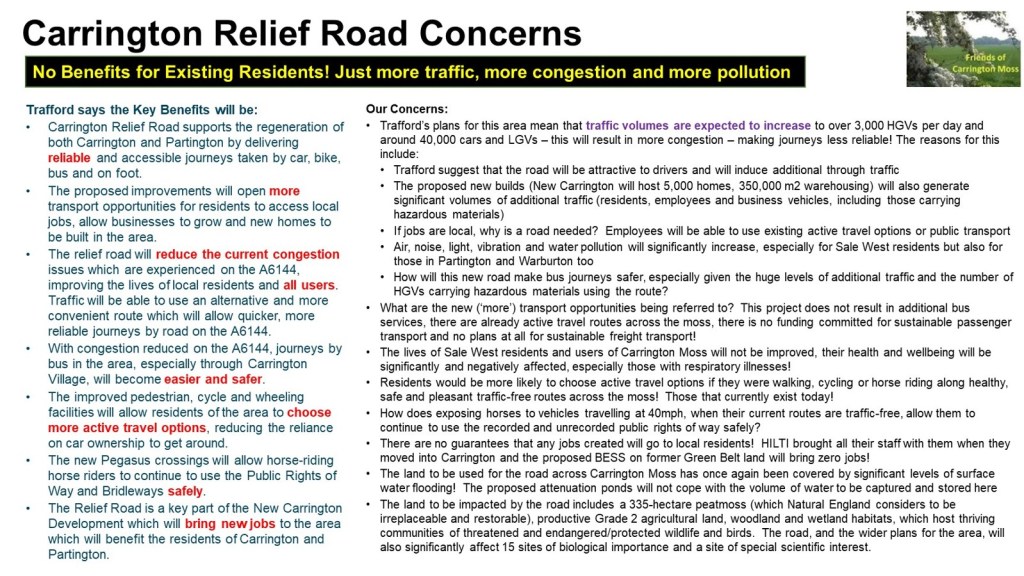
Not current or new local communities in the surrounding areas, who will suffer from significantly increased traffic, more congestion and the health consequences of air, noise, light, vibration, dust and water pollution, many homes will also be at a considerable risk of flooding

Not horse riders, walkers or cyclists who frequently use the traffic-free routes on, across and around Carrington Moss, whose current safe, healthy and very pleasant trips will be fractured by huge volumes of traffic, they will be required to walk or ride alongside hundreds of highly polluting vehicles, travelling at speed, which will be unsafe, unhealthy and very unpleasant

Not the red listed birds or the endangered wildlife species that breed and feed on Carrington Moss, their homes will be destroyed, their foraging corridors shattered, their lives at risk as victims of roadkill

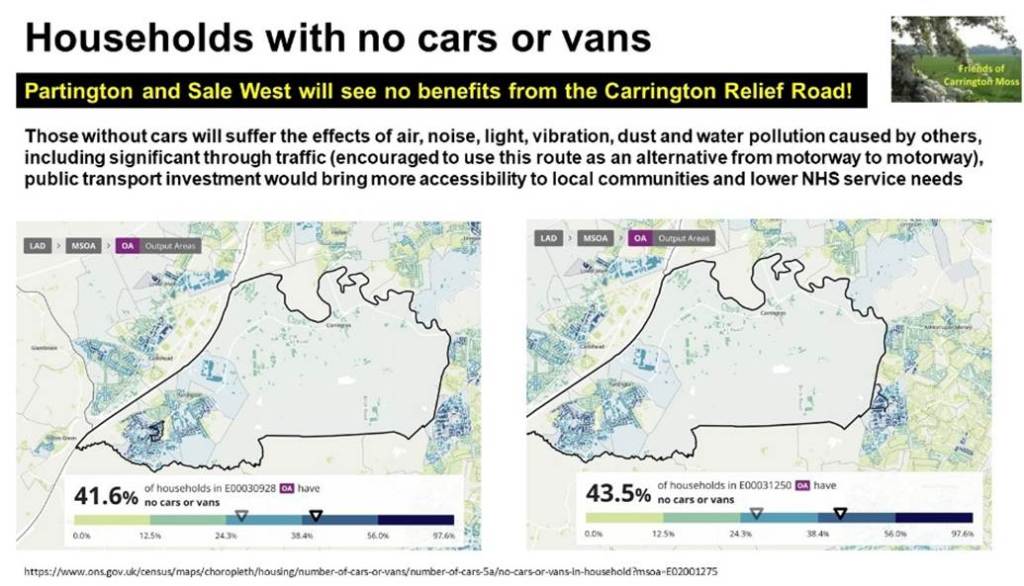
Government data makes it clear that there are many households in the area which do not have access to a car.  Building a new road will not benefit them at all (but they will still suffer the health consequences of increased pollution that are caused by others driving through their areas).

Over the past almost 10 years, despite confirming that this area is poorly served by public transport, Trafford has been unwilling to explore more sustainable alternatives, such as those proposed by the Friends of Carrington Moss.

We hope you will support our campaign to remove the Eastern part of the Carrington Relief Road (CRR) from the plans.  This will bring numerous benefits to local communities and users of the moss and will reduce the costs to the public purse. 

The submission of a planning application for the road is expected before Christmas.  Once it has been validated by Trafford’s planning team, the documents will be made public, and the Friends of Carrington Moss will review them over the following couple of weeks.  We’ll share our findings on social media, in our newsletter and at our online public meeting.

In the meantime, please follow, like and share our posts on social media and don’t hesitate to send any comments you may have to friendsofcarringtonmoss@gmail.com.

Developer Contributions Consultation

Also known as Trafford’s New Carrington Masterplan Funding Mechanism and Delivery Strategy Consultation (closing date 15th October)

What is it? What are the key issues? and Why is it important for residents to respond?

As you know, the proposed developments on and around Carrington Moss are huge!  5,000 houses, 350,000m2 employment space and 4 major new roads, all threatening the 335 hectare peat moss (restorable irreplaceable habitat), the productive Grade 2 agricultural land, the woodlands and the wetlands, and all impacting 15 sites of biological importance and a site of special scientific interest, to say nothing of the populations of numerous red listed birds and endangered wildlife species.

Because of the size and scale of the proposed schemes, in addition to the typical costs that would be incurred when they put forward a planning application, developers will be required to contribute to the strategic requirements (such as roads, buildings to support education and healthcare, and utilities), which Trafford describes as ‘hard’ infrastructure.  These costs would not have been required had the development been focused on previously developed (brownfield) land, rather than on former Green Belt and greenfield land in an isolated, unsustainable location.

The consultation documentation aims to set out the proportionate financial contributions for schemes that have not yet secured planning permission.

The strategy focuses on those so called ‘hard’ infrastructure items and supposedly prioritises the delivery of New Carrington “in a comprehensive and coordinated manner”.  The document confirms (figure 19) that almost half of the identified ‘hard’ infrastructure costs will be funded from developer contributions, and the other half will be funded by the public sector and other sources.

Balanced?  Sadly not!

Developer contributions are limited by government guidance.  This means that, for a scheme to be considered viable, developers must achieve a certain level of profit.  The contributions developers pay cannot be increased to the extent that the scheme would be considered unviable (ie they do not make the necessary level of profit).  So, if there are any excluded or missing costs not incorporated within the calculations (and there are a lot of them), the proportions shown in the graphic above are very misleading. 

The total contributions to be paid by the public sector should be explicitly and transparently shown, rather than covertly hidden in an appendix or not included at all!  It is vital that communities understand the full cost of destroying our essential natural resources to facilitate building in such an unsustainable location.

The biggest issue is the lack of consideration of harms to, or destruction of, natural capital assets.

Given the extensive environmental and ecological harm/destruction to be caused as a consequence of Trafford choosing this location for development, the calculations should include the costs related to the mitigation of, or compensation for, the loss of Green Belt, the cumulative harm to natural capital assets (such as, for example, the peat moss, the woodlands, and the farmland).  These have been explicitly excluded from the costs and subordinated to a future phase of the masterplanning work.

This means that the information provided in the documentation is incomplete and does not reflect the actual costs to be incurred if all the proposed developments go ahead.

Effectively, in omitting what we are calling the ‘Natural Infrastructure’ strategy from these calculations, the harms can be caused but funding may NEVER be available to provide the obligatory mitigation and compensation.

Why are we concerned?

Take a look at our response (here), but, in summary, not only have the natural infrastructure requirements been shelved to some point in the future, but our suggested amendments to the proposals have been summarily dismissed, resulting in unnecessarily inflated costs for the public purse. 

The cost of the road schemes, for example, would be significantly reduced if our alternative proposals were accepted.

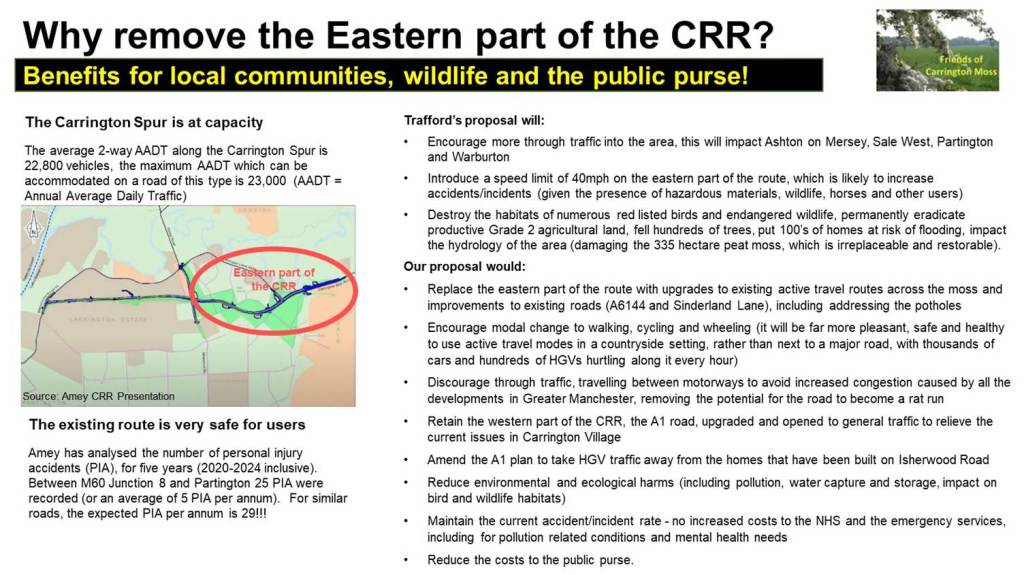
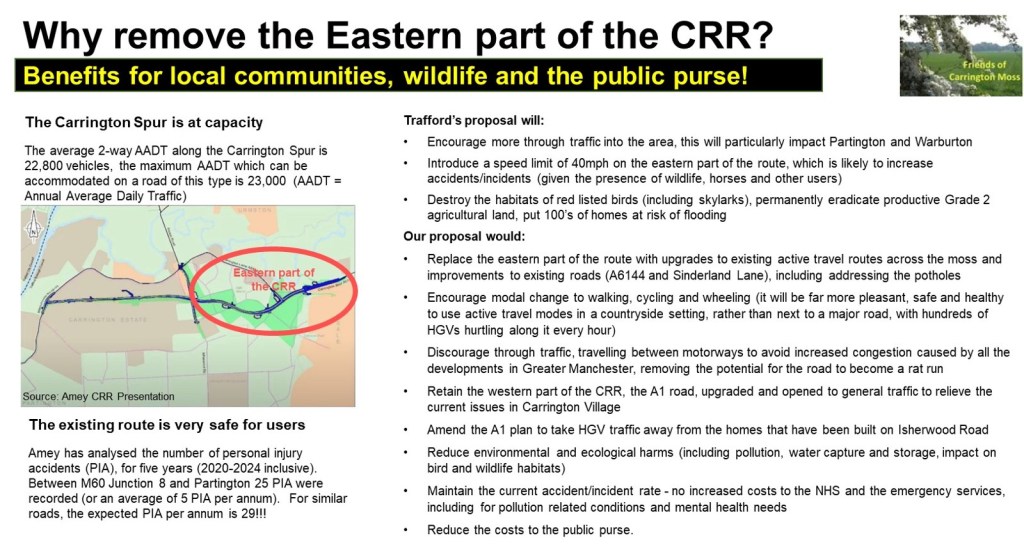
The eastern part of the Carrington Relief Road (CRR), across the moss, could be replaced with upgrades to existing active travel routes and improvements to existing roads (A6144 and Sinderland Lane).  This would encourage modal change to walking, cycling and wheeling (it will be far more pleasant, safe and healthy to use active travel modes in a countryside setting, rather than next to a major road, with hundreds of HGVs hurtling along it every hour).  It would also discourage the huge levels of induced traffic that will use this road, travelling between motorways and significantly impacting Partington and Warburton.  The western part of the CRR, the A1 road, should be upgraded and opened to general traffic as planned to relieve the current issues in Carrington Village.  The plan for the A1 should be amended to take HGV traffic away from the homes that have been built on Isherwood Road.  This would require a very short road to run in parallel with Isherwood Road/Ackers Lane, rather than a new road all the way to the Carrington Spur.

The latest information received from the CRR team[1] shows that the current road (A6144) is much safer than an average road of the same type and that there is ZERO capacity to increase traffic on the Carrington Spur.  Trafford should, therefore, not be proposing a new road that will allow traffic to travel at much higher speeds (particularly given the hazardous materials carried by some of the HGVs), or encourage more through traffic into the area.

Because it includes the eastern part of the road, the current CRR proposal unnecessarily inflates the cost of construction and ongoing maintenance (including for the attenuation ponds needed to capture all that water[2] currently stored on the moss), and the costs of the mitigation needed to address air, noise, light, vibration, dust and water pollution, along with other environmental enhancements.  Costs will also increase for the NHS and other emergency services because of increased pollution and traffic accidents/incidents, and there is likely to be an upsurge in the requirement for mental health services due to the stresses caused to local residents because of construction, congestion, the loss of green spaces, and, possibly, future flooding!

Facilitating vehicle access onto Firsway from the new Sale West developments (1,500 homes) will significantly increase traffic and will result in that road becoming a rat run from the M60.  It will require the felling of hundreds of trees, drastically affecting the wildlife and birds and impacting the dark skies in this area.  It will also increase safety concerns on Firsway and, consequentially, the costs to the NHS/emergency services of dealing with any resulting pollution related health conditions and accidents/incidents on the road network.  Limiting access through the Firs Plantation to active travel users only, would not only reduce the costs of constructing the Sale West Link Road, it would also reduce the cost of mitigating or compensating for environmental/ecological harms and the costs to the NHS. 

For all the same reasons, we suggested that the Eastern and Southern Link Roads should not connect with each other, as this will result in huge levels of increased through traffic from the M60 and other motorways, particularly impacting Warburton.  The proposed approach will also cause extensive damage to the very deep peat that will need to be compensated for.  As with the other schemes, it will also significantly increase pollution and will impact the dark skies in this area, with consequential costs for the NHS and other agencies. 

All the current proposals for these roads result in the need for higher contributions from the public purse, whilst our alternative options reduce the cost of constructing, the cost of mitigation/compensation for environmental/ ecological harms and the consequential costs to the healthcare sector and the emergency services.

The Healthcare costs included in the calculations seems to be limited to primary healthcare (which comprises doctors, dentists, pharmacists, and opticians), not mental health provision, not hospital provision (known as secondary healthcare) and not other emergency service provision.  All of which will significantly increase as a result of the proposed developments.  Furthermore, the Council does not recognise the impact on the need for increased social infrastructure because of the employment development (our objection to this is explained in our response).

Sustainable Development

The documentation repeatedly suggests that the ‘hard’ infrastructure is of the utmost importance to the sustainable delivery of New Carrington.  Yet, given the definition of sustainable development this is hugely misleading.

The government’s National Planning Policy Framework (known as the NPPF[3]) defines sustainable development as “meeting the needs of the present without compromising the ability of future generations to meet their own needs”. 

Given the proposed harms to, or destruction of, irreplaceable habitat, food producing cropland, woodland and wetland, it seems ‘sustainable development’ has a much narrower definition in this suite of documents.

With that definition in mind, it is clear that the New Carrington allocation cannot be ‘sustainable’, even with the proposed ‘hard’ infrastructure investment, because development here is dependent on considerable harm to, or the complete loss of, a number of essential natural capital assets that future generations will not be able to reverse. 

And, what is worse, as mentioned above, the costs of mitigating and/or compensating for those cumulative harms is not even included in the calculations set out in this consultation and no information has been provided about how such funding requirements will be addressed, or when!

What should you be asking for (in your own words)?

The masterplan project priorities should be reviewed to ensure that there is a comprehensive understanding of the costs of all elements of these proposals.  The Natural Infrastructure Strategy should be considered a prerequisite to finalising the contributions scheme.  It should be progressed with urgency, with its evolution including extensive engagement with communities.  The land to be used for environmental and ecological mitigation or compensation should also be identified as a matter of urgency. 

The documentation provided in this consultation should be updated and implemented when the full costs of the impact of development are known.

No environmental or ecological harms/destruction should be allowed to be caused until it is confirmed that funding for the mitigation and compensation for the loss of Green Belt and those extensive cumulative harms to the environment and ecology will become available.  We also need confirmation of where any agreed mitigation or compensation will be located – it is possible that, because of the size and scale of the developments proposed here, enhancements will be implemented elsewhere, which means our local communities suffer all the health, wellbeing and traffic consequences of these plans, and others will benefit from environmental and ecological improvements in their areas!


[1] https://www.youtube.com/watch?v=L3uG5SzmzjA

[2] https://friendsofcarringtonmoss.com/carrington-lake-2/

[3] https://assets.publishing.service.gov.uk/media/67aafe8f3b41f783cca46251/NPPF_December_2024.pdf

Poor Public Transport for the New Carrington Allocation Area

Lorraine Eagling

The Bee Network High Frequency Routes Map shows all the routes in Greater Manchester that have buses or trams every 12 minutes or less. 

It is disappointing to see that, compared to the rest of Greater Manchester, Trafford has the least number of high frequency buses.  Whilst all the other boroughs have at least two high frequency services, Trafford’s only frequent service is from Manchester City Centre to the Trafford Centre.

It probably comes as no surprise to the residents of Trafford that they have no high frequency buses, especially the residents of Partington, Carrington and Sale West, where the most frequent bus is every 25 minutes in rush hour, every half an hour during the day and every hour in the evening.

Residents are failed again

New Carrington will be the largest development in Greater Manchester, with 5,000 new homes and 350,000 square metres of industrial/warehousing across Carrington, Partington and Sale West. Despite what is set out in Appendix D of the Places for Everyone Plan, there is no formal commitment to invest in any public transport infrastructure. No trams, no trains (despite the former railway lines running through the allocation area) and no commitment to additional bus services.

The only transport commitment for New Carrington is the £132 million Carrington Relief Road.

In fact, according to the New Carrington Transport Strategy 2023, (page 63), bus services will “fall short of the currently unachievable addition of around 25 – 30 new buses which would be required for a fully sustainable Scenario 3, and which would enable a reasonably comprehensive network, along with 15-minute headway service to both Stretford and Sale Metrolink stations”.  So, not only is there no commitment to public transport infrastructure investment but the proposed bus service will be inadequate for a development of this size.

Residents of Carrington, Partington and Sale West were promised improved public transport connections in Trafford Council’s 2006 UPD and in the 2012 local plan.  These improvements never materialised and, despite the size and scale of the allocation, and the opportunity to finally deliver these promises, what we have seen is a clear lack of ambition to achieve what is required by the regulations, sustainable development!

An Unsustainable Development

As mentioned above, the only actual commitment for transport in New Carrington is the £132million Carrington Relief Road. This road is not only expensive, but will not benefit existing communities, particularly in Partington and Sale West as we have set out in our previous blog.

As the public transport options will NOT be ‘reasonably comprehensive’, New Carrington will be unsustainable, car dependent sprawl that causes huge amounts of harm to our natural capital assets.

In most cases, residents in New Carrington will face the higher costs of car dependent living. For those who do not have a car, their ability to enter paid employment or the training needed to secure a well-paid job, is constrained by the lack of local public transport options. Also, local public amenities are already oversubscribed, so, once the housing developments are occupied, residents will have to have to travel further afield to access schools, doctors, dentists etc.

Increased Air Pollution

The Carrington Relief Road is forecast to induce more motor traffic into the area, with the Environmental Impact Scoping Report confirming (paragraph 14.46) Traffic flows are likely to increase due to the improved desirability of the route”

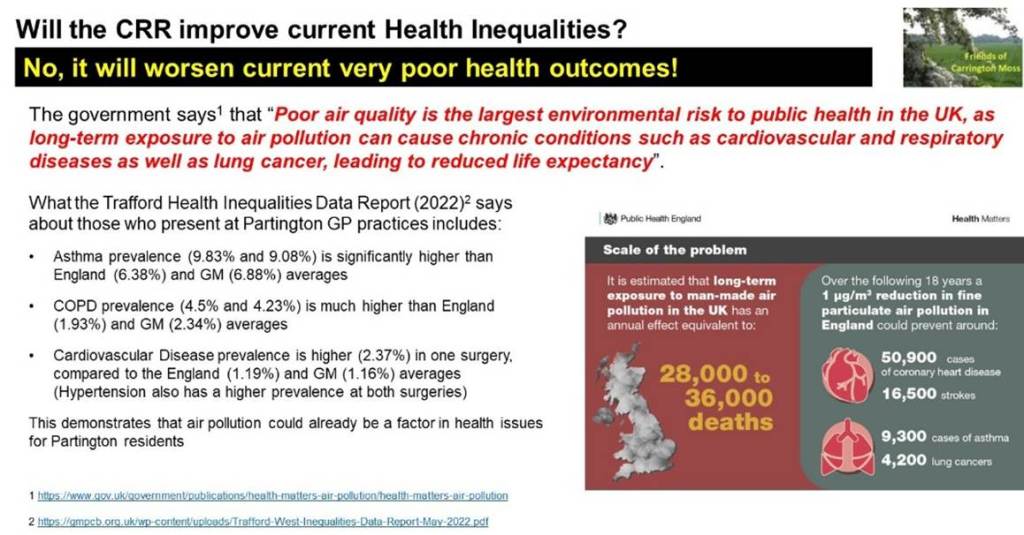
The Let Manchester Breath Coalition’s response to the GM Clean Air Plan shows that Greater Manchester consistently has the highest levels of Nitrogen Dioxide in the country, car ownership is increasing well above the national average and Manchester ranks in the top ten for highest number of emergency admissions and deaths for lung conditions across the UK.

Air pollution is a public health emergency, so it is inconceivable that the only transport infrastructure for the largest development in Greater Manchester is a £132 million ‘relief’ road, that will be built on Grade 2 agricultural land.  It will impact 15 sites of biological importance and a site of special scientific interest, along with woodland and wetland habitats.  It will also damage (or lead to the destruction of) a 335-hectare peat moss that has the potential to absorb five times more carbon than a forest of an equivalent size. This is a complete betrayal of future generations.

Meeting Targets Will Be Impossible

Furthermore, the Greater Manchester Transport Strategy set out the “ambition to improve the transport system so that – by 2040 – 50% of all journeys in Greater Manchester are made by public transport or active travel“. 

Car centric developments like New Carrington will make it impossible for the Greater Manchester Transport Strategy’s target to be met. 

It certainly feels like the residents of Greater Manchester are being failed.  Economic growth and profit are being put before public health and equality? Compare Andy Burnham’s plans for GM with those of David Skaith, the Mayor of North Yorkshire, who has said he will prioritise improving public transport in the region rather than campaigning for the A64 to be dualled!

Yorkshire has the opportunity to achieve sustainable development, New Carrington certainly does not!

Call for Action 2 – Carrington Relief Road!

There have been numerous concerns raised about the route of the Carrington ‘Relief’ Road across Carrington Moss, as it will cause significant harms to both human and wildlife populations and several of our members have suggested that there is a significant lack of awareness shown by those making the decisions about this proposal. 

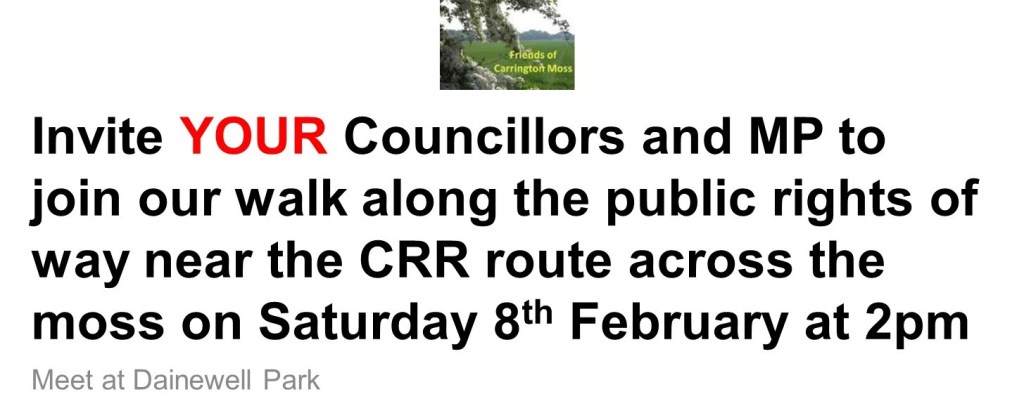
With this in mind, we hope you will all join us on a walk along the public rights of way near to the Carrington Moss part of the route for the new road.  We plan to meet on Dainewell Park on Saturday 8th February at 2pm. 

We’d like you to invite your Councillors and your MP to join us on the walk, so we can share our concerns.  If you are not sure who your Councillors or your MP are, click on this link to find out.  You just need to put in your post code and, hey presto, the information is there.  When the details come up, you will see a link at the right-hand side which says “Write to all your Councillors”.  You can drop them a note and invite them to come along.  If you click on your MP’s name, you can also send an email to him inviting him to come along and hear your concerns about the road.  The more invitations the politicians receive, the more likely they are to join us on the walk.

As we mentioned in our previous blog (Call for Action 1 Respond to the Consultation), the Friends of Carrington Moss welcome the long-awaited opening of the A1 route through the employment area of Carrington, but all HGVs should be required to use that route, rather than travelling along the A6144 through Carrington Village.  The CRR consultation confirms that “HGVs will not be banned on the A6144” but this should be challenged in consultation responses. 

It is disgraceful that Trafford Council have enabled the current situation being experienced by Trafford residents living in Carrington, including the air, noise, light and vibration pollution they are suffering day and night.  During the past more than 10 years of planning for unviable and unsustainable growth here, Trafford Council has not identified and/or committed funding for sustainable passenger and freight transport solutions for the area.  This is particularly shocking given the anticipated number of HGVs using local roads each day, including those that will carry hazardous materials.  There are various alternative options Trafford could have considered, including using the former railway lines, the Manchester Ship Canal and the potential to deploy pipelines (there are several of these in the area already)!

We do, though, have major concerns about the part of the route which runs across Carrington Moss.  Not just because of the impact it will cause to Sale West residents and the lack of benefits to surrounding communities, but also because of the harm it will cause to the 335-hectare peat moss (described by Natural England as irreplaceable and restorable), the productive Grade 2 agricultural land, the extensive woodland and the wetland habitats.  All of which are essential to a sustainable future for our children and grandchildren.  The road, and the wider plans for New Carrington, will also significantly impact 15 sites of biological importance and a site of special scientific significance.

Click here to join our online public meeting on 28th January at 6pm to discuss these issues further.  All are welcome.

Finally, despite highlighting previous inaccurate, incomplete or misleading information in CRR materials, the consultation resources (letters and website) have yet more examples.  We will be requesting a further Call for Action from local communities.  Look out for our next blog for more information on this.

Call for Action 1 – Carrington Relief Road!

Respond to the Consultation

As the first Carrington Relief Road (CRR) consultation goes live today (20th January 2025), we are issuing our first Call for Action to local communities.  Please take the time to respond and encourage friends and family to participate too.

The consultation period includes some face-to-face sessions, and we hope you will be able to attend one of these.  Just a reminder that the current CRR team are NOT responsible for the decisions made in the past and that they have been directed to give a very limited scope to the consultation, which is only based on the design of the road! 

The inadequacies of this consultation have been determined by Trafford Council, and they have repeatedly rejected our requests for communities to be able to influence the wider aspects of transport solutions for the area – our next Call for Action will address this failure (see below).

This consultation ends on 28th February.  Your inputs are extremely important, so do click on this link to read Trafford’s materials and submit your own response.  We will be discussing this consultation at our next online public meeting on 28th January (6pm), the link to the meeting is here and all are very welcome to join us.

At the meeting, we will highlight some of the key points to consider, which include the following:

  • there are two parts to the Carrington Relief Road (CRR):
    • we are totally supportive of the upgrading of the A1 route in Carrington (this runs through the employment zone from Isherwood Road to the A6144 near Saica Paper), all HGVs should be encouraged to use this road, rather than the A6144 through Carrington Village – this could have come forward years ago without any objections!

    • we are totally against the development of the road across Carrington Moss and have been proposing our alternative to Trafford for the last 4 years, without success – they are only interested in promoting the CRR, despite its escalating costs – it is a commitment to support development – not a solution aimed at benefiting existing communities
  • how the current design ‘benefits’ communities:
    • Carrington residents will only benefit from this new road if through-traffic and HGVs are unable to use the A6144 through the village, with appropriate traffic calming mechanisms put in place (otherwise, residents here will just be surrounded by constant traffic and the associated pollutant impacts)

    • Partington and Warburton residents will, sadly, not benefit from the scheme – Trafford has acknowledged that the road will induce additional traffic, much of which is likely to continue through Partington and Warburton, seeking an alternative route to the motorways, furthermore, given the low levels of car ownership in Partington, a new road will not reduce the isolation of this community (unlike a tram/train connection)

    • Sale West residents will be the most negatively affected by the scheme, they will suffer from huge increases to air, noise, light, vibration and water pollution, a significant, intensified and more frequent risk of local flooding, and the loss of the current safe, healthy and pleasant traffic-free recreational routes – we recognise that the recorded and unrecorded public rights of way will still be there, but, with the road solution, residents will be walking, cycling and horse riding next to the over 40,000 motor vehicles expected to use the road each day (including over 3,000 HGVs) – the number of vehicles will significantly increase from the current traffic numbers due to the proposed developments in the area and the induced traffic using the road as a ‘rat-run’!

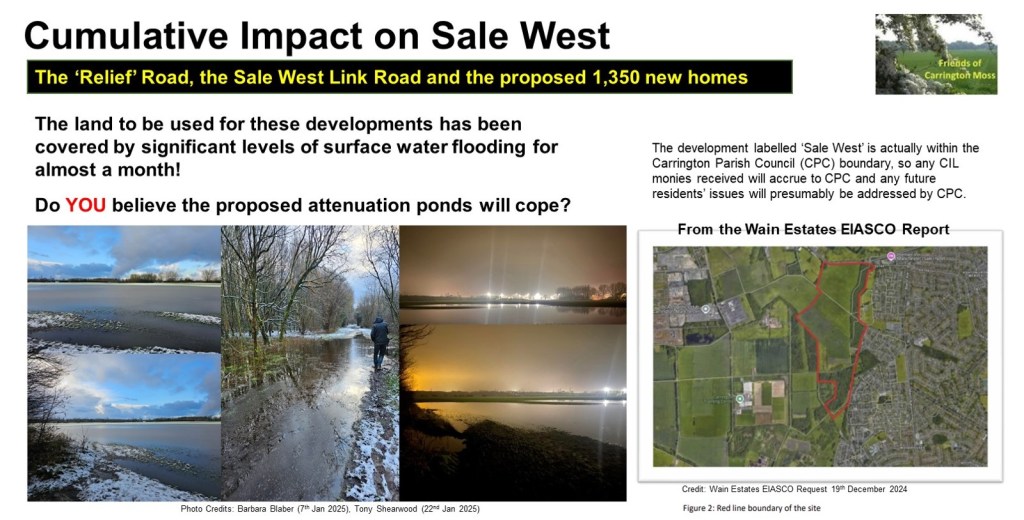
    • Urmston residents will not benefit from the scheme either, but they are also likely to see an increase in traffic on their local roads and the risk of local flooding will increase due to the loss of water capture and storage on Carrington Moss (we do not believe the proposed attenuation ponds will be sufficient to replace the capacity lost when the road is built)
  • how the design ‘mitigates and compensates for the impact on the natural environment’:
    • the part of the road that cuts across Carrington Moss will severely impact red listed birds (including, for example, the skylark, which is prevalent along the route of the road) and protected/endangered species – we are very saddened by the thought of yet more roadkill!

    • the road will fracture the corridors used by wildlife and birds to access food and water sources – this will result in further depletion of their species

    • the road will also damage the peat moss (a restorable 335-hectare irreplaceable habitat according to Natural England) and the sites of biological importance/site of special scientific interest, even where these are not directly impacted – this is because of the changes to hydrology that will be required to keep the road water-free

    • it is likely that Trafford will consider that the attenuation ponds will replace the immense water capture and storage functionality of the moss – we think they underestimate the level of water captured here and this could lead to huge risks for local communities

    • Trafford is also likely to assume that these pond areas will create biodiversity gains, but what must be considered is that the losses will be experienced immediately, whereas any gains could take years to deliver, and, in that time, species will be lost to the area forever

    • the road will also impact the potential opportunities to support the Local Nature Recovery Strategy

    • the loss of productive Grade 2 agricultural land will impact future food security as this cannot be replaced elsewhere in Trafford
  • how the design constrains the development of the New Carrington Masterplan which is currently under development and covers the whole allocation area:
    • the CRR will significantly restrict and constrain what is possible in terms of recreational, ecological and natural capital benefits for the Sale West area, considerably increasing the inequities of access to green space for residents

    • the Natural Infrastructure Strategy underpinning the Masterplan has not yet even been discussed – this should determine the approach to mitigation and compensation for environmental and ecological harms to be caused across the allocation area (including the cumulative harms) – such issues should not be addressed as piecemeal solutions for individual developments, including the CRR.

Whilst we are keen for residents to respond as constructively as possible to this consultation, we also need to recognise that Trafford has not given communities the opportunity to influence either:

  • the choice of transport options for this area (why weren’t we asked if we wanted trams or trains, given the size and scale of the developments they are proposing, the number of years this has been under consideration, and the sheer common sense that we should make full use of the former railway lines running through the allocation area and the proximity of the Manchester Ship Canal?), or
  • the route options for the road.

You might want to mention this in the final section of the response questionnaire (headed “Further Comments / Queries), but with these things in mind, there will be a future Call for Action from local communities to address the total lack of previous consultation about the CRR. 

Look out for our next blog for more community action on the Carrington Relief Road Consultation.

What exactly is the Vision for New Carrington?

Houses on stilts?  An estate by the lake? HGVs replaced by boats (well we like that idea)!

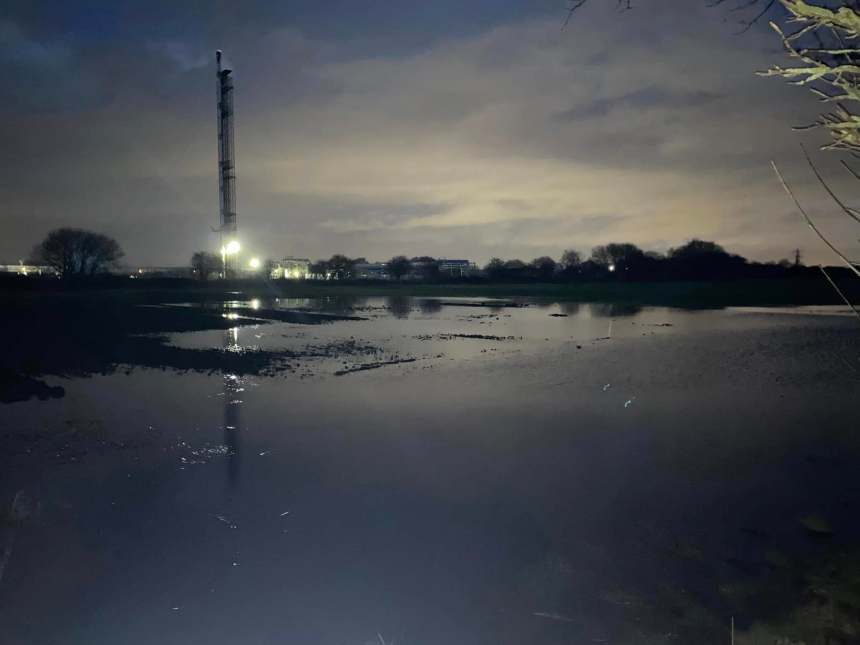
The recent heavy rainfall event significantly impacted many in our communities (and beyond), not only causing disruption to travel and a lot of inconvenience (wonder who’ll be jailed for that*) but also, very sadly, causing the deaths of wildlife and domestic animals.  The Manchester Evening News (2nd January) reported that 1,000 people were evacuated from their homes and several major roads were under water and closed for a long period. 

Whilst Trafford was “working closely with the Environment Agency, fire and rescue services, and the police to provide support to those in urgent need”, there was a huge amount of community support too.  Thanks to everyone who did their bit, particular thanks to Carrington Riding Centre for their support to those affected (humans and animals).

Despite the Environment Agency issuing six flood warning and four flood alerts, the Mayor of Greater Manchester, Andy Burnham, astoundingly stated that the severity of the flooding took authorities by surprise because no specific warnings were given!  He has called for “accountability”.  We wonder what he actually means by that.

Will he and his colleagues, the leaders of 9 districts in Greater Manchester, be held accountable, for example, for their decision to allocate land that is essential for climate mitigation in his Places for Everyone Spatial Plan.  One of those allocations is New Carrington, in which Trafford Council proposes to approve the development of 5,000 houses, 350,000m2 warehousing and 4 major new roads! 

These developments will mean that huge swathes of land that is currently capturing and storing thousands of litres of water will be concreted over, against the wishes of local communities, causing significant environmental and ecological harm and causing enormous risks to future generations (and not just in relation to flooding).

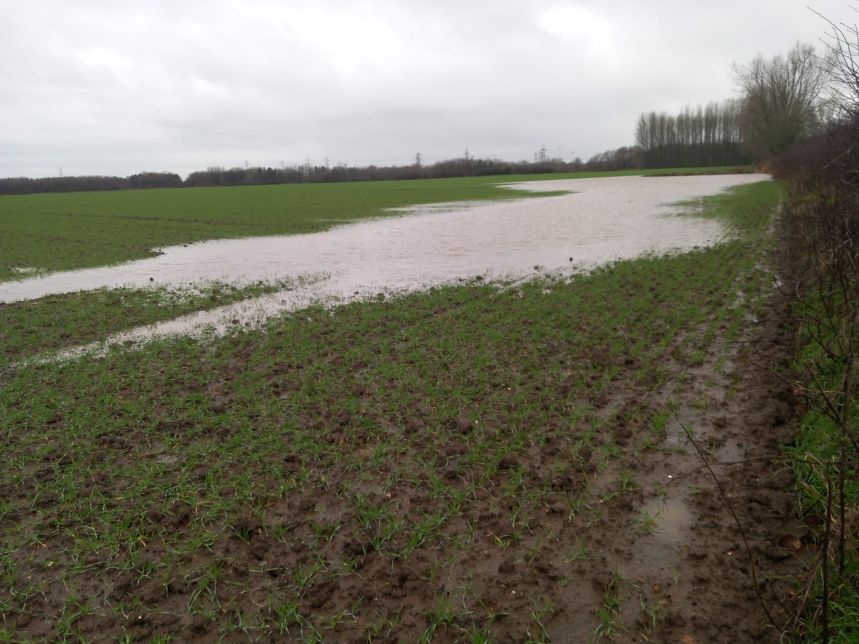
There is a lack of understanding at Trafford Council about just how much water is hosted by Carrington Moss.  This area has saved local communities from more severe flooding for decades.  You can see some of our videos showing the extent of flooding in previous years on the Carrington Lake page of our website.

The Met Office (and many others) have reported that rainfall is now heavier and more frequent than in the past.  Their scientists found that “rainfall associated with storms is becoming both more intense and more likely”.  Whereas we could, at one time, expect such events to be once in 50 years or so, those extreme weather conditions are now expected to occur at least once every five years. 

This means that wetland habitats, like Carrington Moss, are hugely valuable for the ecosystem services they provide. 

What is really worrying many in existing communities though, is that, if this very wet land is developed, future heavy rainfall events will not have the benefit of Carrington Moss to protect local areas.  Once a flood event has happened to their homes, residents will find it difficult to get insurance and there will be huge costs to the public sector (which is funded by us). 

Much of the land that is proposed for development is under high levels of water.  The Council and developers will tell residents that they have a sustainable drainage strategy but let’s be clear, draining all this water into the River Mersey (or Sinderland Brook) will cause local and downstream flooding.  This is contrary to national guidance and our concerns about this issue have been repeatedly ignored by Trafford, the Greater Manchester Combined Authority and the PfE Planning Inspectors. 

Will they all be held accountable for future flood events that occur here and in surrounding communities?

Many of you will have seen the Manchester Evening News article that reported the closure (once again) of the A555 Airport Relief Road, which had cars submerged to their rooftops!  Transport solutions such as this do not benefit anyone, and as Trafford themselves admit, the new road here (Carrington Relief Road) is expected to induce additional traffic into the area (definitely not what we need). 

We are currently expecting the consultation for the Carrington Relief Road to be issued later this month.  Please keep this flooding in mind when you respond.  We believe our alternative option is a more sustainable solution that will benefit both current and future residents. 

For more information about our ongoing campaign, please sign up to our monthly newsletter here and join us at our monthly online public meetings.

Note: Image credits Rob Duncan, Mary Lennon and Tony Shearwood

*for anyone who does not understand this reference, protestors who cause inconvenience to others by, for example, sitting in the road to raise an issue, can be jailed – yet those who knowingly make decisions that result in far more serious implications, such as planning for or approving development in areas that should be capturing flood water, putting current and future communities at real risk of harm, currently escape any accountability or punishment!

Unsustainable New Carrington – “Trapped Behind the Wheel”

by Lorraine Eagling

Where we live and how we get around are key to what shapes our everyday lives.  A recent New Economics Foundation (NEF) report ‘Trapped Behind the Wheel’ found that

far from moving our economy towards sustainability and improved wellbeing, England’s new homes in recent years have increasingly encouraged car-dependent lifestyles.

One factor in this change has been the outsized share of new homes being built in rural areas, which has risen continually across the country in recent years”.

New Carrington will be one of these car and HGV-dependent developments that will not be sustainable, nor will it deliver improved wellbeing for new and existing residents.  The majority of the housing and warehousing will be located on grade 2 agricultural land and part of a restorable 335 hectare peatmoss! 

Despite the proximity of New Carrington to Partington, Carrington and Sale West, there is currently a lack of adequate public transport and no committed funding for new public transport infrastructure.  In fact, there are no plans to connect New Carrington to the water, rail or tram network, despite the allocation being adjacent to the Manchester Ship Canal, having former railway lines running through the site and it being the largest development in Greater Manchester.

The Council are pushing ahead with this plan regardless of the experience of the past 15 years, which shows us that, without substantial changes and investment into new public transport infrastructure, there is a major risk of locking in increased car and HGV dependency for decades to come.

As a result, Trafford Council and the Government will not be able to deliver priorities such as

Bringing the cost of living down to more manageable levels, reducing spatial inequality and responding adequately to the climate emergency

In most cases, residents in New Carrington will face the higher costs of car dependent living. Their ability to enter paid employment or the training needed to secure a well-paid job is constrained by the availability of local public transport infrastructure.  

Although there are plans to improve bus services as part of the masterplan, Partington, Carrington and Sale West have seen bus services reduce significantly over recent years, so any increase in services provides no net gain overall. 

“A 2021 study demonstrated that in ‘left-behind’ neighbourhoods, which have high deprivation and poor social infrastructure provision, public transport is worse than average (74% have no railway station and bus journeys per capita have declined faster than the national average). Residents are less able to afford to compensate by owning a car (40% of households have no car, compared with 26% across England). These areas of the country typically have worse connectivity than the English average but rely more than other parts of the country on their local bus service”. (Emmet Kiberd, Benedikt Straňák, NEF, November 2024)

So, why is there no commitment to invest in new public transport infrastructure such as reopening the rail line between Irlam and Timperley?  Part of the answer may lie in the following figures.

“The public transport system in wealthier parts of the country, such as London and the south-east, is much more effective and gives residents there far more access to jobs than the equivalents in the north-west, Yorkshire, and parts of the Midlands. Despite this, public investment in transport has tended to overlook the parts of the country where it is most needed. The north of England would have received an additional £51bn in public investment in transport if it had matched the per capita level seen in London from 2014/15 to 2019/20. Similarly, investment in active travel infrastructure between 2016 and 2021 was £24 per person in London but only £10 per person in the rest of England. (Emmet Kiberd, Benedikt Straňák, NEF, November 2024)”

Regardless of the lack in funding in the north for public transport, Trafford Council plan to build a relief road (the name is misleading), with a current cost of £76million, which is very likely to rise! 

Why isn’t this money being used for new public transport infrastructure? If the Government is to deliver on its priorities, when there is a ‘black hole’ in public finances, surely public transport must take priority over road building.

Then, there is another question, why is Trafford pushing ahead with this development when there are other available sites and enough windfall sites over the past four years to provide 40% of the housing target for New Carrington? 

Emmet Kiberd and Benedikt Straňák (NEF, November 2024) suggest the reasons behind these questions are

  • “Favour cheaper greenfield land in a profit-driven housing development system.
  • Relatively lower levels of local political opposition to new developments in more remote areas.
  • A lack of early, integrated planning of transport, housing, and development sites, reinforced by substantial underfunding of public planning departments.

The provision of public transport and active travel for new homes is affected by:

  • The insufficiency of Section 106 funds to cover the public transport needed, together with the lack of negotiating power for councils tends to see transport provision lose out in a trade-off against social housing, community facilities, and other items.
  • The use of large amounts of public funding on expensive road infrastructure alongside new developments, encouraged by a lack of advance transport planning and car-centred approaches.
  • The provision of public transport and active travel for new homes, which is affected by poor public transport and active travel provision in adjacent neighbourhoods, due to congestion and a lack of safe walking and cycling routes”.

Clearly, there is a need for ambitious policies and brave decisions in relation to the New Carrington Masterplan because the second-best solutions that present themselves are unlikely to solve the problems and deliver the priorities that will bring the cost of living down to more manageable levels, reduce spatial inequality and respond adequately to the climate emergency.

Concerned about traffic? Email your Councillors about the Carrington Relief Road!

Whilst we await the consultation for the Carrington Relief Road (CRR), we continue to collect data and scrutinise the traffic flows in our locality.  Our analysis is very revealing! So, why are we worried about the impact of the CRR? Read on to understand our concerns.  Contact your Councillors if you are concerned too (details of your Councillors can be found here).

Trafford Council has acknowledged that the construction of this £76million road is not for the benefit of existing residents (as stated in their Carrington Relief Road Environmental Impact Scoping Report)

1.2. The key objective of the new Carrington Relief Road is to provide sufficient capacity within the transport network to deliver growth of housing and employment in the wider New Carrington masterplan area, and realise the socio-economic benefits of the future development. The redevelopment of this Site provides an opportunity to deliver a new link road for Trafford that will facilitate future phased development of c.5,000 new homes and 360,000sqm employment floorspace”.

Unfortunately, existing residents will be adversely affected by the new road as demonstrated below.  Yet, if monies were invested in public transport infrastructure, as previously promised in the local plan, there would be far greater health, economic and social benefits for both existing and new residents, not to mention the preservation of an area that supports climate mitigation, nature’s recovery and future food security.

So, why are there no plans to invest in train/tram infrastructure in what is the largest development in the Places for Everyone Plan?  It is described as the single largest regeneration scheme in the North West by Andrew Western, MP for Stretford and Urmston in his comment supporting the Wain Estates Case Study here.

Trafford Council’s Local Plan 2012 proposed to deliver “significant improvements to public transport infrastructure by improving access to Partington, the Regional Centre and Altrincham with links to the Metrolink system”.   The New Carrington Masterplan presents the perfect opportunity to deliver these much-needed improvements by directing the funding into schemes that already had the backing of the local businesses, Councils and the community, such as reopening the Cadishead Viaduct.  More information on that initiative can be found here.

Whilst we understand that funding is an issue and the Council are reliant on contributions from developers and the government, these types of schemes are long-term, sustainable solutions to the inequalities that exist in Partington, Carrington and Sale West and are a much better use of public money.  It is well documented that roads are short-term, unsustainable options.

We are already experiencing the impact of climate change, with erratic weather patterns leading to localised flooding and crop failure.  The proposals for New Carrington are contrary to Trafford’s declaration of a climate emergency in 2018 and its aims to be net zero by 2038.  The lack of funded sustainable transport options also conflicts with the Greater Manchester Transport Strategy 2040, which has a vision for 50% of trips to be made by sustainable modes, and states (page 8) that “Achieving the Right Mix is expected to lead to zero net growth in motor vehicle traffic in Greater Manchester between 2017 and 2040”). 

How will they meet these targets?

Whilst we acknowledge active travel forms part of the transport intervention in New Carrington, any progress made in getting people to choose active modes will be heavily outweighed by the significant increase in road traffic as described in their scoping report.  Walking cycling or horse riding next to over 3,000 HGVs a day will not be pleasant, safe or healthy!

The Proposed Road  

The western end of the Carrington Relief Road starts opposite the Saica Paper Factory and will run along the existing A1 Road behind Carrington Village.  This road is to be upgraded as part of the scheme.  The eastern end of the Relief Road will be constructed across Carrington Moss, from Isherwood Road to the junction of the Spur Road and Banky Lane. 

The cost of the overall scheme is currently estimated at £76 million but could rise due to the increased cost of materials, the need to address contamination and the complexity of building on or near to a 335 hectare peatmoss (hydrology issues will need to be tackled – depending on the final route).

In responding to Trafford’s ‘engagement event’ (which took place in 2021), in advance of the release of the CRR route options report, we put forward a proposal that would reduce HGV traffic through Carrington Village and negate the need to construct an expensive road across Grade 2 agricultural land, woodland and wetland habitats.

We proposed that the existing A1 Road be upgraded and opened up to all heavy goods vehicles to resolve the issue of hundreds of HGVs passing through Carrington Village every day.  We proposed upgrading the existing A6144 between Isherwood Road and the Carrington Spur, which is not at capacity, and reducing speed limits.  We also proposed upgrading the existing active travel routes across Carrington Moss.

Unfortunately, our suggestions (and those of Natural England – a national organisation that advises the government on all issues related to the natural environment), were ignored.  So, we have continued to collect traffic data and here is a summary of our findings:

Induced Traffic

Our most recent surveys focused on the pattern of traffic travelling from the west of Partington towards the M60. 

During term time, the total number of cars travelling from Warburton, Warrington and Lymm into Partington is 69% of the total number of cars recorded leaving Partington in the direction of Carrington.  During school holidays, this figure is 63%.  This shows that the majority of the traffic travelling through Partington towards Carrington is coming from outside the area.  The volume of this induced traffic will increase (as described in Trafford’s own Environmental Scoping Report – Traffic flows are likely to increase due to the improved desirability of the routeparagraph 14.46)

What proportion of traffic will benefit from the new road

At the Manchester Road/Isherwood Road and Carrington Spur/Banky Lane junctions term time figures have been used, when traffic is highest.  Full details of our surveys can be found here and here.

  • During term time 37% of the traffic coming from the M60 is headed towards Carrington.
  • During term time 40% of the traffic from Sale West is headed towards Carrington
  • During term time 53% of the traffic from M60 or Sale West is headed towards Flixton.

The traffic headed towards Flixton would not use the relief road, so ……

….. only 18.1% (an average of 47% of 37% and 47% of 40%) of the traffic from the M60 and Sale West would use the new relief road.

Furthermore – during term time ……

….. only 32% of the traffic from Partington and Carrington heading towards the M60 would use the new road, as the rest of the traffic is headed towards Flixton.

Let’s think about that – only 18.1% of the traffic from the M60 and Sale West and only 32% of the traffic from Partington and Carrington would use the CRR – yet the Council is proposing to spend £76m on an outdated, unsustainable road-based solution!

Remember:

  • Congestion in Partington will increase significantly and will have a major impact on existing residents. Not only will there be increased induced traffic as described earlier, but the construction of approximately 3600* houses in central Partington, Partington East (which is really Carrington South) and Warburton will put extreme pressure on the road network – note that these numbers do not include the additional homes recently constructed or still to be built in other parts of Partington (Lock Lane, Oak Lane, Hall Lane).
  • Congestion from Sale West to the M60 at the Banky Lane Junction is the heaviest of all routes during peak times.  This will increase significantly due to induced traffic from the relief and the construction of 1450* houses in Sale West.

* Figures taken from the GMCA Joint Development Plan paragraph 11.381.

Having your say!

If you wish to express your opinion regarding this matter, the public consultation for the Carrington Relief Road is due to commence in the coming weeks.  You can also join the discussions at our monthly online public meetings – you will find the link to the next meeting here.  As mentioned above, you can also email your local Councillors to outline your concerns.

Is the Carrington Relief Road really a relief road or just a green light to major development?

By Lorraine Eagling

Following my blog about the New Carrington Transport Strategy (8th March), I decided to carry out some more traffic surveys to further clarify my findings and conclusions (you can read the previous blog here).

I carried out surveys in the morning rush hour during the Easter Holidays and then mid-term time (the week the GCSE examinations started).  This time the data was taken between 8.10 and 8.30, whereas last time the data was collected between 8.30 and 9.00.  I wanted to confirm that traffic increased significantly during term time and what direction was the traffic flowing.

The following tables show the percentage of cars and vans travelling in the different directions at the two major junctions that the relief road is purportedly to relieve.

Car and Van traffic at the Junction of Carrington Spur, Carrington Lane and Banky Lane

Percentiles of traffic flow (cars and vans) during peak times in the Easter holidays April 2024 – average hourly total 1833 vehicles

Percentiles of traffic flow (cars and vans) during peak times and term time April 2024 – average hourly total 2160 vehicles

There were tailbacks from the M60 heading towards Sale West.

Conclusions drawn from these tables regarding car and van traffic at this junction

  • During term time 63% of the traffic from the M60 is travelling towards Sale West, therefore, would not use the new relief road.
  • During school holidays 49% of the traffic from the M60 is travelling towards Sale West, therefore, would not use the new relief road.
  • The majority of the traffic from Sale West during school holidays and during term time (69% and 60% respectively) is travelling towards the M60, therefore, would not use the new relief road.
  • There is a 28% increase in the number of cars travelling from Carrington to Sale West during term time.
  • The busiest route (the highest traffic count) was from Sale West both during term time and school holidays.

This suggests that the majority of the traffic travelling from the M60 and the majority of the traffic from Sale West would not use the new relief road.  Also, the increase of 28% in traffic using the relief road during term time is school traffic which could be addressed using school buses. 

Car and Van traffic at the Junction of Carrington Lane, Flixton Road and Isherwood Road

Percentiles of traffic flow (cars and vans) during peak times of the Easter holidays April 2024 – average hourly total 2204 vehicles.

Percentiles of traffic flow (cars and vans) during peak time and term time April 2024 – average hourly total 3081 vehicles.

There were no tailbacks at any of the junctions, however traffic travelling towards the M60 was slow due to an accident on the M60 at Eccles.

Conclusions drawn from these tables regarding car and van traffic at this junction

  • During term time 64% of the traffic from Carrington/Partington is travelling towards Flixton.  This means that the majority of the traffic from Carrington and Partington will not use the section of the relief road that runs parallel to the existing A6144 between Isherwood Road and the Carrington Spur.  During school holidays this figure is 43% which is still almost half the traffic. 
  • During term time 49% of the traffic from the M60 travels toward Flixton and during school holidays this figure is 34%
  • It would be more direct to travel along the existing A6144 from the M60 if you were heading towards Flixton as you pass through one junction as appose to two junctions if you were to use the new relief road.  If we consider term time traffic, 37% of the vehicles from the M60 head towards Carrington.  Of this, 49% heads towards Flixton (and will most probably use the existing road), 51% heads towards Carrington and would probably use the new road.  So, that means 51% of the 37% of traffic, which is a total of 18% of the traffic coming off the M60, would benefit from using the new road.

Overall, the data shows that traffic increases significantly during term time.  At the Banky Lane Junction, the heaviest traffic flow is between Sale West and the M60.  At the Isherwood Road junction, the heaviest traffic flow is between Carrington and Flixton.  So, why do the council feel there is a need for a new road between these two junctions, that will cost in excess of £76 million (the figure keeps rising) – rather than seeking to use public money on alternative, more sustainable options?

As local residents have constantly explained, the major issue with the roads in this area, is the high number of HGVs passing residents’ homes, causing structural damage due to the vibrations, as well as air, noise, light and dust pollution. 

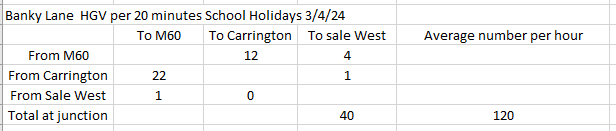
The following tables summarise the numbers of HGVs recorded during these surveys, some of which were travelling at excessive speeds.

HGVs at the Junction of Carrington Spur, Carrington Lane and Banky Lane

HGVs at the Junction of Carrington Lane, Flixton Road and Isherwood Road

We can see from these figures that the numbers of HGVs are consistent irrespective of the time of year.  Also, the numbers remain consistent whether it is peak time or not, as evidenced in previous traffic surveys.  Assuming a 10-hour working day (although residents will testify that these vehicles are running through the night), this is an average of 1500 HGVs a day.

You have to question why all of these vehicles pass residents, homes when there is already a road that bypasses Carrington Village?  Why hasn’t this road (the A1 service road) already been improved and made available to take HGVs off the A6144 through the Village and alleviate the long suffering of local communities?

During the course of doing these traffic surveys the only congestion I witnessed was along the Carrington Spur Road and that was as a result of an accident on the M60 at Eccles. 

Trafford Council’s website states

“The current route via the A6144 and Manchester Road is heavily congested by both cars and heavy goods vehicles (HGVs).  Affecting the lives and journey times of people living in the area. 

To provide easier and safer journeys, Carrington Relief Road will provide:

A new convenient route (Option F) to encourage HGVs to divert away from the congested A6144

Deliver improvements to make travelling by bus easier and safer

Provide new routes to enjoy when travelling by foot, bike and horse”

This statement is questionable.  Firstly, the route is only heavily congested when there are issues on the surrounding motorway networks.  Secondly, there is already an alternative route for HGVs that could be opened to divert HGV traffic away from the A6144.  Thirdly, we already have routes to enjoy when travelling on foot, by cycle or on horseback – these public rights of way could be improved at a significantly lower cost, bringing considerable health and wellbeing benefits (which will not be generated if residents are walking, cycling or horse riding next to a very busy major road).

The truth is this road is not being built improve the lives and journey times of people living in the area.  As Trafford Council’s own ‘Carrington Relief Road Environmental Impact Scoping Report’ states

“1.2. The key objective of the new Carrington Relief Road is to provide sufficient capacity within the transport network to deliver growth of housing and employment in the wider New Carrington masterplan area, and realise the socio-economic benefits of the future development. The redevelopment of this Site provides an opportunity to deliver a new link road for Trafford that will facilitate future phased development of c.5,000 new homes and 360,000sqm employment floorspace”.

So, Trafford Council admit that this relief road is not about improving the lives of existing communities but it’s to give the green light to build the biggest housing and industrial development in Greater Manchester.  Once again, the communities of Carrington, Partington, Sale West and Warburton have been failed. 

That Environmental Impact Scoping Report also recognises that through traffic will be induced into the area

Traffic flows are likely to increase due to the improved desirability of the route” (paragraph 14.46)

and, if the 5,000 new homes and 360,000sqm of warehousing are built, it will not be long before the new relief road is at capacity and nothing has been gained but so much will have been lost (a 335 hectare peat moss, Grade 2 agricultural land, woodlands, wetlands, biodiversity, endangered species).

Trafford Council has failed to deliver on their promises of good public transport in successive Local Plans. 

Instead of spending in excess of £76million on a short-sighted plan, other options should be seriously considered and pursued, such as opening the train line linking Partington with Irlam and Timperley.  Long term prosperity and equality needs a public transport network that provides connectivity, reliability and sustainability for everyone and this is Trafford Council’s opportunity ensure our communities get this, at long last!

FOCM Response to CRR EIASCO

The Friends of Carrington Moss have responded to the Environmental Scoping Report for the Carrington Relief Road. Take a look at the issues we identified in our letter below:

Dear Planning and Development Team

The Friends of Carrington Moss are responding to the EIASCO Scoping report for the Carrington Relief Road (CRR) as there are a number of inconsistencies, errors and concerns in relation to the document.  We set out the most important issues below and in the attachment.

The document confirms that (paragraph 1.2) the key objective of the road “is to provide sufficient capacity within the transport network to deliver growth of housing and employment in the wider New Carrington masterplan area, and realise the socio-economic benefits of the future development”.  Yet, it has been sold to existing residents as a means of addressing their transport and isolation issues – which it will not do for the following reasons:

  • It will significantly increase traffic in the area, as acknowledged within the report
  • It does not provide any relief from the huge and increasing number of HGVs that travel on local roads every single day (along with the consequential air, dust, noise, light, and vibration pollution)
  • It will not bring any benefits to Partington or Sale West residents and whilst it is “intended to take traffic away from the A6144 Carrington Lane and Manchester Road” (paragraph 16.63), the expected significant increase in traffic levels is likely to result in Carrington Village being surrounded by a highly congested road network.

We do not believe these issues will be adequately tested within the Environmental Assessment (based on the contents of this Scoping report).  In addition, whilst the document purports to bring public transport benefits, other than delivering an increasingly congested road surface, the provision of improved public transport services is outside the scope of the scheme (despite paragraph 16.3 suggesting that the “new relief road will provide significant upgrades to public transport”).  An alternative scheme to reopen the former railway lines would bring significantly more benefits to current and future local residents.  We do not agree with the demolition of the Burford Bridge as that will restrict opportunities for rail connectivity to Carrington businesses in the future.

One of the main inconsistencies is that the document repeatedly states that the CRR “will comprise 4.1km of single carriageway road”.  Yet, the report also suggests that part of the road will be dualled.  This will, of course, result in greater land take, higher costs and more congestion (especially for West-bound traffic).

We are concerned that dualling even part of the road will result in inappropriate speeds (drivers tend to exceed the limit, rather than drive more slowly than allowed) and we will object to the proposed 40mph speed limit on the Eastern extent of the road (paragraph 4.38, see also paragraph 14.46).  This will be dangerous for those crossing, especially with horses, dogs or young children and will also lead to more wildlife casualties.

Whilst the document confirms (eg paragraphs 4.138, 9.21) that the CRR route is in Flood Zone 1 (the lowest risk of flooding), we are concerned that the lack of local knowledge underestimates the level of water captured in the area (please see the videos and images on the Carrington Lake page on our website which shows extensive surface water flooding on the site of the road).  According to the document it is intended that all the Attenuation Ponds will discharge into the River Mersey.  We are rather alarmed that this will lead to the potential for the Mersey to breach its banks more frequently than it currently does today.  This will have an impact on local residents and users of the Mile Road in Flixton.

In addition, Natural England suggested (at the Places for Everyone Examination) that there are 335 hectares of restorable peat at Carrington and we do not believe the impact of the proposed hydrological changes on the peat has been fully covered by the EIASCO Scoping exercise.

We will review the comments of the statutory consultees in relation to the issues scoped in and scoped out once they become available and we may have further comments at that time but we would like to highlight that Operational Vibration (paragraph 13.12) should be scoped in, rather than scoped out because of the number and weight of the HGVs that will travel the full length of the CRR (which could have significant adverse effects for the proposed new homes at the Eastern end of the site and the existing businesses at the Western end).

Furthermore, paragraph 16.23 dismisses the impact of the scheme on businesses within Aston upon Mersey but does not consider the productivity implications of the increased traffic and the delays they will be facing both at the Carrington Spur junction and on the Spur itself.

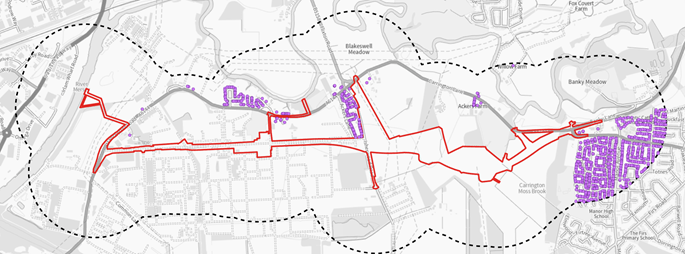
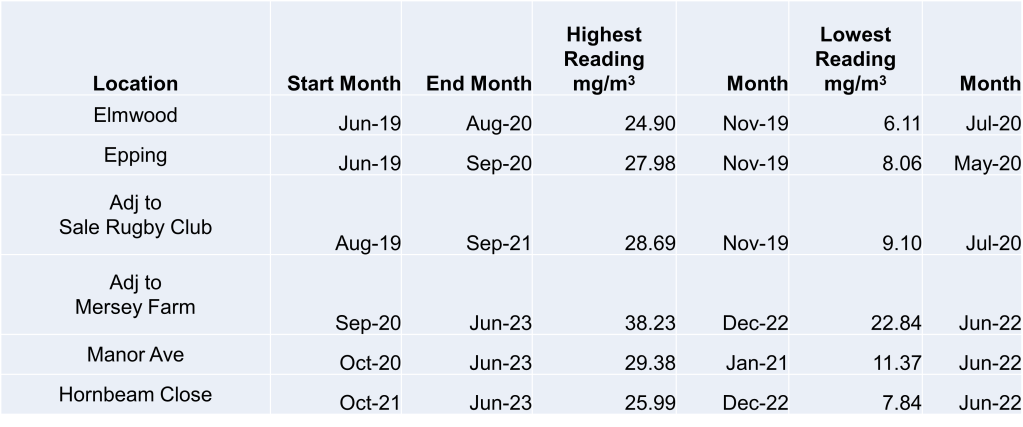
Whilst we appreciate that the document acknowledges (eg paragraphs 10.63 and 10.65) that the construction of the road will have significant effects, we do not believe all the impacts on human and wildlife health have been fully considered.  The Air Quality measures, for example, include locations way beyond the red line boundary (eg TR27, SAIN, TR25) and, as acknowledged in the report, refer to the Covid 19 period.  We are unclear whether the DEFRA modelling anticipates the level of development, especially the huge and increasing numbers of HGVs.  You may already be aware that Carrington Parish Council has installed an Air Quality Monitoring System on Manchester Road opposite the entrance to the business park.  The data from this system should be considered within the Environmental Assessment, along with relevant monitoring locations within the red line boundary.

The document confirms, in relation to Greenhouse Gas emissions, (paragraph 18.10) that “At the time of drafting this scoping report, only preliminary data and background research is available to inform the decisions”.  We would welcome further information as soon as it becomes available.

With all of the above and our attachment below in mind, we would appreciate the opportunity to discuss the road design and intended future actions in detail with the project team.

Kind regards

Marj Powner (Chair)

On behalf of the Friends of Carrington Moss

Summary of Issues and Concerns

Consultation

It is with great disappointment that we note that communities do not feature in this Environmental Scoping exercise in any way, shape or form, despite residents being the key stakeholder and the people with the most knowledge about the area within the red line boundary. 

Section 3 of the Scoping Report does not make it clear that there is a role for communities in the Environmental Scoping exercise (see paragraph 3.4).  This is a huge omission as the Scoping exercise should take into account inputs from (among others), the Parish Councils, the Friends of Carrington Moss, Trafford Wildlife, Peak and Northern Footpaths Society, and the British Horse Society.  We are the organisations with the in-depth knowledge of this site.  There should also be inputs from, for example, of the children with Special Educational Needs who regularly use the PROWs at the Eastern end of the site, between the Carrington Spur and Isherwood Road.

Paragraph 3.13 states that “Engagement with key stakeholders has been regularly undertaken over a number of years”.  This is incorrect.  Communities have only been involved in one very limited engagement exercise and, even then, our inputs were not included in the report to Committee (neither was the Natural England response). 

There is no mention of consultation in relation to the Environmental Scoping (ES) exercise in Sections 7, 8, 9 and 10

Section 11 (Biodiversity) suggests that future consultation for the ES will be carried out only with the GMEU.  Whilst their input is very valuable, the reserves on Carrington Moss are maintained by Trafford Wildlife and are also well known by Cheshire Wildlife Trust.

Section 12 (Socio Economic and Human Health) does mention “other interested parties” (paragraph 12.3) but it is not clear which organisations this refers to.

Sections 13, 14 and 15 suggest future ES consultation will only be carried out with statutory consultees.  Sections 16, 17 and 18 state that no consultation with statutory bodies has been carried out to date and does not mention involvement of communities.

Increasing Traffic Volumes

The document repeatedly highlights the impact of increasing traffic, with many references to the number of HGVs (see, for example, paragraphs 4.46, 4.47, 4.114, 7.5, 7.6, 10.72, 11.57 and 14.46), emphasising that design features will be needed to accommodate increased traffic volumes (including, for example, a signalised junction at the Lyondell Basell compound, along with a dedicated left-hand turning lane, and alterations to the Banky Lane junction to accommodate future traffic demands).  The report suggests that the CRR is planned to “limit the growth of road traffic” to single carriageway capacity (paragraph 7.5).  We do not believe the Environmental Assessment will test that premise (based on this scoping document), especially as that paragraph 11.57 suggests that traffic volume (and air pollution) increase is only a possibility, which is ludicrous given that the purpose of the road is to support extensive development.

The Friends of Carrington Moss has offered to share the outcome of our traffic counts with the project team to supplement the reliance on other outdated information (paragraph 7.14).  Our counts are up to date, taken by residents, in specific locations on the existing route, at various times (including during term time and school holidays).

Health and Wellbeing of existing residents and wildlife

Section 12 (Socio Economic and Human Health) appears to underestimate and minimise the potential impact of the scheme on existing residents.  We would like to see more emphasis on:

  • Alternative sustainable freight transport – rail and water
  • Alternative sustainable passenger transport – firm commitments to increase the bus services (these have been promised in the 2006 UDP and the 2012 Core Strategy)
  • The health implications of walking, cycling and horse riding next to over 3,000 HGVs a day and thousands of cars – rather than using the current safe, pleasant & healthy routes across Carrington Moss
  • The productivity benefits of green spaces and access to nature
  • The impact of the scheme on the health and populations of wildlife and birds (it seems the plan is to further reduce the already significantly depleted population of skylarks, for example, moving them elsewhere is not the answer)
  • The loss of recreational space and opportunities
  • Schools within the allocation area

There is a recognition that:

  • the prevalence of asthma and COPD in the Study Area is likely to be higher than could be anticipated at a national level” (paragraph 12.80)
  • the “Site LSOAs are within the 6-8th worst performing deciles nationally for air quality, and within the 8-9th worst-performing deciles nationally for sulphur dioxide (SO2) levels” (paragraph 12.95)
  • air pollution in Trafford generally (relating to fine particulate matter) is worse than regional or national levels” (paragraph 12.96)
  • There are significantly more people living with disability within the area surrounding the Site than Trafford generally, or nationally” (paragraph 12.111)
  • There is considered to be significantly higher prevalence of Asthma and COPD in the area surrounding the Site than could be anticipated at national level” (paragraph 12.113)
  • Air quality in the Study Area is considered to be poor, and the Site lies within the Trafford Air Quality Management Area” (paragraph 12.114)

Given the above, we would like more information about the proposed mitigation of the significant health impacts of the scheme.

Inaccuracies and Inconsistencies

It would also be helpful if the report was accurate.  Paragraph 16.6, for example, states that “the Site was traditionally dominated by a long-established Petrochemical works” and paragraph 12.90 states that the “area surrounding the Site is largely industrial in nature, dominated by the Carrington chemical works and power station, and business parks”.  That is incorrect.  These statements refer only to the Western part of the site, which is not contentious.  The Eastern part of the CRR will be constructed on Grade 2 agricultural land.  This part of the site is dominated by fields, woodland and extensive landscape views!  

Paragraph 4.3 suggests that the site “is located close to the SRN including the M60, M62, M6 and M56 Motorways” and paragraph 12.103 describes Stretford & Gorse Hill communities as being “close” to the Site.  What is the definition of close?

Paragraph 11.14 states that “Brookheys Covert is managed by the Cheshire Conservation Trust as a nature reserve”.  Cheshire Conservation Trust hasn’t existed for quite some time – it was a forerunner of Cheshire Wildlife Trust.  Brookheys Covert is owned by the National Trust and the community organisation Trafford Wildlife conducts conservation work on their behalf.

Paragraph 4.25 suggests that “Between the Redline Site Boundary and the A6144 Carrington Lane to the north of the CRR Route is Sale Sharks Rugby Club Training Ground“.  We believe this should say Sale Rugby FC Training Ground.

There is a lot of confusion about Wards, populations and communities, which is why it would be a good idea to involve resident groups in this exercise.  Paragraph 12.61, for example, states that “The Proposed Development is located within Trafford Local Authority Area which had a usual resident population of 10,291 people, according to Census 2021 data”.  Which area does this figure actually relate to?

Similarly, paragraph 16.16 states that “the overall proposal of new Carrington will provide approximately 5,000 new houses across a total area of approximately 179.7 hectares”.  This figure should be checked as the overall allocation area is 1,153 hectares (which will provide both housing and warehousing development), of which Green Belt is 169 hectares.

St Marys Ward is now called Manor Ward (paragraphs 12.24, 12.127).  In terms of Wards “immediately surrounding the Site”, if Davyhulme, Flixton and Urmston are considered to meet this criteria, then Broadheath and Bowdon Wards should also be included.  Paragraph 12.190 mentions Warburton Ward.  Warburton is a village, it is in Bowdon Ward.

Paragraph 12.24 also mentions that, for comparative purposes, Salford City Council and Manchester City Council will be used as a baseline.  On what basis are these Councils comparative to Trafford (they are both urban/City areas with very limited rural locations)?  A more appropriate Council to use would be Tameside (which has a similar land area and a similar population level). 

Paragraph 12.31 suggests that “the most important sectors, by total employment for Trafford is within the Professional, Scientific, and Technical Sectors, followed by business support services, and Retail”.  These are not the sectors being provided by the New Carrington development!  Further information is required about this analysis.

Similarly, paragraph 12.47 states that “there is capacity at Primary and Secondary schools across Trafford” and paragraph 12.51 states that “Trafford have firm plans to deliver 1,330 additional new primary school places on a permanent basis to cater for the additional needs, for the period 2023/24 to 2024/25”.  This is not consistent with our own research and again, we would welcome more information about this analysis.

Paragraph 12.54 does not mention dentists or access to hospitals, which will be key community facilities and paragraph 16.22 does not mention Manchester United or Sale Rugby FC as local businesses.

There is an ironic typo in paragraph 4.4 but of more concern is the inference that the Ship Canal is a beneficial transport corridor (to the Atlantic Gateway).  The alternative of making use of this sustainable transport option has been dismissed in favour of an unsustainable road solution.

Finally, we believe that this document needs a further review to ensure it is as up to date as it should be.  Paragraph 14.6, for example, states that the consultation on the Trafford Local Plan has recently closed.  We do not believe there has been a consultation on the new plan since 2021.  Paragraph 17.8 refers to the Environment Bill 2020, which became law in 2021.

« Older Entries