Author Archives: friendsofcarringtonmossgmailcom

What will be the true cost of the Carrington Relief Road?

Committee member, Lorraine Eagling, reviews the agenda item relating to the plan for the Carrington Relief Road, which was discussed at Trafford’s Scrutiny Committee on 13th March 2024.  A link to the recording (from 47:49 minutes) can be found here and the report is available here.

The new part of the relief road will be constructed across farmland, parallel to the A6144 between Isherwood Road and the Carrington Spur.  In the presentation to the Scrutiny Committee the new road was described as ‘not a big road’ (despite previous suggestions that it would be a dual carriageway).  The main carriageway that carries motor traffic will be 7.3 metres wide and there will be 5 metres on either side for active travel (2.5m for pedestrians and 2.5m for cyclists), so a total of 17.3 metres wide.  

This field, which grew potatoes last year, will be sacrificed for the road and for housing

It is really encouraging to see that pedestrians and cyclists are given so much consideration, but would residents want to walk, let alone cycle beside a major road that carries over 3,000 heavy goods vehicles a day, along with a huge number of cars? 

Would an active travel corridor that runs parallel to the existing road be a better option?  We think it would!

And what about horse riders, we have over 1,000 horses stabled on and around Carrington Moss!  We have repeatedly raised their needs with Trafford and yet they still don’t even get a mention in this presentation!  At least one of the stables provides services to children with special educational needs.  Those children will not be able to ride near to the thousands of motor vehicles that will be travelling along the Carrington Relief Road every day, the noise alone will be an issue.  They currently have lots of options for circular routes along the very safe and very quiet public rights of way, short circuits or longer rides.  The road is going to fracture their routes and reduce the opportunities for these very vulnerable members of our community.

The Scrutiny Committee were given a presentation on the history of New Carrington, which showed that since the closure of the railway line in the 1980’s, Partington and Carrington have become increasingly isolated and car dependant.  Several Councillors raised the question of why sustainable options aren’t being re-introduced like re-opening the old railway bridge to allow for a light rail or full rail link between Irlam and Timperley.  Councillor Holden explained that this idea has been around for some considerable time because a bridge was built in Broadheath so that this train line would remain viable.  We know that former MP, Kate Green, with the backing of the residents of Partington and Carrington, lobbied Parliament about re-opening the line, so it is not new to Government. 

Now that HS2 has been scrapped, shouldn’t this be something the GMCA and Trafford Council actively pursues? Especially when New Carrington is the largest development in the Greater Manchester Spatial Framework (frustratingly, New Carrington is described by executive members as ‘one of the largest brownfield sites in Greater Manchester’, which is highly misleading given the majority of the brownfield land already has planning approval and 169 hectares of greenbelt will be released for the development of housing, warehousing and roads, affecting a 335 hectare peatmoss, Grade 2 agricultural land, woodland and wetland habitats).

Interestingly, Stockport Council, which pulled out of GMCA’s Places for Everyone (PfE) Plan in order to protect its greenbelt, is now in talks with TfGM and GMCA to have the Metrolink extended to their new transport interchange

So, as the largest site in the PfE Plan, why isn’t New Carrington being prioritised for such sustainable transport investment, especially when it is described as the ‘Western Gateway’?

In a recent traffic survey, carried out by Friends of Carrington Moss, during peak times we recorded approximately 50% of the traffic coming from the M60 going towards Carrington and less than 50% of the traffic from Carrington headed towards the M60.  In fact, approximately 50% of the traffic coming from the M60 is headed towards Sale West and over 60% of the traffic from Carrington and Partington headed towards Flixton.  Full details of our survey can be found in my previous blog here.

During term time, peak time traffic increased by approximately 500% and there was significant traffic queuing from the M60 to Sale West and from Sale West to the M60.  There was no queuing traffic in other directions or at other junctions.

In essence, only half of the traffic surveyed used the existing A6144, which the new road aims to relieve!  It is evident that the main cause of congestion is school traffic which could be reduced by reviewing Trafford’s school admissions policy and providing school buses.  Shouldn’t the Council tackle this issue instead of spending £76.5 million on a road that only 50% of existing traffic will use and that will offer no relief to the residents of Partington and Sale West as explained in my previous blog?

At the Scrutiny meeting, Councillors also raised the issue of how the Council will raise in excess of £54 million of public money for the relief road.  The Council’s Director of Growth & Regulatory Services, Adrian Fisher, acknowledged the risks and explained that when the planning committee addressed all of the infrastructure needs of New Carrington, which includes all roads, schools, playing fields etc, they decided that in theory there is enough funding from developers to meet needs.  He explained that the main issue is with the sequencing of the funding, that where the main risks arise is getting the first bit of infrastructure up and running.

Sequencing is definitely an issue, as it’s the chicken or the egg scenario.  Developers’ contributions are based on all development completed, but they won’t develop all sites unless the relief road is built!  Mr Fisher describes the site as the biggest in Greater Manchester and it will not able to deliver houses unless the road is built!

So, at what point will the developers make their contribution?  Trafford have recently had their fingers burnt when it comes to developers Section 106 contribution.  Also, as mentioned in the meeting, the developer contributions are not only for this road, but for other roads that will be needed for this huge site, for schools and other community facilities.  Will the developer contributions be enough for all this infrastructure?  The answer is a definite NO!

Councillor Carter asked how the new road would impact the peat land to the south of the proposed carriageway, in particular relating to drainage.  Mr Fisher acknowledged that there is significant peat in the south part of the site and that this will be an issue when it comes to development in that area and will be an important consideration.

We know how important peat moss is, so much so that the Government is investing in peat restoration to fight climate change.  With this in mind, why would Trafford Council give planning permission to build on this precious habitat?  The answer is that they are wedded to building a road, rather than advancing more sustainable options and, if they don’t give planning permission, they will not get the developers’ contributions towards the costs of the road.

Councillor Holden raised the issue of extensive contamination, and now there is the recent discovery of PFAS (Per-and polyfluoroalkyl substances) on the site.  Mr Fisher acknowledged that this will be addressed when building the new road and this is why the costs of the road has increased significantly.  He explained that a separate drainage system is needed to avoid contamination of groundwater as a result of run off from the road.  It was confirmed that the Council will be working with the land owner/developer and the Environment Agency to come up with a solution that avoids flushing out contaminants into local watercourses and environment.  We know that this area is particularly sensitive for the water environment given its location above a principal aquifer and nearby surface waters including the River Mersey and Sinderland Brook, so it is vital any contamination risks are appropriately remediated.

So, what will the true cost of the Carrington Relief Road be? Not just in financial terms but in relation to the ecology and biodiversity of the area, in relation to the health and wellbeing of residents and in relation to climate mitigation issues that will impact future generations, our children and our grandchildren? 

New Carrington Transport Strategy

Lorraine Eagling looks at what the Strategy means to residents given today’s traffic volumes!

It’s without question that a transport strategy is desperately needed by the residents of Carrington, Partington, Sale West, Warburton and Ashton on Mersey even before the plans for New Carrington get underway, so it was encouraging when Trafford Council published The New Carrington Transport Strategy but very disappointing that no residents had been involved in its development.   

The residents of these isolated and poorly served towns have long been promised and waited for a plan that provides the transport solutions they deserve, that are sustainable and will provide long term options for existing residents and for future generations.

The Strategy describes all the sustainable options (scenario 3) that would provide residents with regular and reliable connectivity to the rest of Manchester.  Solutions that would provide the residents with access to trains and trams and reduce traffic on local roads.   The Strategy goes on to explain, however, that these long-awaited public transport services are not an option because they are too expensive to implement and the only affordable option is a relief road, now expected to cost a minimum of £76.5m (and that is before any resident requirements such as additional junctions, crossings and traffic calming measures, for example are included in the design). Reminiscent of Bullseye’s infamous phrase ‘look at what you could have won!’, residents have once again been let down. 

The proposed relief road will run along the existing A1 Road, which starts opposite the Saica paper factory, to Isherwood Road.  From here a new road will be constructed adjacent to the peat moss and across the farmland to meet the Carrington Spur Road at the junction with Carrington Lane in Sale West.  The new section of the road will have massive implications to the environment. More details about the impact of the CRR can be found at this link, where you can look at our many previous blogs about the Carrington Relief Road by scrolling down the web page.

It’s a very disappointing outcome and it is questionable when the following is taken into consideration:

  • There is no mention of HGV traffic anywhere in the report.  As we know, the huge number of HGVs is the main concern for residents in Carrington Village and beyond.
  • The traffic data used in the report is taken from TfGM 2017 base year, which is outdated and pre-covid.  Considering the implications of this Strategy, the data should be current.  It is not clear whether any actual traffic monitoring has been done at key locations in order to access what road interventions would have the greatest benefit.
  • In addition to the outdated TfGM data, the Strategy interpreted daily travel modes from evidence of what it describes as ‘comparable brownfield’ development sites in South Gloucestershire, including areas of Stoke Gifford, Bradley Stoke, Patchway and Filton, on the northern edge of Bristol.  These sites have their own train stations and are home to industries such as aerospace and hi-tech engineering.  This is hardly comparable to New Carrington, Partington, Warburton and Sale West, where there are no train stations and the main industry is HGV intensive warehousing and logistics.   Also, New Carrington is not just brownfield, it is green belt, comprising peatmoss, woodlands, wetlands and grade 2 agricultural land.

What about the traffic data?

We have been collecting our own traffic data at key junctions in Carrington and Sale West for several years, but to verify the figures in the report, we collected some specific data in February and March 2024.   The results of our survey are as follows:

Cars and Vans

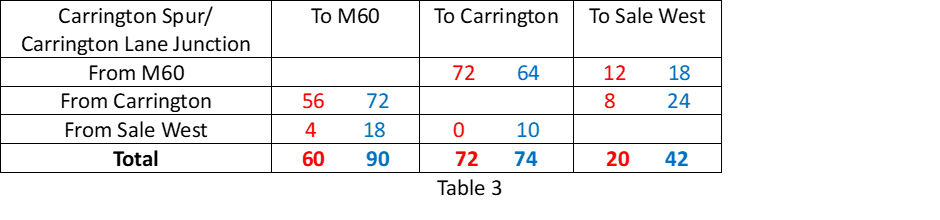
Table 1 shows the average number of cars per hour, during peak times, at the junction of the Carrington Spur and Carrington Lane in Sale West.  The red data was recorded during school term time and the blue data was recorded during school holidays.

As expected, the number of cars increases around this junction during term time.  The data shows during term time there are almost four times as many cars travelling from the M60 to Sale West.  Also, the number of cars travelling from Carrington to Sale West is more than double during term time and the number of cars travelling from Sale West to Carrington is more than tripled.    

On average, a total of 2,728 cars pass through this junction during peak times.   During term time, 48% of the car traffic from the M60 is heading towards Sale West and 43% of the traffic heading towards the M60 is from Sale West.  Additionally, 39% of the traffic from Carrington is heading towards Sale West and 47% of the traffic from Sale West is heading towards Carrington.

Other observations at this junction are:

  • Traffic queuing along the Carrington Spur Road from the M60.
  • Traffic queuing along Carrington Lane towards the M60.
  • Other routes were flowing freely.
  • 2 buses maximum during the survey period.

Table 2 shows the average number of cars per hour during peak times at the junction of the A6144, Flixton Road and Isherwood Road in Carrington.  The red data was recorded during school term time and the blue data was recorded during school holidays.

As expected, car traffic increases during term time, with the exception of those vehicles headed towards Isherwood Road.  During term time the car traffic from Carrington to Flixton increases by almost five times.  62% of the car traffic from Carrington is headed towards Flixton.  It is also interesting to see that 36% of the traffic headed towards the M60 is from Flixton.

Other observations at this junction are:

  • All traffic was flowing and there was no queuing at any junction.
  • Some traffic was travelling at excessive speeds, including HGVs.
  • 3 buses maximum during the survey period.

According to the data in the Transport Strategy, 875 cars travel from Partington and Carrington to Urmston (the report does not mention Flixton) on a daily basis.  We recorded 678 in one hour during one peak time and 282 and hour during non-peak time.  It suggests that the data in the report is an underestimation for traffic moving in this direction.

The data in the transport strategy is not as specific as the data we collected but assuming the traffic from Carrington and Partington heading to ‘Sale West’ and ‘10km inside GM’ is the traffic headed towards M60, then their data suggests there are 10,587 cars per day travelling along the A6144 between Isherwood Road and the Carrington Spur Road.  Our data shows 663 cars during peak time and 502 cars during non-peak time per hour.  Assuming two peak times and 10 hours of non-peak traffic, that is a total of 6,346 cars travelling along this route.  This time, the data in the report seems an over-estimation for cars travelling along this section of the A6144. 

We will repeat our traffic count in the coming months, to test the validity of this result.

HGV Traffic

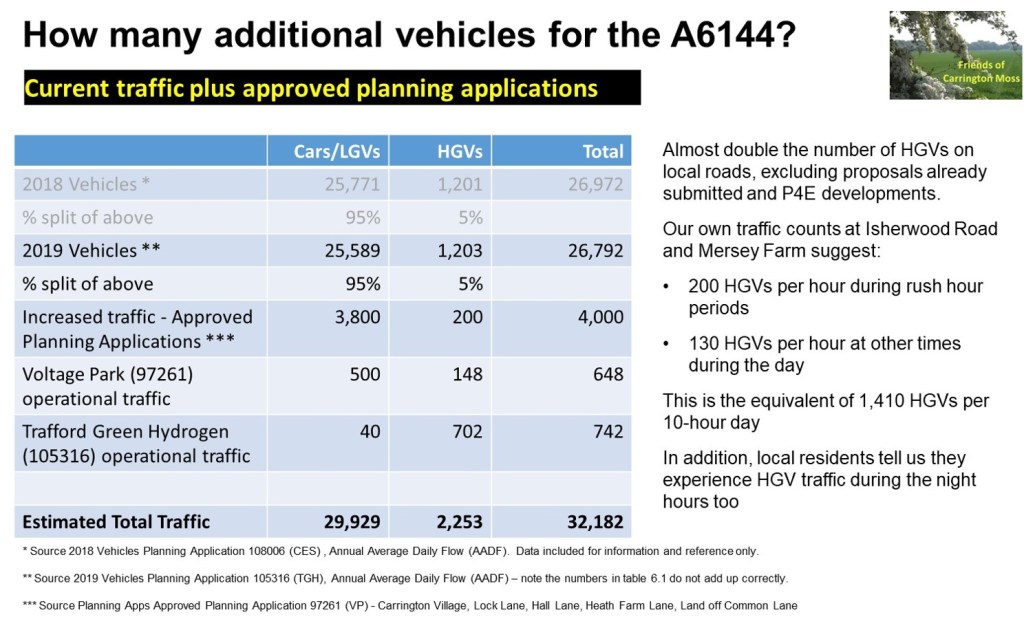
The data shows that during peak times there are approximately 152 heavy goods vehicles at the Carrington Spur junction and 213 at the Isherwood Road junction per hour.   At non-peak times, there are 208 and 206 respectively.  This suggests that HGV traffic is consistent irrespective of peak or non-peak times and is in excess of 2,000 per day. This figure will increase significantly as the proposed new warehousing is built.

Conclusions

Our data shows that:

  • The A6144 Carrington Lane in Sale West has as much car traffic as the A6144 in the direction of Carrington, as 48% of the traffic from the M60 turns towards Sale West during peak times.
  • The A6144 between Isherwood Road and the Carrington Spur has less car traffic than that suggested in the report.
  • There was no queuing traffic at the junction of the A6144 and Flixton Road during peak time. There was, however, significant queuing on the Carrington Spur and on Carrington Lane.
  • There is a massive increase in car traffic during term time indicating that there is insufficient public transport for students to get to school and a large proportion of students are travelling to schools from either outside the catchment area or from outside the borough.

Considering the findings of this data, how will the relief road reduce the traffic issues highlighted?

The biggest issue for the residents of Carrington Village has always been the large number of heavy goods vehicles that pass their front door every day.  The existing A1 Road could be opened immediately to redirect HGVs away from the village.  This would be a quick win (if the businesses in Carrington are willing to use that road).

Partington is experiencing housing development on a huge scale.  The new developments on Lock Lane, Hall Lane, Oak Road, Heath Farm Lane and the Greyhound will create another 1,291 dwellings.  Despite these developments increasing the number of houses in Partington by 38%, the routes in and out of Partington will remain the same.  Only after the cars and buses have contended with the congestion in Partington itself, can they access the proposed relief road further along the A6144.

For residents in Sale West and Ashton on Mersey to benefit from the proposed relief road to Carrington, they will have to access it from Carrington Lane which is already heavily congested even before the new relief road joins this junction. 

In essence, residents in Carrington Village will only benefit if HGV traffic moves onto the existing A1 Road.  Residents in Partington, Sale West and Ashton on Mersey will have to queue in traffic in their towns before they can access the relief road.  The new relief road, which will cost at least £76 million offers no relief to these residents who will see the population in their area increase significantly as a result of the Places for Everyone Plan.  There will be an additional 2,260 houses in Partington and Warburton, 1,443 in Sale West (in addition to the 263 already with planning permission) and 603 in Carrington Village. 

So how can this Transport Strategy justify such significant expenditure on a road that offers no solution to traffic issues that already exist? 

There are other considerations here too: 

  • Why hasn’t the A1 Road already been opened to HGV traffic to resolve the issues in Carrington Village? 
  • Why are so many students being driven to school? 
  • Do the school admissions policies in Trafford need reforming?
  • Does the Education authority or TfGM need to look at providing school buses? 

The data shows that it is school traffic and heavy goods vehicles that create the congestion along the A6144.   These are the issues that need addressing rather than spending £76 million on a scheme that will not solve the transport issues that have plagued this area for decades.  This money could contribute towards the ‘scenario 3’ solution in the Transport Strategy and should be invested in long term, sustainable passenger and freight transport interventions. 

There are several options that could be considered, such as:

  • opening the railway bridge between Irlam and Partington to give residents access to trains
  • opening up the ‘greenway’ and the former railway line from Partington to Altrincham to give residents access to trams
  • revisiting the 2012 Local Plan option to build a bridge from Carrington to Port Salford. 

These are long term sustainable options that will reduce congestion and open up Greater Manchester and the rest of the UK to residents of these local areas.

What we need is a Transport Strategy that meets residents’ requirements, why isn’t Trafford talking to us about it?

Does the New Carrington Outline Transport Strategy address resident priorities?

We had hoped the collaborative way the New Carrington Masterplan is being managed would prevail for other aspects of development in the area, but sadly, no!  Once again, we have a “strategy” that has been agreed by Trafford’s Executive without any input from the residents who will be severely impacted by its implementation (not only by what is in the “strategy” but also by what is not)!

At a recent Trafford Executive Committee meeting (29th January 2024), the report about Infrastructure and Development in New Carrington was introduced (we note there is a typo in the report date but it was presented in 2024, not 2023).  As part of this report the New Carrington Outline Transport Strategy was presented to the Executive.

On the positive side, the Council has begun an open and transparent process for developing the Masterplan for New Carrington (the details are on their website here).  This is good news, because, it is clear that residents have a lot to bring to the table in relation to what is needed in the area.

The Executive report itself is actually a marked improvement on previous documents created by Trafford about the Carrington Relief Road.  It does acknowledge some of the issues that have arisen (and continue to be identified).  In view of Trafford’s declaration of a climate emergency back in 2018 and its carbon neutral goals, set out in 2020, the accompanying Transport Strategy document, however, remains unambitious and has several major omissions.

Interestingly, that “strategy” document was produced in September 2023 but has been kept under wraps until after the Places for Everyone (P4E) Modifications Consultation was completed, which is rather disingenuous of Trafford’s politicians and officers, given that its contents signal concerns about whether the huge list of “Necessary Transport Interventions” set out at Appendix D (page 708) of the P4E Plan can, or will, be delivered. 

Resident Priorities?

Whilst the production of this “strategy” is to be welcomed, there has been no involvement of the community in determining the Vision, or the aspirations, and there is nothing in the document that suggests that communities will be engaged as the “strategy” evolves in the future!  It is, therefore, not a surprise that it merely continues to promote car/HGV-dependency, leaving a legacy of huge levels of air, noise, light, vibration and water pollution (to say nothing of the carbon emissions), that will result in poorer health outcomes for residents and higher costs to the public purse.  There is a reference to a specific consultation about one initiative, the Carrington Relief Road, but that was supposed to commence in January 2024, so is already behind schedule.

HGV traffic on the A6144 is, by far, the biggest concern for residents, yet there are no figures in this document which identify the size of the issue (either now or in the future), nor does it explain how Trafford proposes to address this problem.  The “strategy” confirms that the new road will be the panacea for freight transport!  Yet, we know that businesses are not in favour of restricting HGV use on the A6144, as was confirmed in a response to a planning application.  There is no indication about how the proposed route changes will be agreed with businesses and implemented so that travel through Carrington Village can be limited to local resident movements.

So, what we have now is a “strategy” which:

  • does not address any of the issues related to the huge number of HGVs that are travelling on local roads, there are no references to sustainable freight transport solutions and no aspirations to even consider them – is this really a strategic document?
  • does not estimate the anticipated induced traffic that will arise from the construction of the proposed new roads (causing more congestion, much higher levels of pollution and increased travel incidents), particularly for Partington, nor does it reveal the ultimate aim, set out in the GM Transport Strategy 2040, to create a link between the M60 and the M62 via Carrington (page 124/125), which will undoubtedly induce immense volumes of motor vehicle traffic through the area
  • does not even mention the importance of local travel routes to horse riders (there are more 1,000 horses stabled in and around the area – source British Horse Society) – this is a huge gap as horse riders need specific surfaces (to reduce the potential for the animals to slip in wet weather, for example, and specific crossing points) – it would be inappropriate to consider active travel routes here without including their considerations.

The background facts are rather selective, there is no reference, for example, noting that Partington has a much lower rate of car ownership (27.2% of households with no cars or vans according to Census 2021) compared to the rest of Trafford (19.3%).  Neither is there any mention of the likely changes arising from the increased charges on the Warburton Toll Bridge.  There are no figures highlighting the difference in traffic volumes during school term times and school holidays (there is a marked variation in numbers which we have observed in our traffic counts that could be addressed through increased school bus services, cycling buses and other initiatives).

Because the proposed new road will be constructed adjacent to and beyond Carrington, it is more likely to induce additional traffic into Partington than to relieve traffic for residents there.  Other initiatives are needed to improve transport options for Partington residents, such as community transport and the reopening of the former railway line between Timperley and Irlam.  This latter scheme would be highly beneficial to the people of Partington and would enable sustainable passenger and freight transport to be fully examined.  Given the lack of consideration for this option from Trafford, Partington Parish Council has begun to explore opportunities to raise the funding needed for a feasibility study for the initiative.

What about the funding?

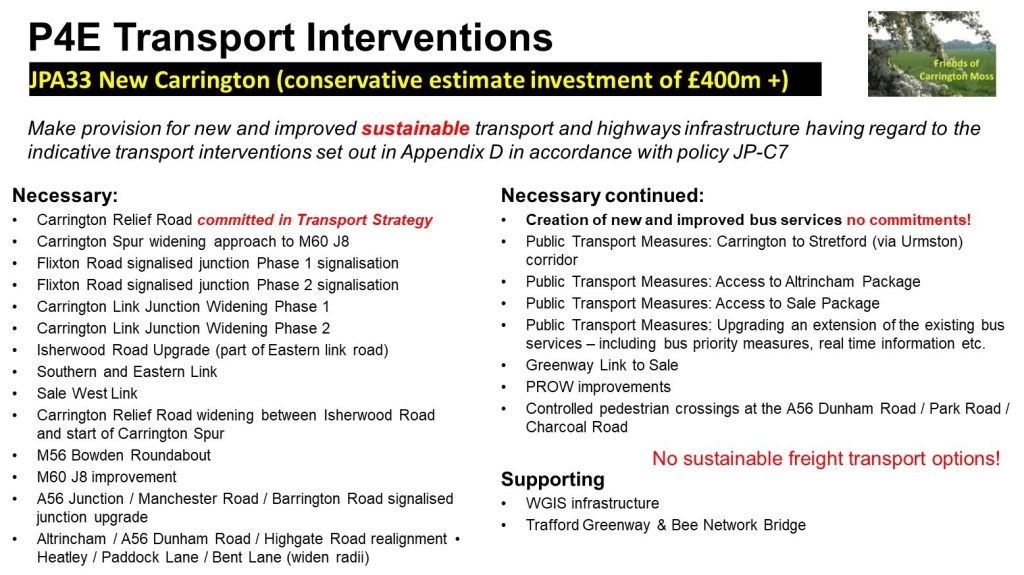
There is very little information in the document about the costs/funding of the overall “strategy”.  There are only figures related to the Carrington Relief Road (£76.5m) and the overall Greater Manchester Transport Strategy 2040 (£1.1b).  Our own very conservative estimate puts the overall cost of the “Necessary Transport Interventions” for the New Carrington development to be over £400m, see Appendix D (page 708) and listed in the graphic above. 

That GM Transport Strategy 2040 aims to reduce car use to no more than 50% of daily trips by 2040 and reduce demand on road space from freight, moving freight traffic onto rail and water-based transport by the same date. The associated Transport Delivery Plan states that “The Right-Mix aim is for 50% of trips to be made by sustainable modes across GM.  This will require zero net growth in motor vehicle traffic between 2017 and 2040, and non-car mode share to increase from 39% of all trips in 2017 to 50% of trips in 2040”.

With the strategic aim to significantly reduce motor vehicle traffic by 2040 (just 16 years away) in mind, along with the requirement for zero net growth in motor vehicle traffic, there is surely no business case for public money to be invested in a new road, that will impact the borough’s and the region’s carbon neutral ambitions, and generate huge levels of air, noise, light, vibration and water pollution.

Given the very marginal viability of the allocation, especially taking into consideration the contamination issues raised at the Executive Committee meeting, we believe that the public purse will be required to pick up the vast majority of these funding requirements and/or local residents will be forced to accept a huge development without the benefit of the Necessary Transport Interventions to make it, not only sustainable, but also tolerable. 

The Committee Report particularly highlights (paragraph 5.9) the long-elapsed time of the funding period for the Carrington Relief Road (a 9-year funding programme).  Consideration should be given to alternative options that may reduce the cost impact for the public purse and make sustainable transport solutions a reality.  This could include upgrading the existing routes (A6144 and the A1 currently private road in Carrington), along with significant enhancements to the public rights of way across Carrington Moss, making them suitable for extensive active travel, horse riding and, possibly, bus services only.  This would be a much more attractive option for encouraging modal shift as walking and cycling next to huge numbers of HGVs and other motor vehicle traffic is unpleasant, unhealthy and unsafe.

At the Executive Committee meeting a number of insightful questions were raised by Councillors, including Councillor Welton, who asked why there is no analysis of the costs of not achieving Scenario 3 (which is the most sustainable option).  As Councillor Welton highlighted, not achieving that scenario will lead to higher costs in terms of carbon emissions, poorer public health outcomes, increased traffic incidents and congestion and higher costs of road maintenance. 

More Missing information – Carbon Emissions!

The Transport Strategy does not include any information about the carbon implications.  There are no calculations that estimate what impact the different scenarios could have on Trafford’s carbon neutral ambitions. 

Interestingly, the “strategy” references the Greater Cambridge Local Plan to support its assertions in relation to compable sites.  In the P4E assessment work we have done with partner organisations, including Steady State Manchester (who produced an excellent document which calculates the carbon emissions resulting from P4E), our responses to the Planning Inspectors included reference to the Greater Cambridge Local Plan.  Their plan, unlike P4E, incorporated a Strategic Environmental Assessment that calculated the projected carbon emissions for each spatial option being considered (and they were comparable to the spatial options set out in P4E).  Cambridge discovered that coupling residential development and public transport leads to approximately 20% lower carbon emissions than a strategy that promotes car-dependent development in the Green Belt!

Given Trafford’s climate emergency declaration and carbon neutral ambitions, the document should be very clear how such a large development, and the associated road infrastructure, will impact both Trafford’s and the region’s carbon neutral goals.  The lack of sustainable freight transport options is a key consideration here because the carbon implications of the huge numbers of HGVs will be significant.

Comparing New Carrington with similar areas?

The “comparable” areas mentioned in the document are not actually analogous with New Carrington.  The benchmark sites (such as Filton, which has the UK’s largest Aerospace Area – BAE Systems, Rolls Royce, Airbus to name a few) are home to a Global Technology Centre and companies such as Filton Systems, Hewlett Packard and Viridor.  These industries are not like those businesses that are currently operating in (or are proposed for) New Carrington, which are predominantly warehousing/logistics units that generate extremely high numbers of HGV journeys.

Additionally, Filton and the surrounding areas of Stoke Gifford, and Patchway each have their own train station, whereas Carrington, Partington, Sale West and Warburton have no train stations and non are proposed in this “strategy”.  Another “comparable” site, Waterbeach, is a new development but, unlike New Carrington, it is getting its own train station.  There are no large warehousing sites proposed for that location.  It will have flexible workspaces and hubs (more cottage industry makers and creators) and, therefore, limited HGV traffic!  It is a real challenge to understand how these sites can be considered to be “comparable” to the New Carrington location!

The Executive Report states (paragraph 9.1) that “New Carrington will be the main growth point in Trafford for the next decade or more” but the New Carrington allocation is not even comparable to Trafford’s other major warehousing location – Trafford Park does have sustainable freight transport solutions!

What about the deep peat deposits on Carrington Moss?

At the P4E Examination in Public, Natural England’s contributions included the following:

  • Natural England (NE) wrote to the planning inspectors in June 2023 (OD42), stating that there is extensive and restorable deep peat within allocation JPA33 (New Carrington), that the deep peat should be considered to be an irreplaceable habitat, and that “the combination of the location and the extent of development proposed by the allocation policy means the proposed development is incompatible with avoiding the deterioration of this irreplaceable habitat
  • NE’s view, set out in OD23, is that the development will not only prevent future restoration but “will cause irreversible damage to the body of peat directly under the developed land and the wider peat mass, which depends on the continuity of the flow of water”.  They go on to recognise that the degradation of the peat mass will also result in significant greenhouse gas emissions
  • NE confirmed (in OD42) that their position is in line with the England Peat Action Plan, that there should be no development on (restorable) deep peat, and that peat should be kept wet and in the ground.  NE drew attention to their “extensive experience of peatland restoration projects” which provides considerable credibility to their professional judgement in this matter.

So, for Trafford to conclude in the report (paragraph 7.7) that “peat is not considered to be a significant constraint on future infrastructure provision” demonstrates a huge lack of understanding of the impact of hydrology on the main body of peat, which Natural England estimates to be around 335 hectares.  This is not a surprise, as it is recognised that Natural England are the experts, not Trafford, and their advice should be followed.

Even More Omissions from the “Strategy”!

Whilst the 29th January Executive Committee report mentions that the 2006 Unitary Development Plan (UDP) included a safeguarded route for the road and that the 2012 Core Strategy significantly underestimated the cost of such a route, it does not explain why the land that was safeguarded for the Manchester Ship Canal bridge is not included in the Transport Strategy.  This was also a Proposal E15 requirement in the 2006 UDP and one of the Implementation Projects listed in the 2012 Core Strategy (p80).  This initiative would reduce the number of HGVs (and other vehicles) on local roads significantly.  It is clear that the majority of the actions set out in previous local plans have not been delivered in this area and the potential benefits of the most sustainable solutions, particularly for freight, (such as bringing the former railway line back into use and/or transporting goods via the Manchester Ship Canal) have been totally ignored by Trafford for almost two decades.

The Carrington Relief Road appears to be going through a name change to the A1 Link Road.  The recognition that this road will not “relieve” anyone is welcome but we do wonder where the road will link from and to!  The government’s announcement about the funding to be made available as a result of cancelling HS2:states that “more than £500 million in funding will be provided for 2 major road schemes around Manchester. These include a new link road between the M62 and the M60Whilst this initiative is set out in the Greater Manchester 2040 Transport Delivery Plan, and we assume the A1 link road is ultimately being proposed to provide the first stage of this scheme, the “strategy” makes no mention of this longer-term proposal.

More information:

There are many tables full of confusing information throughout the document.  The calculations about the number of trips do not include the current traffic numbers, the HGV movements and there is no estimate about the expected level of induced traffic.  So, effectively, there is no assessment of the expected overall traffic levels on the new road. 

The “strategy” states (page 18) that “Employment provision in the area should offer a wide range of employment types” and (page 15) that currently 6% of car journeys and 7% of public transport journeys are internal (within Carrington and Partington).  This suggests few residents currently work in the Carrington area, an assertion borne out by our own research.  The current and proposed employment development does not offer a diverse range of job opportunities (despite the assumption on page 38).  It is predominantly warehousing which requires a small, low paid workforce.  There should be more evidence to show how the target of 17% of internal journeys can be achieved.

The current conditions (set out on page 14) focus on Carrington and Partington, without referencing the issues related to Sale West or Warburton, which will be impacted significantly by this “strategy” and, as mentioned above, totally omits any reference to the huge number of HGV movements in the area.

What next?

We have requested a meeting with Trafford to discuss the contents of the “strategy” further and will provide an update to residents as soon as we are clearer about the implications.

Trafford has a website page dedicated to the Carrington Relief Road, you can access it here.

You can find our previous blogs about the Carrington Relief Road by scrolling down at this link.

Is the New Carrington Allocation Aligned with Trafford’s Corporate Plan Priorities?

At a recent Trafford Executive Committee meeting (11th December 2023), the leader of the Council introduced their report about performance against the Council’s Corporate Plan, 2023/24.

On the positive side, the Council has a wide range of responsibilities and there are areas for which Officers and Elected Members should be congratulated but ………..

the report highlights (paragraph 1.6) that

The priorities for 2021-2024 are described as ‘better health, better jobs, greener future’ as outlined below:

Reducing Health Inequalities
Working with people, communities and partners, particularly in deprived areas, to improve the physical and mental health of our residents.

Supporting people out of poverty
Tackling the root causes to prevent people from falling into poverty and raising people out of it.

Addressing our Climate Crisis
Leading the way in our region’s response, reducing our carbon footprint and tackling the impact of climate change”.

Reducing Health Inequalities:

Carrington Moss currently provides deprived communities with a huge area of free to access green space, which will no longer be available due to the proposed development of 5,000 homes, 350,000 m2 warehousing and the plans for 4 major new roads. The moss currently has:

  • almost no traffic, so no air, noise, light, vibration or water pollution – fresh air to breathe (for both humans and wildlife), a peaceful environment for those with anxieties or other wellbeing issues, an area where you can hear and see red listed birds and other endangered wildlife, encouraging outdoor activities and hobbies that improve the health of local people
  • local residents participate in a number of sporting and recreational activities on Carrington Moss, including those professional athletes and children attending the Manchester United or Sale Rugby training grounds, the horse riders who use many of the circular routes (there are over 1,000 horses stabled on or around the moss) and the walkers, cyclists, bird watchers, nature spotters, photographers, artists ….  the list goes on!

Supporting people out of poverty:

  • in the plans for the area, there is only one transport option being funded and prioritised – and that is a new road!  So, those in transport poverty (and there are many in the local area who cannot afford to run a car) will have no benefits from this allocation (Trafford itself describes the area as currently having poor public transport provision)
  • furthermore, the only job opportunities being provided by the allocation are warehousing, which is very limiting in terms of both career choices and wages
  • and those currently working in the rural economy in the area (and their supply chains) will have their job or volunteer opportunities decimated or eliminated entirely!

Addressing the Climate Crisis:

  • the current habitats on Carrington Moss are essential to support the mitigation of climate change and the achievement of Trafford (and the region’s) carbon neutral ambition
  • these habitats include the 335 hectares of peat moss itself (which can be restored to capture and store huge volumes of carbon), Grade 2 agricultural land (which is perfect for growing crops to support the food security of current and future generations), large areas of woodland (which again are a great carbon store and provide shelter and food for the red listed birds and endangered wildlife) and wetlands (which capture and store huge volumes of surface water, that will have to be directed elsewhere when the area is concreted over
  • there are also a number of sites of biological importance and sites of special scientific interest on and around Carrington Moss, these are extremely important for conservation and nature’s recovery.

In addition to all of these benefits, Carrington Moss also has fantastic historical value.  Obviously, the peat has been forming for thousands of years, horses have been ridden over the moss since medieval times, the Victorians used it for dumping night soil and waste (the remnants of the train tracks remain) and, in the Second World War, it was used as a decoy bombing site to save the centre of Manchester.  As typical flat peatland terrain, it also boasts expansive views (you can see the hills over 20 miles away on a clear day).  Imagine the future, with those views changed to HGVs thundering down the planned new road and 22m warehouses blotting out everything else in the landscape!

Paragraph 1.9 of the Council’s report confirms that a “new Corporate Plan is expected for July 2024”.  Given the Places for Everyone Plan significantly reduces the protections brought in by the 2012 Core Strategy, ignores the advice of Natural England and unnecessarily decimates the largest natural capital asset in Trafford, can we expect a similar weakening of Trafford’s future corporate plan priorities? 

PS The Greater Manchester Combined Authority has published the responses to the Places For Everyone modifications consultation, our friends at Steady State Manchester have included the link in their short blog, available here.

PPS The Friends of Carrington Moss are working with other Greater Manchester groups to determine the next steps in our campaign to prioritise brownfield development across the region (and let’s face it, there is a lot of brownfield land that could be used, and GM has received significant public funding to regenerate it)!  We’ll keep you updated as more information becomes available.

Carrington Moss – once again supports local residents

The ditches are full and Carrington Lake has reappeared, the water is extensive and deep, so take care when you are out and about, especially if visibility is poor.

With flood warnings relating to Storm Henk being issued today, it is useful to remind local residents of the many ecosystem services delivered by Carrington Moss (also known as the Moors to some local people) and the extensive natural capital benefits the area provides.

Trafford’s Natural Capital Account states that “a natural capital approach is about everyone understanding the benefits – ensuring the protection and enhancement of natural assets are fully considered in decision making”.  So, the Places for Everyone (P4E) plan should have taken full account of the natural capital value of peat, for example, incorporating all the ecosystem services it provides, and the plan should have evaluated all the other natural capital benefits and ecosystem services of the Green Belt land to be released if the P4E plan is adopted as currently proposed.

The extensive natural capital assets at New Carrington include its:

  • soil resources (the peat mass and the Grade 2 best and most versatile agricultural land)
  • vegetation, including extensive woodlands, hedgerows and other plants
  • natural flood management and carbon capture capabilities
  • ecological corridors, which sustain the habitats of over 25 red listed birds and a number of endangered/protected wildlife species, insects and reptiles
  • ability to reduce the impact of air, noise, light, vibration and water pollution in the surrounding areas
  • active travel routes, which are used extensively for walking, cycling and horse riding (there are over 1,000 horses stabled on and around Carrington Moss)
  • access to nature-based recreational activities which provide physical and mental health benefits to local communities, including social prescribing
  • access to nature-based volunteering activities and outdoor learning for schools
  • preservation of heritage assets
  • extensive landscape views, which are typical of lowland mossland habitats.

Our own, very conservative, estimates suggest that Carrington Moss accrues over £15m in natural capital benefits each year.  We understand this benefit is not included in the £71m figure calculated by Trafford.  They have decided not to capture all assets but have identified those they believe represent “the most critical in an urban context”.  This is consistent with the approach taken by P4E, which completely ignores our rural communities, the rural economy and rural assets, including the associated natural capital benefits provided.

The plans for development on Carrington Moss will cause significant harm to its natural capital assets and we do not believe a comprehensive evidence base has been assembled (contrary to the statement in P4E document 07.01.25, paragraph 1.8).  The majority of the natural capital assets within the New Carrington allocation area have not been measured and there are many data omissions in the P4E documentation. 

Our public bodies appear to have no understanding of what will be lost as a result of the unnecessary and unsustainable plan to release our Green Belt.  Trafford’s current plan includes the destruction of historic wetland habitats, then the creation of new areas of wetland.  This is totally irrational, does not make either ecological or financial sense, will require funding from the public purse, and would not represent the best value for public money.

Neither Trafford, nor the GMCA, have undertaken an assessment of the consequential loss of natural capital assets or the impact to ecosystem services that will occur if the P4E plan is adopted as currently proposed.  This is despite GM’s 5 year Environment Plan (5YEP) setting out the responsibilities for Local Authorities, which appear to have been ignored, including:

  • GMCA and LAs will embed a natural capital approach into strategy and plan development
  • GMCA and LAs will support peatland restoration approaches and provide a clear framework for approach and delivery as part of a resilience strategy”.

The 5YEP also aims to prioritise action to “protect, maintain and enhance our key natural assets”, including restoring “50-75% of our peatlands (odd, then, that Trafford plans to destroy a 335 hectare peat moss).  

How local residents can support Carrington Moss

With all the above in mind, please take the time to sign and share our petition asking the Secretary of State to review the Places for Everyone Plan as it does not bring any benefits to local residents and could result in severe consequences, including the increased risk of future local flooding!

A total lack of understanding!

Feedback from the Executive Discussion about P4E

Some very interesting points arose at the Executive meeting (held on 25th September) which approved the Places for Everyone Modifications Consultation

Councillor Patel, for example, suggested that Green Belt campaigners have taken a “narrow view of how future development can be accommodated”.  This is utterly untrue, totally uninformed and highly insulting.  Green Belt campaigners have used their own time, their own money and their own, and independent, expertise / advice to consider ALL aspects of the Plan.  The Chair of the Friends of Carrington Moss was one of the very few people to attend ALL of the Examination Hearings about the thematic policies.  To describe the work of this and other Green Belt groups as narrow demonstrates the complete lack of engagement the ruling elite has had with the community, and their unwillingness to conscientiously consider the feedback we have been giving (contrary to the Gunning Principles).  

The same is true of our concerns about the lack of evidence that has been provided. 

Let’s be clear, a development of 5,000 homes is a new town and should have been subject to much more detailed scrutiny.  Partington currently has around 3,500 households.  It will be dwarfed by the proposed new town and the requirements of the new community.  The New Carrington development is the largest in the Places for Everyone Plan, representing 25% of Trafford’s housing requirement, the vast majority of which will be built in just one Trafford Ward!

The main report, which can be found in the papers for the Executive Committee at this link, sets out a series of implications of the Places for Everyone Plan.  It is a very misleading set of indicators. 

Indeed, Councillor Coggins raised the greenwashing in the report, particularly in relation to the carbon emissions.  Councillor Patel felt that it would be difficult to summarise in a short paragraph but it is important that such momentous decisions (this is a 17 year plan), that will have a huge impact on current and future communities should be based on an honest and transparent assessment of the implications. There is more information about the carbon emissions implications in the analysis below.

Councillor Coggins raised a number of questions on behalf of the Friends of Carrington Moss, to which Councillor Patel suggested that FOCM should put their questions to the Executive so they can make a detailed response.  We would be delighted to do so, but other emails sent to Councillors have resulted in no response from the Executive. 

The recording of the Executive Committee can be found at this link.  The item about Places for Everyone starts at 4:57 and the discussion lasts for around 40 minutes.


Read on for a more detailed analysis of the content of the Executive meeting.

Councillor Patel’s opening presentation, sadly, focused on the spin, suggesting that:

The plan is “the best route for a sustainable future for TraffordIncorrect given Trafford is proposing development on a peat moss, Grade 2 agricultural land, woodland and wetland habitats, without committed funding for public transport and/or sustainable freight.
There is “huge public interest in the plan’s adoptionThere is huge public interest in removing the Green Belt allocations. There were, for example, 27,000 responses objecting to the release of Green Belt in 2016, these objections have not subsided.
Implementation of the plan represents:

sustainable regional growth”

“better future for communities”

“tackles the housing crisis”

investment “in skills, jobs and productivity”

a “robust strategic framework of environmental protections, including nature’s restoration and significant enhancements to biodiversity across GM”
Sustainable! – when the growth is the equivalent of creating two new boroughs in GM?
Communities will suffer from the impact of increased air, noise, light, vibration and water pollution!
The housing crisis is the lack of social housing – the affordable housing target has been removed from policy!
The investment in jobs in New Carrington is limited to warehousing!
A robust framework that proposes development on a peat moss, Grades 1, 2 and 3 agricultural land, woodland and wetland habitats!
There is not one single allocated site in the whole of Places for Everyone with a purpose of enhancing nature’s recovery!
The plan will “maintain a new and defensible Green Belt which will endure beyond the plan period”Local Authorities can release more Green Belt in their Local Plans – the previous commitment preventing this was not included in P4E Policy.
P4E “will support GM’s plan to be carbon neutral”Incorrect – see this analysis of the carbon implications of P4E, which shows that the 2038 carbon neutrality objective is unlikely to be met, something which has been recognised in the GMCA’s own progress report and in their Overview and Scrutiny Committee report
The “Inspectors have rejected a number of the proposed new additions to the Green Belt”An interesting way of phrasing the situation, which has led to an increase in Green Belt release.  The legal issue that required Green Belt Additions to be removed from the plan was raised by Peel in their regulation 19 consultation response.  The GMCA initially categorised the response as “No Change Considered Necessary” but in March 2023, the GMCA confirmed that 32 of the 49 Green Belt Additions did not meet the exceptional circumstances test required.
The “removal of an overarching GM affordable housing target” has “been replaced with site specific allocations reflective of local needs and viability”Again, an odd way to phrase the removal of this key principle in the plan.  The site specific allocations always had an affordable housing target. In fact, the New Carrington affordable housing target was previously 30% but has now been reduced to 15% (the Planning Inspector refused to allow Trafford to remove it altogether, although this was proposed). Later in the meeting Councillor Patel suggested that the Inspectors had requested the Affordable Housing target be removed from policy but this is incorrect, this modification was proposed by the GMCA.
Green Belt has dominated the debate and has been detrimental to the overall understanding of the planIt has not been detrimental to the understanding of the overall plan for those us who have been fully absorbed in it over the last several years.  Given that 27,000 residents objected to the release of Green Belt in 2016, it should be no surprise that a plan that persists in unnecessarily demanding the loss of nature/biodiversity-rich sites continues to be challenged.
Brownfield and urban development will play the most significant part in land identified for developmentOf the warehousing developments (for which GM has added a 75% buffer/contingency to their requirements), 49% will be built on unsustainable Green Belt locations.
For housing, there is sufficient existing brownfield land supply to build a number of homes that is the equivalent of creating 2 new boroughs in Greater Manchester.
Green Belt release is unnecessary and unsustainable!
in order for the right mix of homes and jobs to be built in the future, some Green Belt release is necessarySo, a plan that only focuses on market housing and warehousing is the right mix of homes and jobs?  That is not the view of many in the community.  No targets for social housing, no identification of land to support gypsy/traveller/student communities and no aspirations for the rural economy (despite rural areas comprising almost 50% of Greater Manchester’s land).
This Administration considers this is an acceptable ask of the Green Belt in order to provide the land supply needed to address the housing crisisHow many homes for social rent (which is the housing crisis given that considerably more market houses have been built than households formed) are planned for the Green Belt? 
This will be monitored but we believe it will be NONE!
If tackling the housing crisis is the key consideration, why is Green Belt land being sacrificed for warehouses?

Councillors supporting the development also made some rather misleading statements:

Councillor Williams stated that “in unlocking the Carrington site for development we will be able to see one of the largest single brownfield sites in Greater Manchester unleashed for residential housing development”Incorrect, the brownfield sites already have planning approval, which has been given outside of Places for Everyone (around 1,200 homes in Carrington and at Heath Farm Lane). It is the Green Belt sites that will be “unlocked” by the plan! In addition, the concerns of the Health and Safety Executive could restrict the regeneration of the brownfield employment sites.
Councillor Wright suggested that the people of Partington will have “access to good jobs through the creation of the Carrington Relief RoadAgain this is incorrect.  Only warehousing jobs are being created at Carrington and these are not known for either their quantity or their high pay.  Access to jobs further afield will be impacted by the huge increase in traffic – 5,000 homes and 350,000 m2 warehousing will add a significant number of cars and HGVs to local roads and, as there is no commitment to funding for public transport, challenges with local school places and other council services, residents will continue to have limited choices.  There are no proposals at all for sustainable freight transport options. The existing Partington community, which has a much lower proportion of car ownership than elsewhere in Trafford, will not benefit in any way from the estimated £80m expenditure of the Carrington Relief Road!  Congestion will impact their travel even more in the future than it does today.
Councillor Patel suggested (in response to a question from Councillor Coggins on behalf of the Friends of Carrington Moss) that the Rural Economy was covered in the Examination Hearings and that the Executive do not believe that there is any specific risk to economic activity because of the planThis is both incorrect and astounding!
There is no mention of the Rural Economy in the plan, it was not discussed at the Hearings (other than confirmation that it is subordinated to Local Plans) and no evidence is included in the Examination database about the impact to the Rural Economy as a consequence of the plan. 
If Trafford has evidence that there is no specific risks to farming, stabling and other rural businesses (and their supply chains), the data that confirms this should be shared.  Loss of Grade 2 best and most versatile agricultural land, loss of access to stabling, loss of supply chain contracts, etc cannot be achieved without a severe impact to those businesses!
In response to a question from Councillor Butt, Councillor Patel suggested that “the reference to Carrington Moss is not reflective of an extent of large peat reserves right across the site, it fluctuates tremendously and the area of deep peat resides in the centre of the siteIn 1995 an academic study confirmed there were 325 hectares of deep peat at Carrington Moss (I’d say that is reflective of a large extent of deep peat)!  Natural England, the government’s adviser for the natural environment in England, do not agree with the development on the site and confirmed during the Examination that there is an inferred peat extent of 280 hectares on the site.  Whilst it is true that peat thickness does fluctuate, it should also be noted that the Heath Farm Lane Ground Investigations found that the “peat is relatively thick in this area (up to c. 2.5m)”.  This is on the edge of the site, not in the centre!

Councillor Ennis asked how convinced the Executive is that Trafford will get any Affordable Housing out of the plan.  Despite hearing the concerns of Councillor Ennis about the definition of the term “Affordable Housing”, Councillor Patel questioned “why local politicians would somehow object to a housing plan that will deliver such tremendous amounts of Affordable Housing”.  We think it is astonishing that the Executive have such confidence in the amount of Affordable Housing that will be delivered.  It is clear that communities will need to monitor that these and other aspirations are achieved given the Executive appear to believe developer behaviours will change.

Councillors Paul and Duncan from Manor Ward defended the peat moss and raised questions on behalf of Friends of Carrington Moss including a question about the lack of ecological evidence in the plan (given the size and scale of this development, such evidence should have been available prior to site selection).  Councillor Patel advised that she will circulate a detailed note in response to that question.  We hope it will be transparently available to residents.

Trafford’s Executive Committee to consider next P4E Consultation

The next phase of the Places for Everyone Plan is for the GMCA to consult on the multitude of Main Modifications being made to the plan following the Examination in Public, which has just concluded.  The Planning Inspectors have confirmed to the GMCA that they are satisfied that the proposed main modifications (set out in PMM6/GMCA12.3.3) are necessary to make the Plan sound and legally compliant.

The formal process requires the Executive/Cabinet Committees of each participating District to approve the commencement of the consultation.

The Executive/Cabinet Committees are responsible for all key decisions and the strategic management of services in their Authority.  You can find out more about the Trafford Executive here

Save Greater Manchester’s Green Belt Group has written an Open Letter to all Councillors in the participating Districts to explain our concerns about the plan, providing factual information about:

  • the District data which shows why Green Belt release is unnecessary anywhere in Greater Manchester
  • why it is a discriminatory plan that has removed the Affordable Housing Targets from policy
  • the huge impact on carbon emissions and climate mitigation opportunities, including the lack of ecological evidence
  • the intention to unnecessarily release Green Belt on the day the plan is approved (meaning Brownfield first is no longer the aim)
  • what the Census 2021 data tells us (really demonstrating that the proposed level of growth is excessive).

The effect on local residents as a consequence of the New Carrington Allocation is exacerbated by the following:

  • no sustainable freight transport options have even been proposed, despite the proximity of the Manchester Ship Canal and a former railway line, this will lead to thousands of additional HGVs on local roads!  
  • no committed funding for sustainable passenger transport in an area that is currently very poorly served
  • the significant surge in air, noise, light, vibration and water pollution caused by the huge increase in traffic, including HGVs
  • the concerns raised by the Health and Safety Executive about the risks related to the COMAH zones in the area
  • the challenges relating to school places (which are already a red risk for Trafford), along with GP and dental surgeries (which are also struggling to meet current demand)
  • the impact for both current and future residents as a consequence of huge levels of surface water flooding that is currently captured by the moss
  • the drainage required for the development (which will impact the whole area, meaning that the 10 current SSSIs/SBIs here could be severely affected – decimating populations of over 25 species of red listed birds and endangered wildlife)
  • the viability of the site is marginal (which means that developers are likely to demand reductions in their contributions and the public purse will need to fund much more of the necessary infrastructure requirements).  

For information, we developed our own assessment of the public interest test relating to this development in our recent blog.

Confusing Green Belt messages from our politicians!

Communities are delighted that the Conservative Party continues to pledge to retain the Green Belt, despite Sir Keir Starmer’s recent vow to concrete it over! 

But …….

That pledge does not secure actual protection for our Green Belt. 

Despite the National Planning Policy Framework (NPPF) paragraphs 140 and 141 suggesting that ONLY WHENexceptional circumstances” are “fully evidenced and justified”, together with a demonstration that “all other reasonable options” have been considered, can Green Belt boundaries be amended, frequent approvals of Green Belt developments occur (including in our region). 

Clearly those “exceptional circumstances” are not a hard test to meet!

Many communities nationwide are campaigning to protect Green Belt sites which comprise irreplaceable habitats (peat moss), Grade 1, 2 or 3 agricultural land, woodlands and wetland habitats.  Our politicians are unnecessarily putting them under threat of development and the current environmental protections are just not robust enough, with the requirement to make “as much use as possible of suitable brownfield sites and underutilised land” (paragraph 141) a mythical aspiration rather than an objective of the NPPF!

Just one example of those poor environmental protections is the risk to Greater Manchester’s peat mosses (many of which are allocated for significant development in the Places for Everyone Plan). 

The Government is taking a very slow pathway to protect peatland soils, despite the increasing recognition of the ecosystem services peat provides.  Since 2009, there has been a commitment to Safeguarding our Soils, recognising that soils play a huge role in the fight against climate change (and helping us manage its impacts).  In the 2011 Defra Natural Environment White Paper, the Government recognised the natural capital asset of soils.  The 25 Year Environment Plan (published in 2018) restates the aspiration to manage our soils sustainably by 2030, including improving soil health and restoring and protecting our peatlands.  More recently, the England Peat Action Plan (2021) sets out the Government’s vision to reverse the decline of our peatmosses.  The aim is to prevent further loss of peatland habitats, to restore more peatland landscapes and the document recognises that rewetting peatland areas and returning them to their natural state could make a significant contribution to achieving our targets for reducing carbon emissions, as well as having other benefits for water quality, nature and flood mitigation.

Yet, there is still no moratorium on builds on peat mosses and no commitment to change in the recent NPPF consultation. 

There have been many interventions from Natural England (which have been summarily dismissed by the GMCA).  Yet, even though there is no actual NEED to build on these precious, irreplaceable habitats and despite every district declaring a climate emergency, some of Greater Manchester’s most important natural capital assets are at risk of destruction!

What about Sir Keir Starmer’s commentary?

The Labour Party position is not a surprise to those of us based in Greater Manchester.  The Save Greater Manchester’s Green Belt Group wrote to Sir Keir in January 2023, copying members of his Shadow Cabinet, GM’s Labour Mayor and Labour MPs (you can read our letter at this link).  To date, we have received no acknowledgement nor a reply from any of the recipients. 

Clearly engagement with communities is not a priority for them.

In fact, as a member of a recent Question Time panel (27th April), Lisa Nandy confirmed (in a discussion about housing), that the Labour Party are working with developers, investors, Councils and planning authorities.  She made no mention of working with communities. 

In this Times article Sir Keir says “Labour would give councils and residents more power to build on green belt land to meet local housing need”.  He continues “It’s important for local areas to have the power to decide where housing is going to be”. 

In fact, as mentioned above, Local Authorities are already able to make changes to, or build on, land designated as Green Belt.  Conversely, residents have NO power within the planning ecosystem!

Sir Keir suggests (in this Guardian article) that the Green Belt “should be built on “where appropriate” to make housing more affordable”, yet there are many articles which confirm that house prices are not impacted by building more homes (and certainly not by building them on Green Belt), including this one, in which Bank of England researchers suggest that high house prices are determined by finance, not supply and demand.

Research by CPRE highlights that only 1 in 10 homes on the Green Belt are classed as affordable (using the current NPPF definition).  The same report suggests that the density of homes built on the Green Belt land has remained at just 14 dwellings per hectare.  This is a quarter the density of developments outside of the Green Belt. 

In Labour controlled Greater Manchester, 27,000 residents opposed Green Belt development in the first consultation for the spatial plan in 2016.  What is now the somewhat disingenuously named Places for Everyone is currently being examined by Planning Inspectors and aims to release 2,430 hectares of Green Belt. 

Residents still oppose it but our Labour Councils, the Labour Mayor and Labour MPs are not listening! 

As mentioned above, and, as outlined in our letter to Sir Keir, there is no actual NEED to build on the Green Belt, not just here in Greater Manchester but the nationwide picture reflects a similar story.

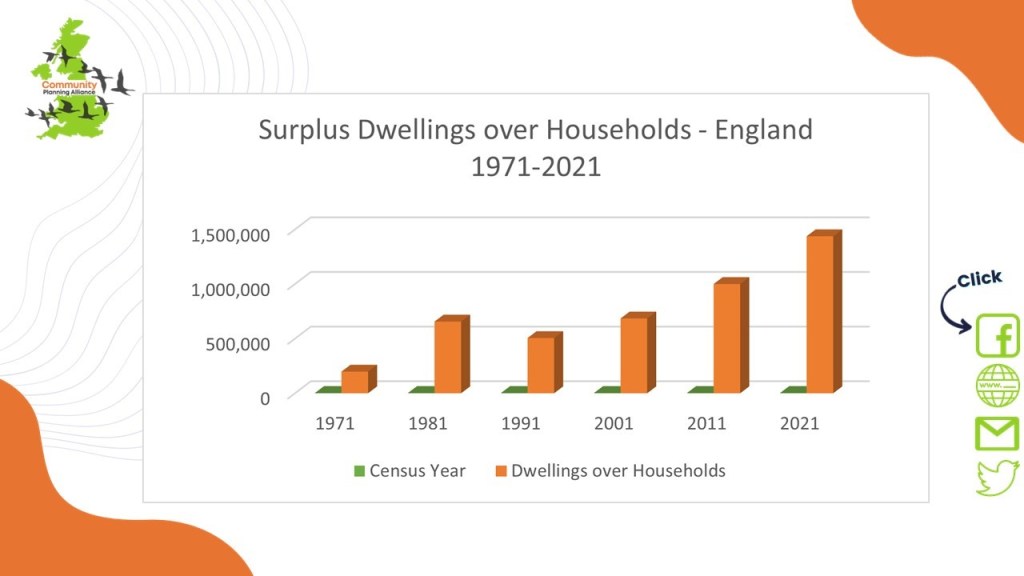
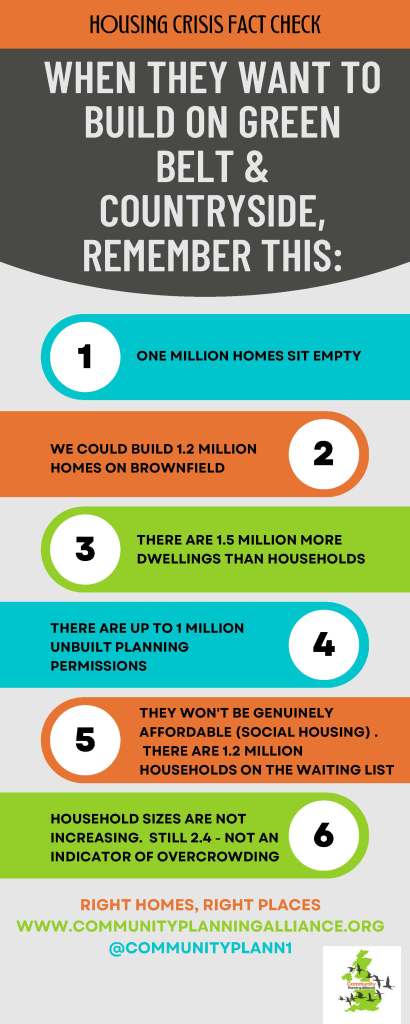
Graphic: Community Planning Alliance

Community Confusion!

Communities are confused by the commentary from politicians and others in relation to land use.  The assertion that there is a backlog of 4.3 million homes is typical, yet the facts do not bear out misleading statements such as this.  Political rhetoric repeats these fictional assertions, yet as the following infographic shows, there is not only a surplus of market homes, brownfield is not being prioritised, homes are allowed to remain empty, despite over 1.2m people on the housing waiting list and developers are allowed to hold on to land with planning permissions without building the approved developments.

Graphic: Community Planning Alliance

What we need is more facts and honesty in the housing debate, instead of pandering to the developer lobbyists who make huge profits building what they want but not what we need!

Is New Carrington a suitable site for development?

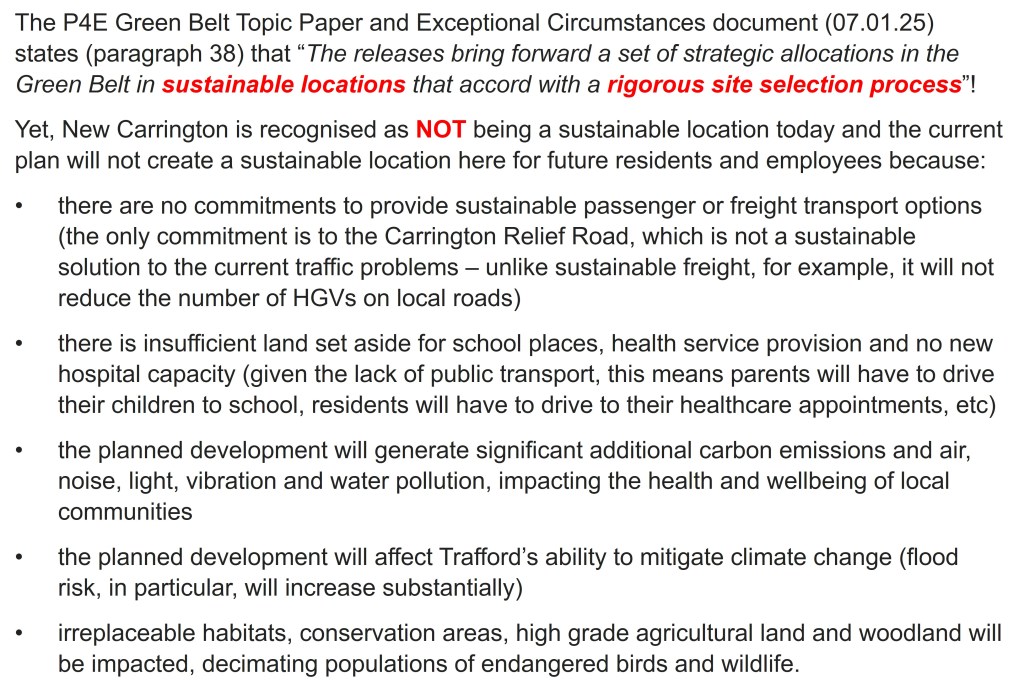
Trafford’s own assessment suggests it is not!

Let’s look at that “rigorous site selection process”!

Given the very recognisable challenges and the extensive harms to be caused by development here (see our previous blog), how was New Carrington chosen? 

Well, we would suggest the P4E Site Selection methodology was flawed.  For a kick off, it ONLY looked at Green Belt sites (despite the supposed focus on brownfield preference), it did not consider ecology or biodiversity issues until Stage 3 of the process, once most of the sites had been filtered out (and, even then, it did not provide any assessment data) and it did not consider natural capital value at all (despite the Government’s recent devolution deal describing Greater Manchester as a “trailblazer” in that area – see paragraph 226).

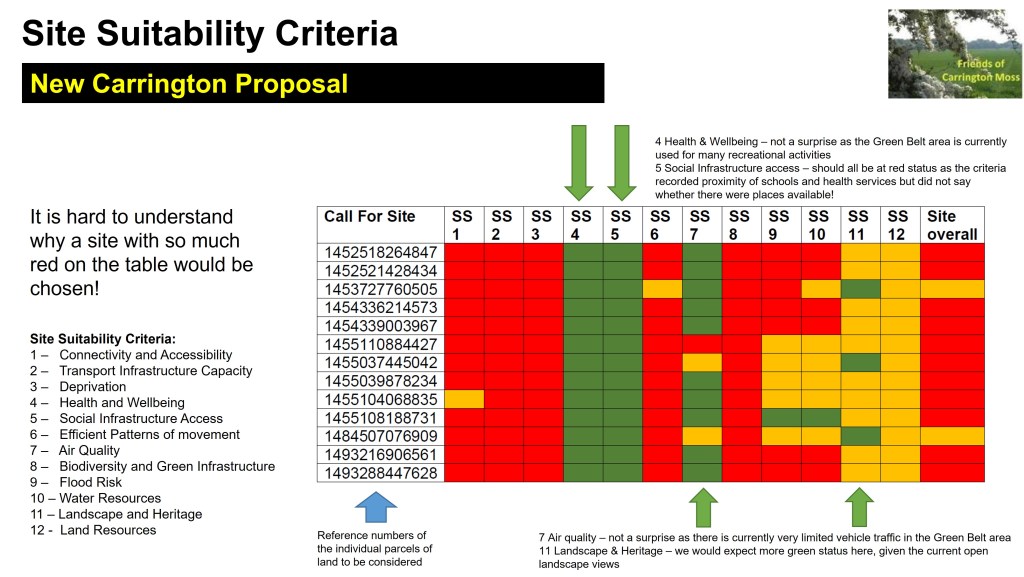
Site Suitability

The graphic below shows how the New Carrington parcels comply with the Site Suitability Criteria and clearly demonstrates that the area is not suitable for development!  In fact, Criterion 5 on the table below should be coloured red too, given the lack of available school places and poor access to health services in the area (the assessment was based on the site’s proximity to facilities, not the capacity of those facilities to support additional residents).

Criteria 4 and 7 have been assessed based on current land use.  So, it is not a surprise that Criterion 4 (Health and Wellbeing) is green.  The area is heavily used for walking, cycling, horse riding and other outdoor activities, including formal sports.  If the development is approved, this criterion will no longer be green because people will find it unpleasant, unhealthy and unsafe to walk, cycle and horse ride next to the planned four major new roads.  These roads will fracture existing public rights of way (and ecological corridors) and will hugely (and negatively) change the experience of those active travel trips (people will no longer be breathing fresh air, or listening to bird song, for example).

Criterion 7 (air quality) will significantly deteriorate as a consequence of the planned development too.

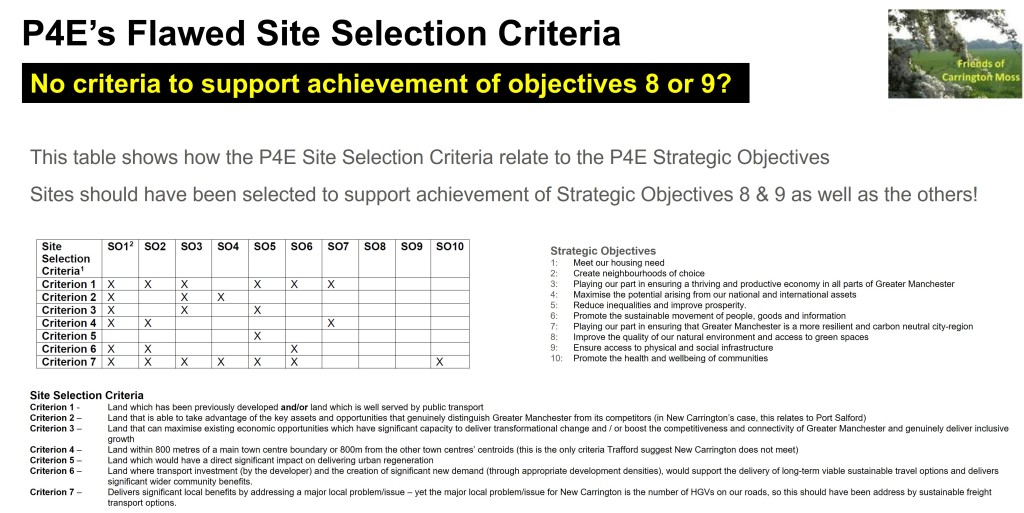
Site Selection

Turning to the site selection criteria, it is incongruous that there were no criteria which considered the P4E Strategic Objectives for improving the quality of the natural environment/green spaces (Strategic Objective 8) or for ensuring access to physical and social infrastructure (Strategic Objective 9).  When compared to the first 7 Strategic Objectives, the graphic below demonstrates the total lack of weight given to these two critical Strategic Objectives (and Strategic Objective 10, Health, does not fare much better, with just one site selection criterion being applicable).

The National Planning Policy Framework (NPPF) suggests (paragraph 8) that, to achieve sustainable development, three overarching objectives need to be considered:

a) an economic objective – to help build a strong, responsive and competitive economy, by ensuring that sufficient land of the right types is available in the right places and at the right time to support growth, innovation and improved productivity; and by identifying and coordinating the provision of infrastructure

b) a social objective – to support strong, vibrant and healthy communities, by ensuring that a sufficient number and range of homes can be provided to meet the needs of present and future generations; and by fostering well-designed, beautiful and safe places, with accessible services and open spaces that reflect current and future needs and support communities’ health, social and cultural well-being

c) an environmental objective – to protect and enhance our natural, built and historic environment; including making effective use of land, improving biodiversity, using natural resources prudently, minimising waste and pollution, and mitigating and adapting to climate change, including moving to a low carbon economy.

The site selection criteria are clearly not consistent with that NPPF requirement.

Furthermore, treating the huge area covered by the New Carrington Allocation (1,153 hectares) as one site means that the site selection criteria are considered attained even if much of the location does not meet those criteria.  We set this out in the table below:

Criterion 1 – Land which has been previously developed and/or land which is well served by public transport  We know no part of New Carrington is well served by public transport and only Carrington itself has some previously developed land but despite the Allocation boundary stretching to cover Partington, Sale West and Warburton, the whole site is considered to meet this criterion.
Criterion 2 – Land that is able to take advantage of the key assets and opportunities that genuinely distinguish Greater Manchester from its competitorsIn New Carrington’s case, this relates to Port Salford, which is, of course, only close to the Carrington part of New Carrington as the crow flies.  There are no direct links.  Despite this, Trafford consider the site to meet this criterion.  
Criterion 3 – Land that can maximise existing economic opportunities which have significant capacity to deliver transformational change and / or boost the competitiveness and connectivity of Greater Manchester and genuinely deliver inclusive growth  Given that much of the employment land (74%) is brownfield, economic opportunities can be maximised at New Carrington without releasing Green Belt.  Trafford suggests the Carrington Relief Road will be transformational for Partington, but this is not the case.  There are few, if any, benefits for Partington, Sale West or Warburton residents (and only minimal benefits for Carrington residents).  What would bring huge benefits to the Allocation area would be the reopening of the railway line – but Trafford is not even considering this.
Criterion 4 – Land within 800 metres of a main town centre boundary or 800m from the other town centres’ centroidsNo part of New Carrington meets Criterion 4.  
Criterion 5 – Land which would have a direct significant impact on delivering urban regeneration  As with Criterion 3, given the amount of brownfield land (74% of the employment land and 23% of the residential), urban regeneration can be achieved without releasing Green Belt.  In fact, urban regeneration in Trafford, and beyond, could be impacted by releasing so much Green Belt here (as developers will focus on greenfield sites rather than bringing brownfield back into use).
Criterion 6 – Land where transport investment (by the developer) and the creation of significant new demand (through appropriate development densities), would support the delivery of long-term viable sustainable travel options and delivers significant wider community benefits.  The Viability Assessment suggests the Total Developer Contributions are only £66.7m, a paltry sum for such a huge development.  This figure includes developer contributions to education and affordable housing.  As we highlighted in our previous blog, the “necessary” transport interventions for New Carrington will cost a minimum of £400m, so it cannot be considered that this site meets Criterion 6.  In addition, there are no sustainable freight transport options on the transport interventions list and it is hard to understand why the existing population (circa 30,000) is not considered to create sufficient demand to support the delivery of long-term viable sustainable passenger travel options.  Community benefits from this allocation are minimal to non-existent!
Criterion 7 – Delivers significant local benefits by addressing a major local problem/issue.  The major local problem/issue for the New Carrington area is the number of HGVs on our roads.  There is no plan to address this with sustainable freight transport.  We do not consider this criterion to have been met.

The way to test our assertion that much of the site does not meet any of the criteria would be to split the Allocation into smaller areas (Carrington, Partington, Sale West and Warburton) and to consider whether each development parcel meets any of the site selection criteria.  If they do not, those parcels should be withdrawn from the Plan. 

Finally, in relation to site selection, Trafford chose to remove some sites that were previously Allocations within the GMSF.  We cannot find any evidence in the P4E documentation which shows how and why sites were chosen for removal or to remain. 

Given all the above, the Public Interest Test in relation to site selection cannot be considered to have been met.  We believe this demonstrates that the site selection process is unsound and that New Carrington should be withdrawn from the Places for Everyone Plan.

New Carrington and the Public Interest Test!

An appraisal of the New Carrington plan shows that development here will NOT meet the Public Interest Test! 

Some words we have heard frequently during the Places for Everyone (P4E) Hearings is that the Plan is “Reasonable”, that, with the “Planning Balance” in mind, the Allocations should be approved and that the proposals meet the “Public Interest Test”.

At the very heart of considering these issues is an assessment of the benefits of a proposed development and the relative harm it would cause, looking at the advantages and disadvantages, analysing information, which should be available for both sides of the scale, and considering the long-term impact of the scheme.  The overall outcome being an understanding of whether the Public Interest Test has been met by proposals in the Plan.  

So, what about Places for Everyone and the New Carrington Allocation?

Now, we appreciate new homes are needed in Greater Manchester (GM), particularly genuinely affordable homes (social housing).  Jobs are vital too, not only for the economy but also to ensure individuals are able to meet their obligations and, hopefully, achieve some of their aspirations.  Residents also need access to school places, health services and community facilities.

On the other side of the scale, we also fully understand the importance of our Green Belt and all the natural capital and ecosystem services it delivers.  Given the climate emergency, mitigation is essential.  We recognise the need to reduce GM’s carbon emissions and to ensure residents are not exposed to high levels of air, noise, light, vibration or water pollution.  We must also consider that all development should be demonstrably sustainable (something we discussed in a previous blog).

National planning policy states that “At a very high level, the objective of sustainable development can be summarised as meeting the needs of the present without compromising the ability of future generations to meet their own needs”.

Flooding, for example, not only damages property, it impacts the mental and physical health of both human and wildlife populations.  With this in mind, the wetlands at Carrington Moss should be retained to continue to deliver the ecosystem services they have done so well, for so many generations.  In addition, the superior carbon capture capabilities of restored mosslands could be achieved here, bringing numerous ecosystem benefits

In summary, the graphic below highlights that New Carrington does not meet the Public Interest Test, as the levels of harm far outweigh the benefits accrued. 

Considerations of the weightings given to the Level of Benefit and the Level of Harm in this graphic are set out in the detailed paragraphs below

Residents, and their views, have been supported throughout the P4E Hearings by a number of MPs, including, for example, Trafford’s Sir Graham Brady (who can be heard here at the New Carrington session) and Salford’s Barbara Keeley MP (who can be heard here).  Our MPs raised a number of very important points which highlight that the Public Interest Test has not been met on the sites they are discussing.

These are all very important issues for existing local residents, whose objections to this Plan have been resoundingly ignored.  In addition, the GMCA have made substantial changes to the version of P4E that has been consulted upon, weakening a number of Policies and removing over 520 hectares of Green Belt Additions (which were proposed in part as compensation for the extensive Green Belt release) with no notice or scrutiny of the decision.

As we have said before

Given there are no other places in Trafford where we can:

  • restore peat, to more effectively capture and sequester carbon, so future generations can breathe cleaner air
  • grow crops and alleviate surface water risks, so our descendants have fresh food, with a low carbon footprint, and residents are not fearful of flooding every time it rains
  • increase significantly the populations of endangered birds and wildlife, to help nature’s recovery, increase biodiversity and mitigate the impact of climate change

this rich habitat, known as Carrington Moss, with a long history of extensive surface water flooding, should not have been included in the P4E Plan for development, but could have been highlighted for protection. 

We, therefore, disagree that the Planning Balance has been achieved in favour of development at New Carrington and strongly believe it would be unreasonable to release the land from Green Belt here.

All in all, the harms extensively outweigh the benefits of this Allocation.  So, for the reasons summarised in the graphic above, and set out in more detail in the paragraphs below, an analysis of the New Carrington Allocation resoundingly demonstrates that the site does NOT meet the Public Interest Test.


Read on for more information about those pros and cons:

Housing

This local analysis used Census and ONS data to highlight that more houses are being built in GM than the number of households being formed.  Trafford, for example, built almost 3,000 more homes, during the 10-year period, than the number of households created (and that figure excludes the empty homes brought back into use).  The data also draws attention to the Government’s defective 2014-based formula, which significantly over-estimates housing need requirements.  P4E confirms that GM has sufficient existing housing land supply (without releasing Green Belt) to exceed the Government’s overstated calculation.

GM’s existing land supply is sufficient to meet the needs of an additional population of around 400,000 new residents, the equivalent of two new boroughs in GM, representing huge growth on the projected population increase of 158,200.

In addition, more brownfield land comes forward for development every year.  The importance of these windfall sites is demonstrated in the recent CPRE State of Brownfield report, which singles out the North West and Manchester as places with high brownfield capacity.  At New Carrington 23% of the land for residential development is on brownfield (so the release of Green Belt is not necessary to achieve the benefits of those developments, they already have planning permission).

Windfall: sites which become available for development unexpectedly and are not included as allocated land in a planning authority’s development plan
Brownfield: previously developed land (which is, or was, occupied by a permanent structure)
Greenfield: a site that has never been previously developed
Affordable (homes): housing for sale or rent, for those whose needs are not met by the market (including housing that provides a subsidised route to home ownership and social housing)
Viability: an assessment to determine whether a site is financially viable, by looking at whether the value generated by a development is more than the cost of developing it.

Furthermore, despite being labelled ‘Places for Everyone’, we do not believe that this Plan will deliver housing for those GM citizens who need genuinely affordable homes (social housing).  GM has c72,000 households on local authority registers, and the Plan estimates that “around 38% of newly forming households are unable to afford to buy or rent a home at lower quartile prices”.  Yet during the P4E Examination, the Affordable Housing Policy has been weakened considerably, removing the specific targets from Policy, and relegating it to a mere aspiration. 

In New Carrington the number of Affordable Homes (including affordable routes to home ownership) was originally set at 30%, but the scheme was found to be unviable.  The number of Affordable Homes was then reduced to 15%, but the scheme was still unviable.  Trafford then decided to increase the house prices at New Carrington by 10% (challenging to achieve at this time of financial difficulties).  At the recent New Carrington Hearing, Trafford proposed a further reduction in Affordable Homes (with the vast majority of the development parcels now only needing to agree to 5% Affordable), despite what Trafford described as the acute need for such housing in the borough.  

So, the plan to release Green Belt here will not help those who are most in need of a home.

We believe the benefits to be accrued by releasing Green Belt to deliver homes should be weighted as “Low” because it is clear that the needs of the most vulnerable residents will not be addressed and existing land supply can meet market housing need.

Employment

Employment land provision is also vastly over-stated in P4E.  Green Belt release results in a totally unjustifiable 75% buffer, with the GMCA’s own expert advisor highlighting that P4E has an Industrial and Warehousing supply margin that “falls well outside the bounds of what has been generally used elsewhere”.

In New Carrington, 74% of the employment land is on brownfield sites, so the release of Green Belt will not provide any benefit in relation to the jobs created there.  Building more warehousing, on what is currently Green Belt land, will bring many disadvantages, including adding to the substantial issues with HGV traffic in the area. In addition, the only employment being proposed is warehousing (which is neither highly paid, nor does it support high staffing numbers).  There are no sites for technology, digital, green jobs, creatives, etc.  The impact on the rural economy and rural jobs (farming, stabling, and their supply chains) has not been assessed, despite the current use of the Green Belt land here.

GM does have alternatives to building on Green Belt, but these appear to have been disregarded, including the potential to convert the 1.3million m2 of excess office floorspace, much of which is in sustainable locations, appears to have been ignored.  This is a huge, missed opportunity. 

It should also be remembered that the market is changing.  Amazon, for example, recently announced that it will be closing 3 warehouses and several delivery stations.  It cannot be considered appropriate to release Green Belt to provide warehousing at a time of such uncertainty.

With these points in mind, we believe the benefits to be accrued by releasing Green Belt to deliver employment land should be weighted as “Low” because New Carrington can achieve high levels of warehousing growth on the existing brownfield land.

Infrastructure (Transport, Schools, Health Services)

The aim of GM’s Transport Strategy is to ensure there will be “zero net growth in motor vehicle traffic in Greater Manchester between 2017 and 2040”, an admirable aspiration.  On freight, the ambition is to achieve modal shift to water and rail.  For people, the intention is that, by 2040,50% of all journeys in Greater Manchester will be made by public transport or active travel, supporting a reduction in car use to no more than 50% of daily trips.

Yet GM’s plans do not prioritise sustainable freight and passenger transport, despite the disproportionate focus on warehousing development and the current poor public transport provision in areas highlighted for development.  In fact, P4E proposes to build housing and employment in 34 unsustainable locations, on what is currently Green Belt land, including here in New Carrington. 

As an example of the inappropriate proposals, Trafford’s only transport commitment for New Carrington is to construct the Carrington Relief Road (CRR), which will lead to very high car dependency and further HGV dominance on local roads.  It will also bring very limited benefits to existing residents, particularly given the increased housing and employment traffic that the New Carrington development alone will generate, and for the 26% of households in the Bucklow St Martin’s Ward that do not have a car, no benefits at all!

P4E includes a long list of potential transport options but there is no confirmation that funding is available to deliver any of the identified schemes, including the CRR.  It should be noted that there are no options for sustainable freight transport, despite the site’s proximity to the Manchester Ship Canal and the presence of former railway lines, which could be brought back into use.

There is also insufficient focus on health services (which are already overstretched across the sub-region).  There is no land proposed for a new hospital to serve those 400,000 additional residents, for example.  School places are currently a strategic red risk in some Authorities, including Trafford, and bring many challenges for existing residents, with parents being forced to drive their children to schools outside of their locality.  The New Carrington graphics do not show land set aside for any new schools, but the scheme will result in over 2,000 additional students across all age groups.  That is a lot of pupils to accommodate and yet more competition for Grammar/Academy school places.

The NPPF (paragraph 95) states that it “is important that a sufficient choice of school places is available to meet the needs of existing and new communities”.  This choice is not available for parents today, never mind when there are an additional 5,000 (“primarily family”) homes to consider. 

New Carrington will result in 20% of Trafford’s local housing need being sited in one Ward (Bucklow St Martins), increasing the population of that Ward by over 70% (and when existing land supply is included, by over 90%)!  This means that some of the most vulnerable people in Trafford are being disproportionately impacted by the lack of infrastructure and services, including losing access to green space.  These already disadvantaged members of our community will experience increased inequity as a direct consequence of this Plan.

We believe the benefits to be accrued by delivering infrastructure should be weighted as “Moderate” because delivery is not confirmed and the potential for mitigation of the proposed huge levels of growth has not been addressed.

Adherence to National, Regional and Local Policies

P4E and the New Carrington Allocation should adhere to the policies set out in the NPPF, it should also comply with Climate Change regulations, which commits the UK government, by law, to reduce greenhouse gas emissions.  The NPPF specifically mentions compliance with the Climate Change Act 2008.  Our response to the Plan consultation (available here) sets out the lack of compliance with local, regional and national policies (page 29).

At a national level, public money has also been spent on a 25 year Environment Plan, an England Peat Action Plan and a range of initiatives relating to nature’s recovery.  Whilst these are not explicitly mentioned in the NPPF, Local Plans should not ignore them.

The recently passed Environment Act sets out legally binding targets to protect our environment, clean up our air and rivers and to boost nature’s recovery.  These were published in December 2022 and aim to:

  • Halt the decline in species populations by 2030, and then increase populations by at least 10% to exceed current levels by 2042
  • Restore precious water bodies to their natural state by cracking down on harmful pollution from sewers and abandoned mines and improving water usage in households
  • Deliver our net zero ambitions and boost nature recovery by increasing tree and woodland cover to 16.5% of total land area in England by 2050
  • Halve the waste per person that is sent to residual treatment by 2042
  • Cut exposure to the most harmful air pollutant to human health – PM2.5
  • Restore 70% of designated features in our Marine Protected Areas to a favourable condition by 2042, with the rest in a recovering condition.

Given that P4E is a 16 year plan, which will heavily influence the achievement of GM’s proportion of these goals (including the required reduction in carbon emissions), we believe the harms resulting from the release of Green Belt would significantly and demonstrably outweigh the benefits, when assessed against these National policies and ambitions.

At a regional level, in addition to GM’s Transport Strategy, public money has also been spent on a 5-year Environment Plan, a Clean Air Plan and the GM Strategy.  Places for Everyone should be fully compatible with all those documents – but it is not!  The GM Strategy Summary states, for example, that “Climate change is the single biggest threat that we face”, yet P4E does not have a focus on ensuring that the mitigation of climate issues is prioritised. 

The Environment Plan outlines the aim to be carbon neutral by 2038 and articulates the 5 challenges incorporated within the plan (mitigation of climate change, air quality, production and consumption of resources, natural environment, and resilience and adaptation to the impacts of climate change). 

Yet the Greater Manchester Combined Authority (GMCA) has not even produced evidence showing the impact of P4E on the carbon emissions.  In the absence of any assessment by the GMCA, Steady State Manchester has analysed the data and has produced a report which sets out the Carbon Implications of Places for Everyone, showing that the 2038 carbon neutrality objective is unlikely to be met.

The lack of compliance with local, regional and national policies has caused us to weight this criterion as “Moderate”.

Green Belt Harm

The National Planning Policy Framework (NPPF) states (paragraph 148) that “local planning authorities should ensure that substantial weight is given to any harm to the Green Belt

National Planning Policy Framework (NPPF): The NPPF sets out the Government’s planning policies for England and how these should be applied (in the preparation of local and neighbourhood plans and to decisions on planning applications).
Green Belt Harm: The fundamental aim of Green Belt policy is to prevent urban sprawl by keeping some land permanently open around urban areas.  The five purposes set out in the NPPF (paragraph 138) are:
– to check the unrestricted sprawl of large built-up areas
– to prevent neighbouring towns merging into one another
– to assist in safeguarding the countryside from encroachment
– to preserve the setting and special character of historic towns
– to assist in urban regeneration, by encouraging the recycling of derelict and other urban land.

P4E commissioned assessments of the Green Belt land proposed for release, to identify the relative harm that would ensue.  The New Carrington Allocation was reviewed for the 2019 and the 2020 planned Green Belt release. 

Although this resulted in an assessment of Very High, High and Moderate-High Harm to Green Belt purposes, 169.5 hectares of Green Belt will be released immediately following P4E Plan approval, despite what is supposed to be a focus on delivering brownfield sites first. 

In addition, the significant volume of Green Belt land to be released here will undoubtedly impact the appetite for brownfield development.  This means that our Green Belt will be decimated whilst brownfield remains wasteland and the amount of available previously developed land increases! 

We do not believe the exceptional circumstances required by the NPPF (paragraphs 140 and 141) to release Green Belt have been demonstrated.  There is a lack of evidence about the impact of the Plan on the environment, biodiversity and ecology, the GMCA has not fully examined all other reasonable options and there is sufficient brownfield land to meet the Government’s formula (which could be supported by ensuring minimum density standards are enforced across the region).

We believe the cumulative harm from the loss of Green Belt should be weighted as “Very High” given the size and scale of the site.

Loss of Peatland

Developing on Carrington Moss will cause a massive carbon emission event and the destruction of this irreplaceable habitat cannot be offset by any amount of Biodiversity Net Gain.

One of the many advantages of carbon sequestration via peatland is its own negligible carbon footprint.  There is no requirement for manufacturing of major technology or equipment and no ongoing use of fossil-fuel based power (although we do recognise that restoration techniques might involve some initial machine-using groundwork and some installation of plastic dams or pipes).  Peat mosses require relatively low maintenance, perhaps some weed incursion control, but mostly it is over to the forces of nature and time to deliver the benefits.

Whilst there are no specific protections in the NPPF, the Government has set out its intentions in relation to peat in various documents over the past 10 years (including the 25 year Environment Strategy and the England Peat Action Plan).  Even P4E recognises that “lowland raised bog is now one of Western Europe’s rarest and most threatened habitats”, that our peatlands sustain a unique range of wildlife and GM’s 5 year Environment Plan aims to prioritise action to “protect, maintain and enhance our key natural assets”, including restoring “50-75% of our peatlands”.  The document sets out responsibilities for Local Authorities, including:

  • GMCA and LAs will embed a natural capital approach into strategy and plan development
  • GMCA and LAs will support peatland restoration approaches and provide a clear framework for approach and delivery as part of a resilience strategy”.

So, a responsible plan should take full account of the natural capital value of peat otherwise it will undermine intended Government and regional policy. 

Furthermore, one of the tests of soundness is that there should be a reasonable prospect that the various Plan policies (including the Allocations) are deliverable.  Given the, albeit slow, pathway the Government is taking to protect peatland soils and the increasing recognition of the ecosystem services peat provides, specific protection is likely to come.  The trajectory for development at New Carrington is spread across the 16-year period of the Plan.  Is it, therefore, reasonable to assume that construction on peat will still be allowed at the time planning applications are submitted?  We believe it is not!

At the P4E Hearings, the GMCA dismissed the advice of Natural England (NE), the Government’s adviser for the natural environment in England, stating that NE had not raised any issues of soundness.  Whilst it is correct that the Planning Inspectors are testing P4E for soundness, we believe it is reckless and negligent to ignore the advice of such national experts.

Examining plans (NPPF paragraph 35)
Local plans and spatial development strategies are examined to assess whether they have been prepared in accordance with legal and procedural requirements, and whether they are sound. Plans are ‘sound’ if they are:
a) Positively prepared – providing a strategy which, as a minimum, seeks to meet the area’s objectively assessed needs; and is informed by agreements with other authorities, so that unmet need from neighbouring areas is accommodated where it is practical to do so and is consistent with achieving sustainable development;
b) Justified – an appropriate strategy, taking into account the reasonable alternatives, and based on proportionate evidence;
c) Effective – deliverable over the plan period, and based on effective joint working on cross-boundary strategic matters that have been dealt with rather than deferred, as evidenced by the statement of common ground; and
d) Consistent with national policy – enabling the delivery of sustainable development in accordance with the policies in this Framework and other statements of national planning policy, where relevant.

NE has confirmed that “it takes 1,000 years for 1m of peat to build up”.  That seems to be confirmation that Carrington Moss is an irreplaceable habitat.  Their advice to the GMCA suggests it is, they say

“The GM Peat Pilot showed the carbon storage within lowland peat within Greater Manchester to be between 1,500 – 2,000 tonnes per hectare Carbon equivalent for 50cm depth of peat. Carrington Moss is significantly deeper than this”.

NE provide guidance about rewetting the peat soils and raising the water table (which is regularly above the surface on Carrington Moss, as can be seen by the information on our website about Carrington Lake).  They also advise that

As a large, continuous peat mass currently under suboptimal management, Carrington Moss provides an ideal opportunity to explore alternative land use scenarios that will assist the City Region in achieving net carbon neutrality by 2038, while providing other ecosystem services through improved ecological function of the peat”.

NE recommends restoration and expansion of the existing relic bog remnants, which would need appropriate buffers and areas of supported associated habitat, to support significant carbon storage.  They also agree with our Alternative Transformation Strategy for Carrington Moss, suggesting that there is

the opportunity to consider and set up a contiguous large area of Carrington Moss as a habitat bank for BNG, and for carbon trading. Natural England strongly supports this approach.”

We consider the loss of this irreplaceable habitat will cause Very High Harm, not just for today but for generations to come.

Harm to our Natural Capital Assets

Natural capital is the way of describing environmental assets (such as land, forests, water, soil, air and minerals) that provide benefits to people (clean air, good health, food and water).  A natural capital approach assigns a value to each of those benefits to help us understand their importance and worth to society.

GM has undertaken no assessment of the loss of Natural Capital Assets or the impact on Ecosystem Services as a consequence of the P4E Plan, despite the Trafford Natural Capital Account stating that “a natural capital approach is about everyone understanding the benefits – ensuring the protection and enhancement of natural assets are fully considered in decision making”.

This clearly has not happened with P4E.  In fact, FOCM identified a lot of missing evidence in our representation.  There is no detail in the Plan relating to carbon emissions, air, noise and light pollution, the rural economy, ecology and biodiversity (including the impact on the SBIs and SSSIs in close proximity), soil resources, or natural capital/ecosystem services. 

Our own very conservative natural capital estimates suggest that Carrington Moss accrues over £15m in benefits each year.  We understand this benefit is not included in the £71m figure calculated by Trafford.  They have decided not to capture all assets but have identified those they believe represent “the most critical in an urban context”.  This is consistent with the approach taken by P4E, which completely ignores our rural communities, the rural economy (including the farms, the stables and their supply chains) and rural assets. 

The natural capital assets on Carrington Moss include the peat moss itself (albeit degraded), the wetland habitats, the Grade 2 best and most versatile agricultural land, the huge expanse of woodland, areas that have significant levels of regular surface water flooding, and those that are used extensively for social prescribing, sports and recreation, including walking, cycling, horse riding, nature spotting, bird watching and a number of other activities.

The publicly available mapping for GM’s Local Nature Recovery Strategy shows existing habitats and opportunities for enhancement (including for Carrington).  Carrington Moss is one of the sites within the GM Wetlands Nature Improvement area.  Yet, the current plan is to decimate historic wetland habitats, then to propose restoration and creation of new areas of wetland, this is totally irrational!

Trafford has not made the overall flood risk and drainage strategy for the site available but we recognise it will need to be compelling given the water levels consistently present on the mossland.  The Government’s planning guidance has recently been updated and Councils will need to demonstrate developments will be safe from flooding for their lifetime, will not increase flood risk elsewhere, and, where possible, will reduce flood risk overall.

The Allocation will compromise the quality of our natural environment, causing biodiversity loss, and will severely limit access to green spaces.  Globally threatened birds/wildlife species will be displaced, their foraging sources diminished, their populations put at further risk.  The scenery will be dominated by new roads and warehouses, rather than landscape views stretching for miles, with high levels of traffic noise, rather than birdsong.  Carrington Moss will no longer be able to support climate resilience and reduce flood risk, which it does so well today!

How can the Planning Balance be determined when there is only evidence covering one side of the scales?  This is important because the fact an Allocation has been made here will be a key influence in decisions about planning applications, despite the lack of evidence at plan-making stage. 

We believe the lack of information about our natural capital assets will result in Very High Harm.

Prioritising unnecessary growth, rather than the climate emergency!

Every Local Authority in GM, every Health Authority in GM and the Greater Manchester Combined Authority have all declared a climate emergency (the GMCA has also declared a biodiversity emergency).  As mentioned above, the GM Strategy states that “Climate change is the single biggest threat that we face”, yet GM’s Local Authority and Combined Authority leaders are supporting a Plan that will significantly increase carbon emissions, cause a huge surge in air, noise and light pollution, and will expand the number of areas with the potential for localised flooding.  Their Plan will destroy irreplaceable habitats (peat mosses), will remove huge amounts of best and most versatile agricultural land (Grades 1, 2 and 3a) and will see thousands of trees felled.  None of these actions is compatible with those declarations nor with their carbon neutral goals.

It seems that climate and environmental impacts do not carry the same weight in P4E as the proposed excessive (and unnecessary) growth.  In addition, the P4E Plan will significantly impact the health and wellbeing of GM residents as a consequence of increased stress, dirty air and loss of green spaces.

During the P4E Examination, at a time when decarbonisation should be top of the agenda, the GMCA backtracked on published policies (net zero buildings will now be something to be worked towards, rather than mandated, and will be subject to financial viability, the ‘get out of jail card’ used by developers to avoid planning policy obligations).  In addition, the weakening of the brownfield first policy could result in more Green Belt release, with the associated increase in carbon emissions, etc.

Given those declarations and the recognition of the future challenges and hazards in the GM Strategy, every plan, every proposal and every decision should be considered through the lens of the climate emergency.

Yet, as mentioned above, the GMCA did not produce any quantitative assessment of the implications of their proposals, and suggested, at the P4E Examination, that it was reasonable for them not to provide such data.  Communities highlighted the approach taken in the Greater Cambridge Plan, an Authority which did conduct quantitative modelling of the carbon impact of their different spatial options.  This Authority was dismissed as an outlier, rather than heralded as setting a standard that other plans should be following.

P4E cannot be considered to be sustainable when it comes at such a huge price to future generations.  The lack of focus on mitigation of the climate emergency will lead to Very High Harm.

Finally

So, with all of the above in mind, is it reasonable to include New Carrington as an Allocation in the Places for Everyone Plan? 

We do not believe it is and, in addition to the above, it must be remembered that there is a total lack of community support for this scheme.  At a local level, the vast majority of residents object to the Allocation and, although the “major stakeholders” (developers and landowners) have been involved in creating the New Carrington Masterplan, there has been no engagement with local communities, not even the Parish Councils, in the evolution of the Masterplan document. 

At a regional level, the scale of opposition to Green Belt loss was huge, with over 27,000 GM constituents objecting to Green Belt release.  It seems there is no “public” in the Public Interest Test in relation to P4E!

In summary, P4E has focused on bringing forward sites in the Green Belt, rather than on tackling the blight of brownfield and proposing truly sustainable development.  The GMCA has significantly over-inflated the requirement for market priced housing and warehousing, there is insufficient provision of desperately needed genuinely affordable homes, rural communities and the rural economy have been totally disregarded, and insufficient weight has been given to the impact on climate change mitigation opportunities, the environment and nature’s recovery.  

Whilst we understand GM’s aspirations, these should be sustainable, balanced by a clear appreciation of the impact on communities and the environment and all decisions should be supported by sufficient information, covering both sides of the Public Interest Test scales. 

For New Carrington, Viability is finely balanced too, and we are not clear that all costs have been included in the numbers.  This development will not just be expensive in financial terms, it will also bring a high cost in terms of carbon emissions, the further depletion of endangered species and the worsening health and wellbeing of local residents.

This is not a reasonable or a sustainable Plan! 

Do the harms significantly outweigh the benefits of the scheme?

Yes they definitely do!

So, for all the reasons set out above, it is resoundingly clear that the New Carrington Allocation does not meet the Public Interest Test.

« Older Entries Recent Entries »