
Trafford’s lacklustre response to our request
For a full and detailed review of the Community Alternative to the eastern part of the Carrington Relief Road
As many of you are aware, we wrote to Trafford on 16th August formally asking them (once again) to consider the alternative route proposal put forward by 3 Parish Councils and 3 community groups on 8th March 2021.
Trafford responded on 30th September, confirming that they would not consider the alternative route because they believe that that this matter was properly addressed by the Council’s Executive in their deliberations and decisions 18 December 2020 and 27 September 2021.
We have notified the Council that we disagree with their conclusion and have asked (via a Freedom of Information Act request) for the evidence that demonstrates the issues raised by the communities have been addressed. We noted that, for example, in response to this planning application, the Environment Agency describes the flood risk assessments as being “insufficient” to demonstrate compliance with planning policy. This is a key issue for communities, and the experience of New Years’ Eve 2024/25 should have been a wake-up call for Trafford in relation to the importance of the land proposed for the eastern part of the route for protecting local homes and businesses from extreme levels of surface water flooding.
We also raised issues about the route option appraisal process and the very superficial nature of the assessment:
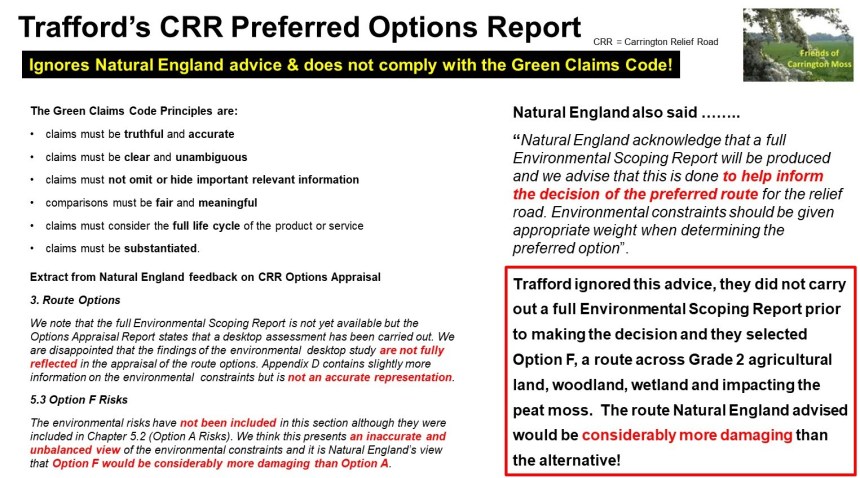
- Natural England described the option appraisal as “inaccurate” and “unbalanced” (their words)
- Our Independent Transport Consultant concluded that his detailed analysis of the Route Option Criteria “clearly demonstrates that Option A should be the preferred option”
- The project team described the traffic data as a “crude assessment“
- The community alternative was rejected due to a ‘misunderstanding’ of TfGM’s active travel requirements and Trafford is unable to provide an assessment or feasibility study relating to the active travel routes on, across and around Carrington Moss
- the Environment Agency has “not previously been consulted by the council / requested to offer a position upon the potential merits of shortlisted Option A versus Option F or vice versa”
- the Council cannot provide an assessment of Option A from the LLFA (Local Lead Flood Authority)
- Trafford cannot provide a separate count of anticipated HGV traffic as required by Planning Practice Guidance
- Trafford’s solution does not comply with numerous national planning policy requirements and does not follow the mitigation hierarchy (which requires that alternative options that avoid harm must be considered prior to seeking to mitigate or compensate for environmental or ecological harm
- Investment in sustainable passenger transport is urgent and must be prioritised – this can only be done by minimising spend on increased road space and could be achieved by adopting the communities’ alternative solution.
Given the above, we do not believe the appraisal met the requirement for the robust data expected when considering all “likely significant environmental effects“, including cumulative effects (for issues such as biodiversity loss, all types of pollution, carbon emissions and/or flooding).
We also raised our concerns about the speculative development to be caused by Trafford’s proposed route weakening Green Belt purposes, deliberately creating Grey Belt, which will encourage additional speculative development. Not only has Wain Estates signalled that they will use Grey Belt designation to allocate their “entire landholding for development“, but their recent response to the planning application also requests that land-take for active travel and environmental/ecological mitigation be minimised, presumably so the development area can be maximised.
We are awaiting responses to our FOI requests and confirmation of when a business case will be available for public review, as Trafford must comply with their Best Value Duty to adopt value for money principles and ensure they manage any risks to their budgets.
With all the above in mind, we would assume that Trafford will approve the solution that offers:
- the best value for public money (the least expensive overall to the public purse);
- the least harm to residents (minimising health impacts and compensation for pollution-related outcomes, flooding costs, etc); and
- the least harm to natural capital assets and biodiversity, including endangered species (a solution, for example, that will not cause ‘County-Scale’ decline in species populations nor require expensive environmental and ecological mitigation proposals that are likely to be challenged by the landowners).


You must be logged in to post a comment.