Tag Archives: transport

New Carrington Transport Strategy

Lorraine Eagling looks at what the Strategy means to residents given today’s traffic volumes!

It’s without question that a transport strategy is desperately needed by the residents of Carrington, Partington, Sale West, Warburton and Ashton on Mersey even before the plans for New Carrington get underway, so it was encouraging when Trafford Council published The New Carrington Transport Strategy but very disappointing that no residents had been involved in its development.   

The residents of these isolated and poorly served towns have long been promised and waited for a plan that provides the transport solutions they deserve, that are sustainable and will provide long term options for existing residents and for future generations.

The Strategy describes all the sustainable options (scenario 3) that would provide residents with regular and reliable connectivity to the rest of Manchester.  Solutions that would provide the residents with access to trains and trams and reduce traffic on local roads.   The Strategy goes on to explain, however, that these long-awaited public transport services are not an option because they are too expensive to implement and the only affordable option is a relief road, now expected to cost a minimum of £76.5m (and that is before any resident requirements such as additional junctions, crossings and traffic calming measures, for example are included in the design). Reminiscent of Bullseye’s infamous phrase ‘look at what you could have won!’, residents have once again been let down. 

The proposed relief road will run along the existing A1 Road, which starts opposite the Saica paper factory, to Isherwood Road.  From here a new road will be constructed adjacent to the peat moss and across the farmland to meet the Carrington Spur Road at the junction with Carrington Lane in Sale West.  The new section of the road will have massive implications to the environment. More details about the impact of the CRR can be found at this link, where you can look at our many previous blogs about the Carrington Relief Road by scrolling down the web page.

It’s a very disappointing outcome and it is questionable when the following is taken into consideration:

  • There is no mention of HGV traffic anywhere in the report.  As we know, the huge number of HGVs is the main concern for residents in Carrington Village and beyond.
  • The traffic data used in the report is taken from TfGM 2017 base year, which is outdated and pre-covid.  Considering the implications of this Strategy, the data should be current.  It is not clear whether any actual traffic monitoring has been done at key locations in order to access what road interventions would have the greatest benefit.
  • In addition to the outdated TfGM data, the Strategy interpreted daily travel modes from evidence of what it describes as ‘comparable brownfield’ development sites in South Gloucestershire, including areas of Stoke Gifford, Bradley Stoke, Patchway and Filton, on the northern edge of Bristol.  These sites have their own train stations and are home to industries such as aerospace and hi-tech engineering.  This is hardly comparable to New Carrington, Partington, Warburton and Sale West, where there are no train stations and the main industry is HGV intensive warehousing and logistics.   Also, New Carrington is not just brownfield, it is green belt, comprising peatmoss, woodlands, wetlands and grade 2 agricultural land.

What about the traffic data?

We have been collecting our own traffic data at key junctions in Carrington and Sale West for several years, but to verify the figures in the report, we collected some specific data in February and March 2024.   The results of our survey are as follows:

Cars and Vans

Table 1 shows the average number of cars per hour, during peak times, at the junction of the Carrington Spur and Carrington Lane in Sale West.  The red data was recorded during school term time and the blue data was recorded during school holidays.

As expected, the number of cars increases around this junction during term time.  The data shows during term time there are almost four times as many cars travelling from the M60 to Sale West.  Also, the number of cars travelling from Carrington to Sale West is more than double during term time and the number of cars travelling from Sale West to Carrington is more than tripled.    

On average, a total of 2,728 cars pass through this junction during peak times.   During term time, 48% of the car traffic from the M60 is heading towards Sale West and 43% of the traffic heading towards the M60 is from Sale West.  Additionally, 39% of the traffic from Carrington is heading towards Sale West and 47% of the traffic from Sale West is heading towards Carrington.

Other observations at this junction are:

  • Traffic queuing along the Carrington Spur Road from the M60.
  • Traffic queuing along Carrington Lane towards the M60.
  • Other routes were flowing freely.
  • 2 buses maximum during the survey period.

Table 2 shows the average number of cars per hour during peak times at the junction of the A6144, Flixton Road and Isherwood Road in Carrington.  The red data was recorded during school term time and the blue data was recorded during school holidays.

As expected, car traffic increases during term time, with the exception of those vehicles headed towards Isherwood Road.  During term time the car traffic from Carrington to Flixton increases by almost five times.  62% of the car traffic from Carrington is headed towards Flixton.  It is also interesting to see that 36% of the traffic headed towards the M60 is from Flixton.

Other observations at this junction are:

  • All traffic was flowing and there was no queuing at any junction.
  • Some traffic was travelling at excessive speeds, including HGVs.
  • 3 buses maximum during the survey period.

According to the data in the Transport Strategy, 875 cars travel from Partington and Carrington to Urmston (the report does not mention Flixton) on a daily basis.  We recorded 678 in one hour during one peak time and 282 and hour during non-peak time.  It suggests that the data in the report is an underestimation for traffic moving in this direction.

The data in the transport strategy is not as specific as the data we collected but assuming the traffic from Carrington and Partington heading to ‘Sale West’ and ‘10km inside GM’ is the traffic headed towards M60, then their data suggests there are 10,587 cars per day travelling along the A6144 between Isherwood Road and the Carrington Spur Road.  Our data shows 663 cars during peak time and 502 cars during non-peak time per hour.  Assuming two peak times and 10 hours of non-peak traffic, that is a total of 6,346 cars travelling along this route.  This time, the data in the report seems an over-estimation for cars travelling along this section of the A6144. 

We will repeat our traffic count in the coming months, to test the validity of this result.

HGV Traffic

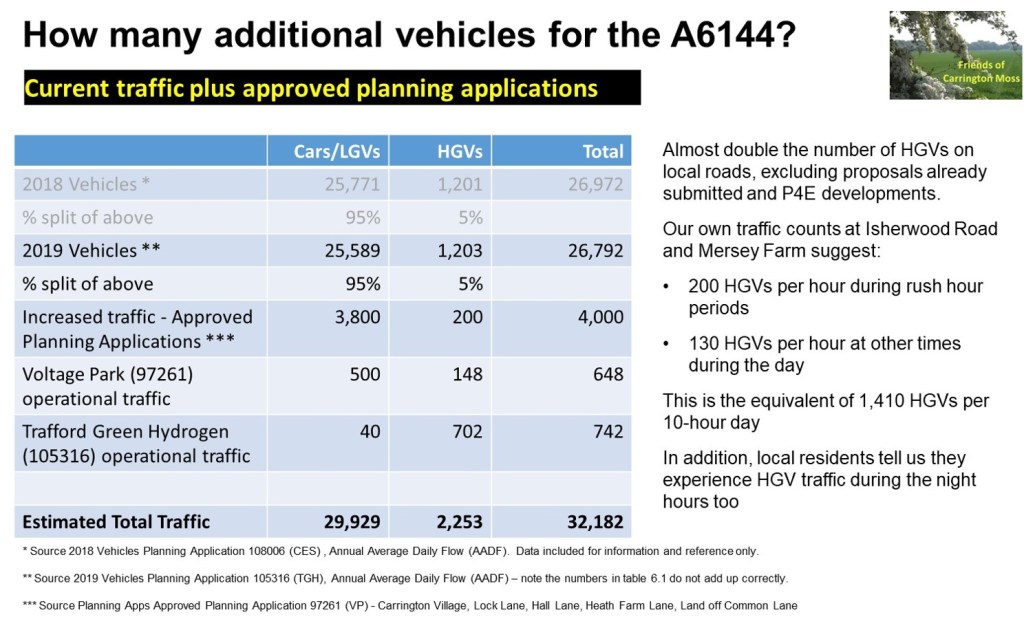
The data shows that during peak times there are approximately 152 heavy goods vehicles at the Carrington Spur junction and 213 at the Isherwood Road junction per hour.   At non-peak times, there are 208 and 206 respectively.  This suggests that HGV traffic is consistent irrespective of peak or non-peak times and is in excess of 2,000 per day. This figure will increase significantly as the proposed new warehousing is built.

Conclusions

Our data shows that:

  • The A6144 Carrington Lane in Sale West has as much car traffic as the A6144 in the direction of Carrington, as 48% of the traffic from the M60 turns towards Sale West during peak times.
  • The A6144 between Isherwood Road and the Carrington Spur has less car traffic than that suggested in the report.
  • There was no queuing traffic at the junction of the A6144 and Flixton Road during peak time. There was, however, significant queuing on the Carrington Spur and on Carrington Lane.
  • There is a massive increase in car traffic during term time indicating that there is insufficient public transport for students to get to school and a large proportion of students are travelling to schools from either outside the catchment area or from outside the borough.

Considering the findings of this data, how will the relief road reduce the traffic issues highlighted?

The biggest issue for the residents of Carrington Village has always been the large number of heavy goods vehicles that pass their front door every day.  The existing A1 Road could be opened immediately to redirect HGVs away from the village.  This would be a quick win (if the businesses in Carrington are willing to use that road).

Partington is experiencing housing development on a huge scale.  The new developments on Lock Lane, Hall Lane, Oak Road, Heath Farm Lane and the Greyhound will create another 1,291 dwellings.  Despite these developments increasing the number of houses in Partington by 38%, the routes in and out of Partington will remain the same.  Only after the cars and buses have contended with the congestion in Partington itself, can they access the proposed relief road further along the A6144.

For residents in Sale West and Ashton on Mersey to benefit from the proposed relief road to Carrington, they will have to access it from Carrington Lane which is already heavily congested even before the new relief road joins this junction. 

In essence, residents in Carrington Village will only benefit if HGV traffic moves onto the existing A1 Road.  Residents in Partington, Sale West and Ashton on Mersey will have to queue in traffic in their towns before they can access the relief road.  The new relief road, which will cost at least £76 million offers no relief to these residents who will see the population in their area increase significantly as a result of the Places for Everyone Plan.  There will be an additional 2,260 houses in Partington and Warburton, 1,443 in Sale West (in addition to the 263 already with planning permission) and 603 in Carrington Village. 

So how can this Transport Strategy justify such significant expenditure on a road that offers no solution to traffic issues that already exist? 

There are other considerations here too: 

  • Why hasn’t the A1 Road already been opened to HGV traffic to resolve the issues in Carrington Village? 
  • Why are so many students being driven to school? 
  • Do the school admissions policies in Trafford need reforming?
  • Does the Education authority or TfGM need to look at providing school buses? 

The data shows that it is school traffic and heavy goods vehicles that create the congestion along the A6144.   These are the issues that need addressing rather than spending £76 million on a scheme that will not solve the transport issues that have plagued this area for decades.  This money could contribute towards the ‘scenario 3’ solution in the Transport Strategy and should be invested in long term, sustainable passenger and freight transport interventions. 

There are several options that could be considered, such as:

  • opening the railway bridge between Irlam and Partington to give residents access to trains
  • opening up the ‘greenway’ and the former railway line from Partington to Altrincham to give residents access to trams
  • revisiting the 2012 Local Plan option to build a bridge from Carrington to Port Salford. 

These are long term sustainable options that will reduce congestion and open up Greater Manchester and the rest of the UK to residents of these local areas.

What we need is a Transport Strategy that meets residents’ requirements, why isn’t Trafford talking to us about it?
Does the New Carrington Outline Transport Strategy address resident priorities?

We had hoped the collaborative way the New Carrington Masterplan is being managed would prevail for other aspects of development in the area, but sadly, no!  Once again, we have a “strategy” that has been agreed by Trafford’s Executive without any input from the residents who will be severely impacted by its implementation (not only by what is in the “strategy” but also by what is not)!

At a recent Trafford Executive Committee meeting (29th January 2024), the report about Infrastructure and Development in New Carrington was introduced (we note there is a typo in the report date but it was presented in 2024, not 2023).  As part of this report the New Carrington Outline Transport Strategy was presented to the Executive.

On the positive side, the Council has begun an open and transparent process for developing the Masterplan for New Carrington (the details are on their website here).  This is good news, because, it is clear that residents have a lot to bring to the table in relation to what is needed in the area.

The Executive report itself is actually a marked improvement on previous documents created by Trafford about the Carrington Relief Road.  It does acknowledge some of the issues that have arisen (and continue to be identified).  In view of Trafford’s declaration of a climate emergency back in 2018 and its carbon neutral goals, set out in 2020, the accompanying Transport Strategy document, however, remains unambitious and has several major omissions.

Interestingly, that “strategy” document was produced in September 2023 but has been kept under wraps until after the Places for Everyone (P4E) Modifications Consultation was completed, which is rather disingenuous of Trafford’s politicians and officers, given that its contents signal concerns about whether the huge list of “Necessary Transport Interventions” set out at Appendix D (page 708) of the P4E Plan can, or will, be delivered. 

Resident Priorities?

Whilst the production of this “strategy” is to be welcomed, there has been no involvement of the community in determining the Vision, or the aspirations, and there is nothing in the document that suggests that communities will be engaged as the “strategy” evolves in the future!  It is, therefore, not a surprise that it merely continues to promote car/HGV-dependency, leaving a legacy of huge levels of air, noise, light, vibration and water pollution (to say nothing of the carbon emissions), that will result in poorer health outcomes for residents and higher costs to the public purse.  There is a reference to a specific consultation about one initiative, the Carrington Relief Road, but that was supposed to commence in January 2024, so is already behind schedule.

HGV traffic on the A6144 is, by far, the biggest concern for residents, yet there are no figures in this document which identify the size of the issue (either now or in the future), nor does it explain how Trafford proposes to address this problem.  The “strategy” confirms that the new road will be the panacea for freight transport!  Yet, we know that businesses are not in favour of restricting HGV use on the A6144, as was confirmed in a response to a planning application.  There is no indication about how the proposed route changes will be agreed with businesses and implemented so that travel through Carrington Village can be limited to local resident movements.

So, what we have now is a “strategy” which:

  • does not address any of the issues related to the huge number of HGVs that are travelling on local roads, there are no references to sustainable freight transport solutions and no aspirations to even consider them – is this really a strategic document?
  • does not estimate the anticipated induced traffic that will arise from the construction of the proposed new roads (causing more congestion, much higher levels of pollution and increased travel incidents), particularly for Partington, nor does it reveal the ultimate aim, set out in the GM Transport Strategy 2040, to create a link between the M60 and the M62 via Carrington (page 124/125), which will undoubtedly induce immense volumes of motor vehicle traffic through the area
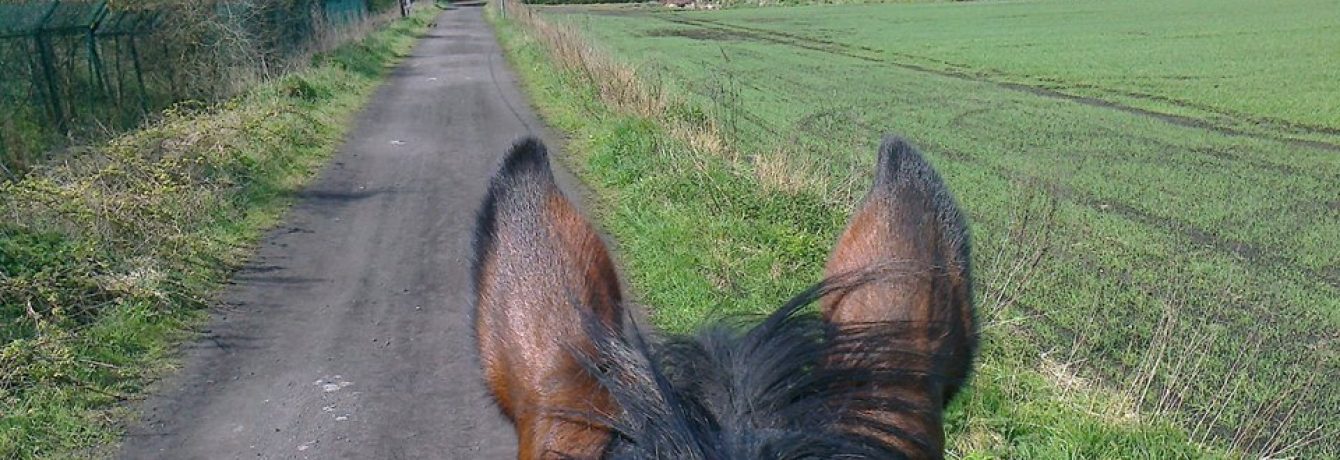
  • does not even mention the importance of local travel routes to horse riders (there are more 1,000 horses stabled in and around the area – source British Horse Society) – this is a huge gap as horse riders need specific surfaces (to reduce the potential for the animals to slip in wet weather, for example, and specific crossing points) – it would be inappropriate to consider active travel routes here without including their considerations.

The background facts are rather selective, there is no reference, for example, noting that Partington has a much lower rate of car ownership (27.2% of households with no cars or vans according to Census 2021) compared to the rest of Trafford (19.3%).  Neither is there any mention of the likely changes arising from the increased charges on the Warburton Toll Bridge.  There are no figures highlighting the difference in traffic volumes during school term times and school holidays (there is a marked variation in numbers which we have observed in our traffic counts that could be addressed through increased school bus services, cycling buses and other initiatives).

Because the proposed new road will be constructed adjacent to and beyond Carrington, it is more likely to induce additional traffic into Partington than to relieve traffic for residents there.  Other initiatives are needed to improve transport options for Partington residents, such as community transport and the reopening of the former railway line between Timperley and Irlam.  This latter scheme would be highly beneficial to the people of Partington and would enable sustainable passenger and freight transport to be fully examined.  Given the lack of consideration for this option from Trafford, Partington Parish Council has begun to explore opportunities to raise the funding needed for a feasibility study for the initiative.

What about the funding?

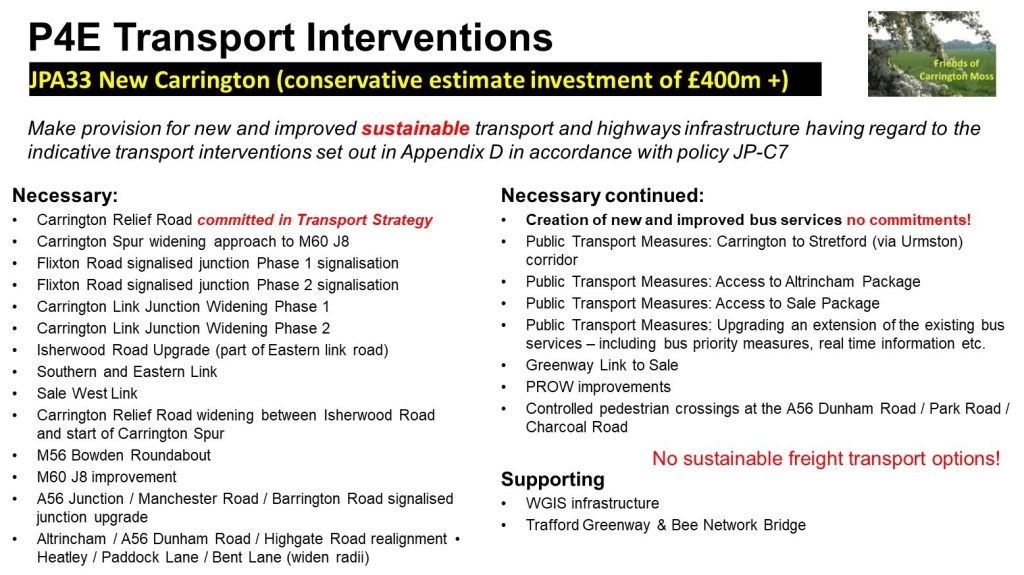
There is very little information in the document about the costs/funding of the overall “strategy”.  There are only figures related to the Carrington Relief Road (£76.5m) and the overall Greater Manchester Transport Strategy 2040 (£1.1b).  Our own very conservative estimate puts the overall cost of the “Necessary Transport Interventions” for the New Carrington development to be over £400m, see Appendix D (page 708) and listed in the graphic above. 

That GM Transport Strategy 2040 aims to reduce car use to no more than 50% of daily trips by 2040 and reduce demand on road space from freight, moving freight traffic onto rail and water-based transport by the same date. The associated Transport Delivery Plan states that “The Right-Mix aim is for 50% of trips to be made by sustainable modes across GM.  This will require zero net growth in motor vehicle traffic between 2017 and 2040, and non-car mode share to increase from 39% of all trips in 2017 to 50% of trips in 2040”.

With the strategic aim to significantly reduce motor vehicle traffic by 2040 (just 16 years away) in mind, along with the requirement for zero net growth in motor vehicle traffic, there is surely no business case for public money to be invested in a new road, that will impact the borough’s and the region’s carbon neutral ambitions, and generate huge levels of air, noise, light, vibration and water pollution.

Given the very marginal viability of the allocation, especially taking into consideration the contamination issues raised at the Executive Committee meeting, we believe that the public purse will be required to pick up the vast majority of these funding requirements and/or local residents will be forced to accept a huge development without the benefit of the Necessary Transport Interventions to make it, not only sustainable, but also tolerable. 

The Committee Report particularly highlights (paragraph 5.9) the long-elapsed time of the funding period for the Carrington Relief Road (a 9-year funding programme).  Consideration should be given to alternative options that may reduce the cost impact for the public purse and make sustainable transport solutions a reality.  This could include upgrading the existing routes (A6144 and the A1 currently private road in Carrington), along with significant enhancements to the public rights of way across Carrington Moss, making them suitable for extensive active travel, horse riding and, possibly, bus services only.  This would be a much more attractive option for encouraging modal shift as walking and cycling next to huge numbers of HGVs and other motor vehicle traffic is unpleasant, unhealthy and unsafe.

At the Executive Committee meeting a number of insightful questions were raised by Councillors, including Councillor Welton, who asked why there is no analysis of the costs of not achieving Scenario 3 (which is the most sustainable option).  As Councillor Welton highlighted, not achieving that scenario will lead to higher costs in terms of carbon emissions, poorer public health outcomes, increased traffic incidents and congestion and higher costs of road maintenance. 

More Missing information – Carbon Emissions!

The Transport Strategy does not include any information about the carbon implications.  There are no calculations that estimate what impact the different scenarios could have on Trafford’s carbon neutral ambitions. 

Interestingly, the “strategy” references the Greater Cambridge Local Plan to support its assertions in relation to compable sites.  In the P4E assessment work we have done with partner organisations, including Steady State Manchester (who produced an excellent document which calculates the carbon emissions resulting from P4E), our responses to the Planning Inspectors included reference to the Greater Cambridge Local Plan.  Their plan, unlike P4E, incorporated a Strategic Environmental Assessment that calculated the projected carbon emissions for each spatial option being considered (and they were comparable to the spatial options set out in P4E).  Cambridge discovered that coupling residential development and public transport leads to approximately 20% lower carbon emissions than a strategy that promotes car-dependent development in the Green Belt!

Given Trafford’s climate emergency declaration and carbon neutral ambitions, the document should be very clear how such a large development, and the associated road infrastructure, will impact both Trafford’s and the region’s carbon neutral goals.  The lack of sustainable freight transport options is a key consideration here because the carbon implications of the huge numbers of HGVs will be significant.

Comparing New Carrington with similar areas?

The “comparable” areas mentioned in the document are not actually analogous with New Carrington.  The benchmark sites (such as Filton, which has the UK’s largest Aerospace Area – BAE Systems, Rolls Royce, Airbus to name a few) are home to a Global Technology Centre and companies such as Filton Systems, Hewlett Packard and Viridor.  These industries are not like those businesses that are currently operating in (or are proposed for) New Carrington, which are predominantly warehousing/logistics units that generate extremely high numbers of HGV journeys.

Additionally, Filton and the surrounding areas of Stoke Gifford, and Patchway each have their own train station, whereas Carrington, Partington, Sale West and Warburton have no train stations and non are proposed in this “strategy”.  Another “comparable” site, Waterbeach, is a new development but, unlike New Carrington, it is getting its own train station.  There are no large warehousing sites proposed for that location.  It will have flexible workspaces and hubs (more cottage industry makers and creators) and, therefore, limited HGV traffic!  It is a real challenge to understand how these sites can be considered to be “comparable” to the New Carrington location!

The Executive Report states (paragraph 9.1) that “New Carrington will be the main growth point in Trafford for the next decade or more” but the New Carrington allocation is not even comparable to Trafford’s other major warehousing location – Trafford Park does have sustainable freight transport solutions!

What about the deep peat deposits on Carrington Moss?

At the P4E Examination in Public, Natural England’s contributions included the following:

  • Natural England (NE) wrote to the planning inspectors in June 2023 (OD42), stating that there is extensive and restorable deep peat within allocation JPA33 (New Carrington), that the deep peat should be considered to be an irreplaceable habitat, and that “the combination of the location and the extent of development proposed by the allocation policy means the proposed development is incompatible with avoiding the deterioration of this irreplaceable habitat
  • NE’s view, set out in OD23, is that the development will not only prevent future restoration but “will cause irreversible damage to the body of peat directly under the developed land and the wider peat mass, which depends on the continuity of the flow of water”.  They go on to recognise that the degradation of the peat mass will also result in significant greenhouse gas emissions
  • NE confirmed (in OD42) that their position is in line with the England Peat Action Plan, that there should be no development on (restorable) deep peat, and that peat should be kept wet and in the ground.  NE drew attention to their “extensive experience of peatland restoration projects” which provides considerable credibility to their professional judgement in this matter.

So, for Trafford to conclude in the report (paragraph 7.7) that “peat is not considered to be a significant constraint on future infrastructure provision” demonstrates a huge lack of understanding of the impact of hydrology on the main body of peat, which Natural England estimates to be around 335 hectares.  This is not a surprise, as it is recognised that Natural England are the experts, not Trafford, and their advice should be followed.

Even More Omissions from the “Strategy”!

Whilst the 29th January Executive Committee report mentions that the 2006 Unitary Development Plan (UDP) included a safeguarded route for the road and that the 2012 Core Strategy significantly underestimated the cost of such a route, it does not explain why the land that was safeguarded for the Manchester Ship Canal bridge is not included in the Transport Strategy.  This was also a Proposal E15 requirement in the 2006 UDP and one of the Implementation Projects listed in the 2012 Core Strategy (p80).  This initiative would reduce the number of HGVs (and other vehicles) on local roads significantly.  It is clear that the majority of the actions set out in previous local plans have not been delivered in this area and the potential benefits of the most sustainable solutions, particularly for freight, (such as bringing the former railway line back into use and/or transporting goods via the Manchester Ship Canal) have been totally ignored by Trafford for almost two decades.

The Carrington Relief Road appears to be going through a name change to the A1 Link Road.  The recognition that this road will not “relieve” anyone is welcome but we do wonder where the road will link from and to!  The government’s announcement about the funding to be made available as a result of cancelling HS2:states that “more than £500 million in funding will be provided for 2 major road schemes around Manchester. These include a new link road between the M62 and the M60Whilst this initiative is set out in the Greater Manchester 2040 Transport Delivery Plan, and we assume the A1 link road is ultimately being proposed to provide the first stage of this scheme, the “strategy” makes no mention of this longer-term proposal.

More information:

There are many tables full of confusing information throughout the document.  The calculations about the number of trips do not include the current traffic numbers, the HGV movements and there is no estimate about the expected level of induced traffic.  So, effectively, there is no assessment of the expected overall traffic levels on the new road. 

The “strategy” states (page 18) that “Employment provision in the area should offer a wide range of employment types” and (page 15) that currently 6% of car journeys and 7% of public transport journeys are internal (within Carrington and Partington).  This suggests few residents currently work in the Carrington area, an assertion borne out by our own research.  The current and proposed employment development does not offer a diverse range of job opportunities (despite the assumption on page 38).  It is predominantly warehousing which requires a small, low paid workforce.  There should be more evidence to show how the target of 17% of internal journeys can be achieved.

The current conditions (set out on page 14) focus on Carrington and Partington, without referencing the issues related to Sale West or Warburton, which will be impacted significantly by this “strategy” and, as mentioned above, totally omits any reference to the huge number of HGV movements in the area.

What next?

We have requested a meeting with Trafford to discuss the contents of the “strategy” further and will provide an update to residents as soon as we are clearer about the implications.

Trafford has a website page dedicated to the Carrington Relief Road, you can access it here.

You can find our previous blogs about the Carrington Relief Road by scrolling down at this link.

Recent Entries »