What do almost 800 residents and businesses really think about the Carrington Relief Road?
by Julie Hay (FOCM Committee Member)
FOCM has analysed the responses to Trafford Council’s recent planning application consultation on the proposed CRR. The results are astonishing, given that we have repeatedly been told by the Council that this new road is desired by residents to “relieve traffic congestion”. Yet local residents sent in responses to this planning application in their hundreds confirming that they do not agree. This is consistent with the feedback to the previous Trafford consultation and the Places for Everyone consultation responses.
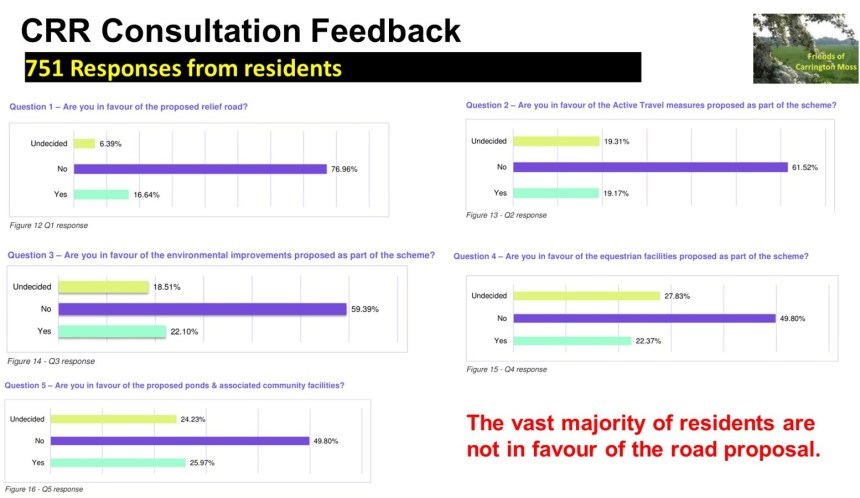
The results of Trafford’s previous consultation clearly show that almost 77% of residents are not in favour of the road. The planning application responses were even more stark.
Of the almost 800 responses, we found only 3 that were neutral (had grave reservations but stated they are not wholly opposed in principal), a further 3 are in support and the remainder objected without reservation.
The 3 neutral responses were firms which are located in the area and these, along with several other companies, express concerns about how they will be able to operate when the CRR and its construction impacts their vehicles’ routes and staff access. Several of them state that joint planning and co-operation, initially promised by the Council, has worryingly not materialised. Some state the Council has changed its plans after consultation, which they feel is “underhand and deceitful”. Some say plans for the CRR conflict with their own plans. United Utilities express their dismay that the plans for CRR take no account of their installations, such as mains outlets and are bound to cause problems and infringe laws as they stand. They request that the Council begin to work with them in spite of having, so far, failed to take this obvious step.
The majority of respondents are from households in Partington, Carrington, Sale, Urmston, Stretford, Lymm, Warburton, Warrington and Greater Manchester. They express a wide range of concerns about the proposals for this 2.7 mile road, and a high proportion feel that, at either end of it (the east and west-bound A6144), the areas will experience increased traffic congestion and pollution. Partington residents are well represented and are particularly concerned about traffic.
Residents are aware that traffic cutting through from the M60 to the M6 (and vice versa) will increase the volume on their already busy roads, thus adversely affecting their communities. Some objections are from local councillors, who state the proposals contradict the National Policy and Planning Framework. They also argue that the short CRR will simply link two bottlenecks, one at the Spur Road in Ashton on Mersey and the other at the already traffic ridden centre of Partington.
The horse community (over 1,000 horses are stabled on and around the moss), including a riding school for the disabled, are likewise unanimously not in favour, as well as animal related charities.
Amongst other objections, many quote the minimum £132 million cost, the vast majority of which will be funded by the public sector, with the Council being responsible for any unforeseen expenditure at a time of high financial pressure and very high Council Tax increases.
Many are aware that the road is being constructed in preparation for thousands of houses, warehouses and other roads to be built on a previously protected carbon sink, which the government’s adviser (Natural England) considers to be a restorable, deep peat irreplaceable habitat, home to many endangered species. Trafford’s own documentation confirms that the road will cause “Countyscale” decline to already red listed species!
Given that there should be a focus on climate mitigation, nature’s recovery and the health of our communities, why, over the past 10 or more years, hasn’t Trafford considered alternative, more sustainable transport solutions?
With all the above in mind, we’d like you to ask yourselves, WHO is actually in favour of this financially and environmentally harmful road, which benefits only those who will make profits and dividends from development?
 Friends of Carrington Moss
The Government’s lack of protection for green spaces within our built environment is dismaying Whilst I understand and agree with the need for AFFORDABLE and SOCIAL housing, building on greenbelt land is not the answer. Greenbelt is the lungs of the community and pushing it further away deprives us of out right to space and relatively fresh air. Monoculture agriculture has driven wildlife to the suburbs; we now have urban foxes and farmland birds come to our gardens; they are now rare in what is generally termed ‘countryside’. So building on our greenbelt is a double deprivation for wildlife. Since much of greenbelt is farmed, building on it will mean farmers are dislocated. If you are going to take farmland, you may as well buy up farms in the countryside outside of the greenbelt area and leave the space between the new and old developments to the benefits of both people and nature.
LikeLike