Monthly Archives: Mar 2026

Are decision-makers tackling housing need and affordability?

Will building more homes reduce house prices?

For far too long our politicians have been listening to lobbyists for the big construction companies and have been closing their eyes and ears to genuine evidence (even that produced by the Office for National Statistics).  They have certainly ignored feedback from their own citizens.

The Community Planning Alliance (CPA) Homes for Everyone report debunked many of the myths around market housing land supply, confirming that there are 1.5 million empty homes that could be renovated, there is planning permission to build over 1 million homes that have not yet been started, and sufficient brownfield land to build more than 1 million homes.  In addition, CPA proposed some novel options to incentivise those with (around 26 million) empty bedrooms to rent them out and to repurpose the more than 165,000 empty commercial premises to support housing need.

The government should be making it easy for Councils and developers to maximise these routes to meet their housing aspirations.  Instead, Ministers are intent on changing planning rules and weakening the regulations that protect our important natural capital and ecosystem services.  

As CPA highlighted in their Veering Off Plan report, despite purporting that their policies will boost housing affordability, the government is neither directing supply nor improving confidence in demand, leaving all stakeholders uncertain and under pressure!

One of the main reasons housing affordability has rapidly declined over the past 20 years is the lack of focus on genuinely affordable homes (social housing), with construction of this essential element of our housing toolkit reducing from over 50,000 per annum in the 1990s to less than 10,000 per annum in 9 of the last 12 years.
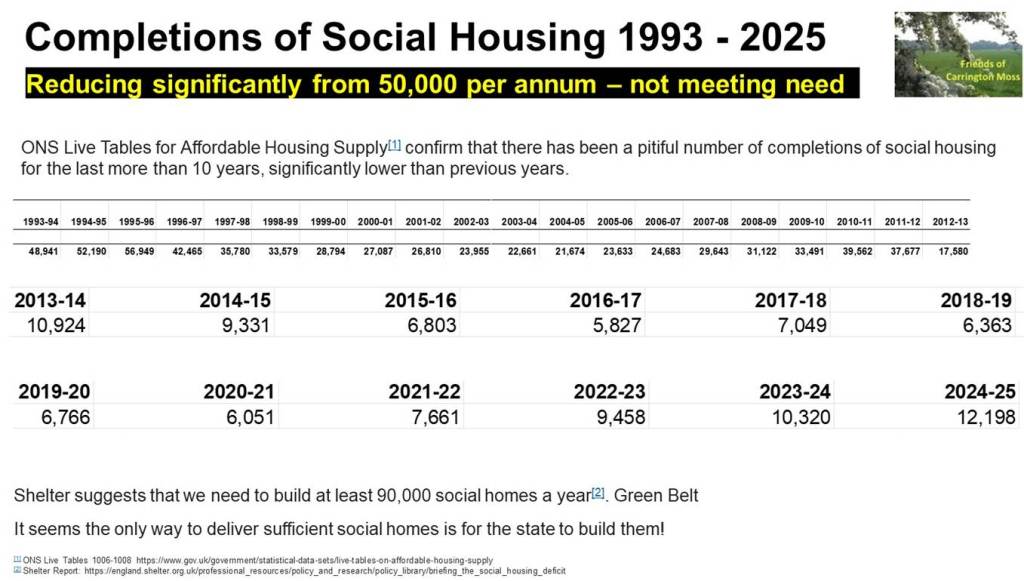
Given the Right to Buy scheme, which, along with the lack of new builds, has seen availability of social housing more or less collapse during that 12 year period, successive governments have missed a trick.  The focus on developer-led market housing has not only resulted in huge increases in house prices (for the reasons set out in the recent IPPR report), it has significantly reduced choice for those who cannot (and some may never be able to) afford to buy, with rental costs exceeding £1,000 a month “in more than half of British neighbourhoods“.

Had there been less lobbying and more emphasis on need, governments would have introduced policy to maximise social housing supply, significantly increasing the number of homes available at an affordable rent.  This would increase competition for private landlords, bringing down all rent levels (and enabling those who could get onto the housing ladder to save up for their deposits).  It would provide security and stability for families, significantly decrease homelessness and would also reduce the costs to the public purse, releasing funding for other priorities.

Well, the narrative that we have a market housing crisis and that housing is so expensive because there are not enough homes to go around is pushed by developer lobbyists and is extremely misleading – overall housing stock levels have consistently risen at a higher rate than population growth, meaning that there must be a huge number of second homes, holiday homes, airbnbs and empty homes.
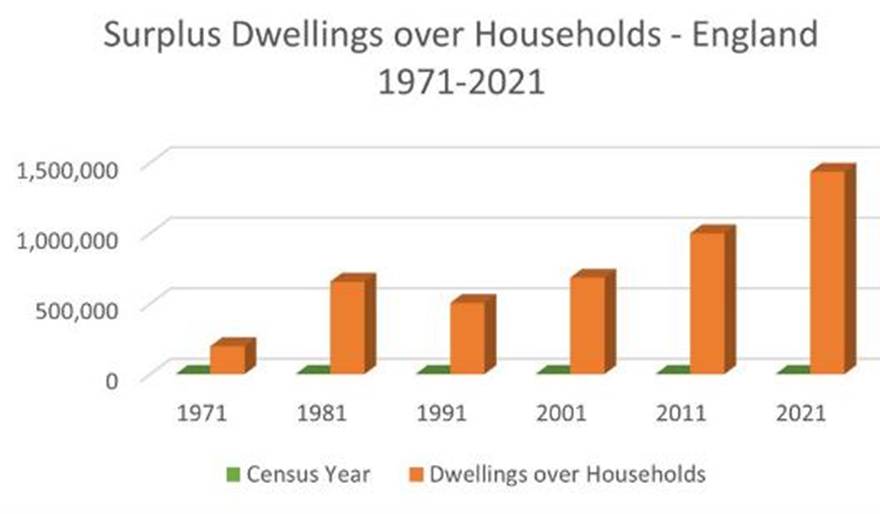
Many new homes are purchased by investors, landlords and speculators, which does not increase supply for those who need them most and does keep house prices high (as they are viewed as a way of making money through financial speculation, rather than just being a place to live).

The IPPR report, mentioned above, highlights that “recent governments have focussed on boosting market housing supply through a combination of changes to planning rules, liberalising access to mortgage finance, stamp duty land tax cuts and holidays, and other demand-side measures like help to buy equity loans”.  They also identify a number of challenges, such as resourcing concerns for statutory agencies, the dependence on the speculative model of development, and the focus on market housing, rather than local need.

There is significant evidence that the typical supply/demand approach does not work for market housing (and let’s be clear, if it did, there would be a lot of very unhappy homeowners, who would see their asset fall in value and possibly negative equity on their mortgages).  Another issue to consider is that, if additional housing supply was to cause sharp declines in house prices, this might raise concerns about the financial stability of mortgage lenders (mortgages are based on the value of a house and if an owner defaults, the lender should be able to recover their money via the asset underpinning the loan – if its value decreases then the banks would not be able to secure a return on their investment).

This excellent blog from Alternative Cornwall discusses the relationship between housing, its status as an asset (as well as a place to live), deregulation and the divergence of wage growth, compared to house prices.  The argument in the blog is supported by this article from Bank of England researchers, effectively confirming that one of the key issues is that houses are now considered to be assets, with prices being determined by the role of finance (ie the Bank of England, historically low interest rates, credit availability, investor demand, etc).  Other articles say similar things, this one, for example, highlights that “the rise in real house prices since 2000 can be explained almost entirely by lower interest rates“.

So, increasing market housing supply is unlikely to significantly reduce house prices, in fact, at a local level, they could cause house prices to rise (because of perceived gentrification, for example).  But – the government’s policies have been great for the asset-wealthy few, who have seen house prices go in only one direction – UP!

Current policies do nothing for the most vulnerable in our society, or for those who are enduring the current cost of living crisis and, of course, the recent increases to interest rates have radically affected affordability for a typical homeowner.

Those policies also do nothing for the environment or nature, which have been attacked and scapegoated to facilitate market housing permissions, which will only be built out when the developer can achieve their desired profit margins.

Even with the government’s recent investment in social and affordable housing (£39 billion), they are only scratching the surface of the issue following decades of decline. Those big corporations will build what they want, when they want, where they want – but they are not focused on what is needed in our communities and authorities should be doing much more to prioritise community participation!

Trafford is making us sick – but do they care???

Local, regional and national policy highlights the importance of ensuring new development does not impact the health and wellbeing of both human and wildlife species.  Whilst this has been partially recognised in the planning application, we do not believe Trafford’s assessments acknowledge the serious impacts that will be incurred by local residents and conservation areas.  This is particularly the case given the flawed approach to calculating the anticipated traffic volumes (many of the expected journeys have been excluded from the numbers and comparisons have been made with districts that have access to wide-ranging public transport services, including railway stations).

The National Planning Policy Framework (NPPF) suggests at paragraph 96 that planning policies and decisions should aim to achieve healthy, inclusive and safe places which (c) “enable and support healthy lives, through both promoting good health and preventing ill-health, especially where this would address identified local health and well-being needs and reduce health inequalities between the most and least deprived communities”.

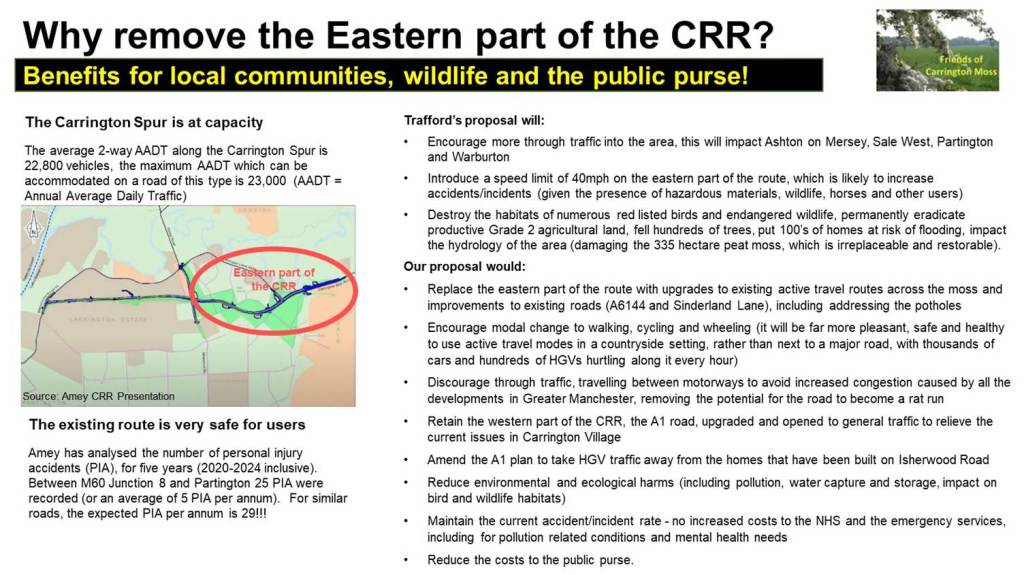
The Carrington Relief Road (CRR) certainly does not comply with this policy.  It will generate huge increases in traffic, not only along the road itself, but also along the east and west-bound A6144.  This will lead to similarly huge increases in air, noise, light, vibration, dust and water pollution (including from road run-off).  The risks and the impact have been substantially understated, the road will cause ill-health, it will increase health inequalities, and it will affect our financial, mental and physical wellbeing.

The public transport improvements promised for Carrington, Partington and Sale West in the 2006 Unitary Development Plan and the 2012 Core Strategy were never delivered (in fact, bus services have been severely depleted over the past 10 or more years) and the more sustainable solutions set out in those plans were never actioned.

Whilst we can draw on lots of research, including, for example, this Public Health briefing, which suggests that less affluent areas “have a higher density of main roads, leading to poorer air quality, higher noise levels and higher collision rates”, the concerns that have been repeatedly raised about the road are not reflected in the Environmental Assessment.  The research goes on to highlight that health inequalities are further exacerbated because “residents of deprived communities tend to travel less than the better off but feel the impact of other people’s travel.  In short, increasing car dependency has led to increasing unfairness” (our emphasis).  

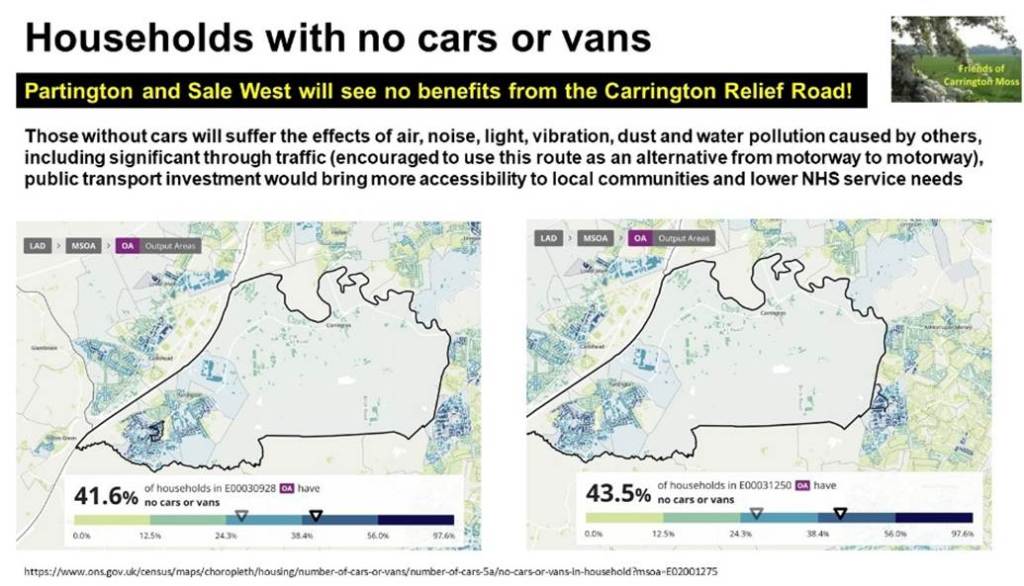
The vision for New Carrington is a clear example of this, with ONS data showing that around 40% of those living in Partington and Sale West do not have access to a car. 

And don’t let anyone kid you, whilst electric vehicles may reduce air pollution somewhat, there will be no radical reduction in particulate matter (PM2.5s), caused by brakes, tyres and dust, and for which there is no safe level.  Yet it does not appear that local monitoring of existing PM2.5 and PM10 has taken place and, as there is no separate count of HGV traffic (despite it being a Planning Practice Guidance requirement), there is no indication of whether the anticipated increase in HGV numbers (and the associated increase in emissions) have been taken into consideration in the Environmental Assessment.

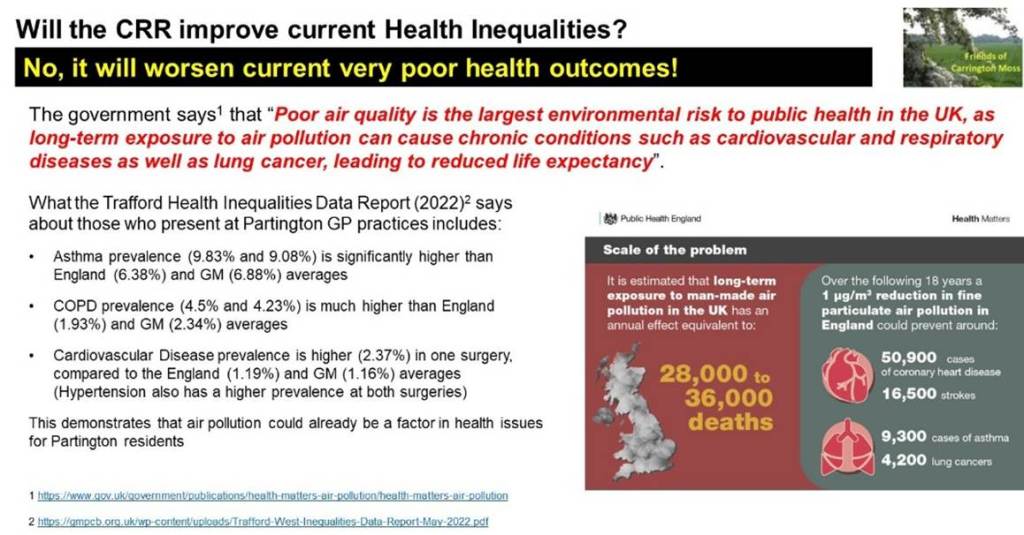
Trafford should be very concerned about increasing our exposure to these pollutants.  These particles will continue to contribute to prevalence of respiratory diseases, cardiovascular issues, and cancer and the huge increase in traffic caused by the CRR will aggravate and accelerate symptoms.

That same Public Health report suggests that “it has been estimated that half of the UK’s £10bn cost per annum of air pollution comes from road transport”, meaning that the new road will add substantial costs to the public purse, whereas the alternative, more sustainable solutions would reduce pollution and would also reduce those costs.

The Environmental Assessment found no significant effects of air pollution on human or ecological receptors either during the construction or operation of this road and the documentation suggests that the PM2.5 modelling results were ‘negligible’.  This is not a credible outcome given the number of cars and HGVs that will be using the road.  There appears to have been no assessment of the impact on vulnerable residents, including in relation to children on journeys to and from schools. 

It is astounding that significant levels of traffic can be “drawn from” the M60, the M6, the M56, the A56 and other roads, along with the additional traffic due to new developments (the Trafford Green Hydrogen development will result in an additional 700 HGV movements a day, for example, with more from Voltage Park and other proposed developments in the area), causing considerable congestion, and yet, Trafford says the impact of pollutants will be ‘insignificant’!

It certainly will not be ‘insignificant’ for the vulnerable communities at either side of the scheme.  Trafford’s Health Inequalities Data Report (2022) suggests that Partington residents, for example, are already suffering from the effects of air pollution, with those presenting at the two general practices having a significantly higher prevalence of pollution-related conditions than elsewhere in Greater Manchester or in England as a whole. 

The Environmental Assessment incorrectly suggests that any change in the prevalence of Cardio-Respiratory Conditions, for example, will be temporary.  The traffic levels, dust, congestion, and pollutants will permanently increase the risks, particularly for vulnerable residents.  

Those living close to junctions, such as at Isherwood Road and Banky Lane are likely to suffer significant adverse effects of pollutants but to be clear, so will residents all along the east and west-bound A6144.

But, the report does not identify the huge level of adverse effects for affected communities and does not demonstrate that these extensive effects are neutralised by the mitigation measures proposed. 

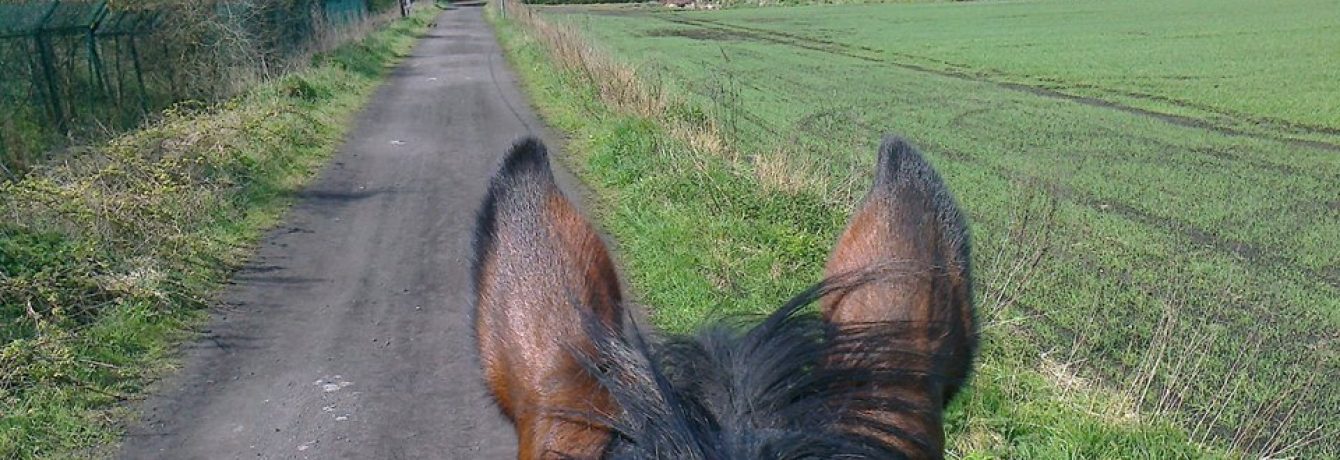
Active travel users, including horse riders, will be substantially affected by emissions both during construction and once the road is in operation.  Current recorded and unrecorded public rights of way will also be severely harmed because there is almost zero motor vehicle traffic on those routes today.

As mentioned above, there are no ‘safe’ levels of PM2.5 emissions.  Repeated tropes about the benefits of the proposed introduction of active travel routes are meaningless.  Walking or cycling adjacent to a major road, which has a minimum of 30,000 cars and over 3,000 HGVs a day travelling along it will not be healthy, safe or pleasant.  Just breathing in the PM2.5 emissions alone will cause significant increases in respiratory-related health episodes. 

With particulate matter lodging itself in various organs, air pollution has been linked to many health problems, far beyond the lungs, including in the brain and for babies still in the womb.  At the other end of life, components of air pollution also seem to be ‘accelerating the process’ of dementia.

The seriousness of air pollution related health problems has been highlighted in this recent article, which confirms dirty air harms the organs in our body, affecting blood vessels, making heart attacks and strokes more likely.  Inflammation in the lungs has caused deadly tumours, with around one in 10 lung cancers thought to be caused by air pollution in the UK.  A report by the Royal College of Physicians estimates there are around 30,000 deaths a year attributable to air pollution.

The health impact of air pollution appears to be consistently devalued in the various planning application documents, which state, for example, that the impact of air pollution on users of sports facilities is ‘not significant’.  Yet recent research (Air Pollution and Its Impact on Health and Performance in Football Players) suggests that “Even short-term spikes in air pollution have been shown to impair performance, increase respiratory symptoms, and delay recovery in athletes”.

A recent study related to improvements to air quality in the Bradford Clean Air Zone found that air pollution was a contributing factor for 35% of GP visits for breathing issues and 49% of A&E visits for conditions including asthma and chronic obstructive pulmonary disease.  The introduction of the clean air zone resulted in a drop of almost 600 GP appointments a month, including 134 fewer GP visits a month for people with problems with their cardiovascular health.

The Full Business Case for the road should, therefore, include the costs associated with additional primary and secondary healthcare service requirements. 

Air pollution also affects ecological sites, yet the impact on these was also dismissed as ‘not significant’ (assuming mitigation measures are implemented).  Again, we are concerned that the traffic numbers need to be revisited, along with the cumulative impact of all construction in the area. 

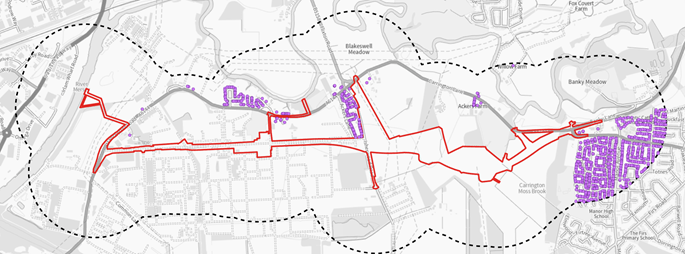
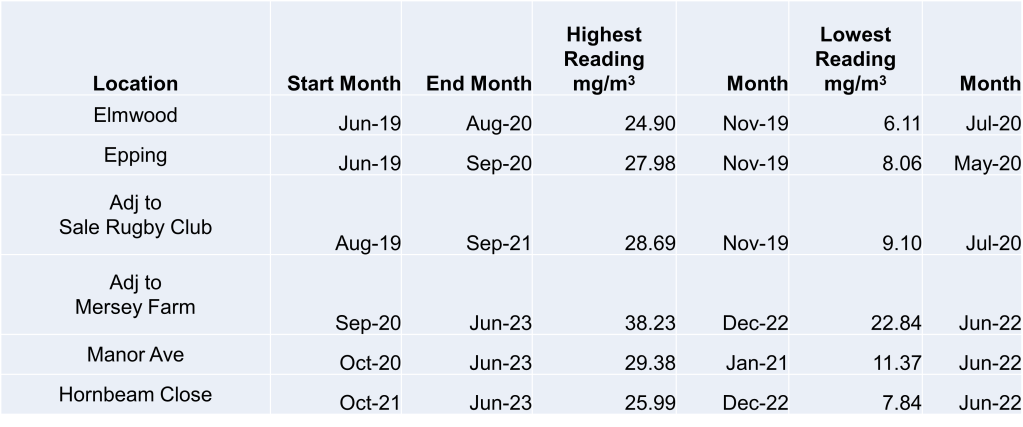
The Friends of Carrington Moss has undertaken air quality monitoring (NO2) at several locations in the area, over a number of years, using diffusion tubes that were sent to an official laboratory.  The readings will be a useful comparison in determining the level of increased emissions if the road is approved. 

We are aware that Carrington Parish Council has invested in an air quality monitor, which covers a range of pollutants, but sadly the readings are not up to date on the website. 

So, who will benefit from the road?

Whilst it is clear that those citizens living in the around 40% of households with no cars will not benefit, we should ask ourselves how much of an advantage it will be for any resident to be at a much greater risk of suffering the extensive health and wellbeing impacts of air, noise, light, vibration, dust and other pollutants, caused by the sheer volume of traffic that will be using this road.