

Is the Carrington Relief Road really a relief road or just a green light to major development?
By Lorraine Eagling
Following my blog about the New Carrington Transport Strategy (8th March), I decided to carry out some more traffic surveys to further clarify my findings and conclusions (you can read the previous blog here).
I carried out surveys in the morning rush hour during the Easter Holidays and then mid-term time (the week the GCSE examinations started). This time the data was taken between 8.10 and 8.30, whereas last time the data was collected between 8.30 and 9.00. I wanted to confirm that traffic increased significantly during term time and what direction was the traffic flowing.
The following tables show the percentage of cars and vans travelling in the different directions at the two major junctions that the relief road is purportedly to relieve.
Car and Van traffic at the Junction of Carrington Spur, Carrington Lane and Banky Lane
Percentiles of traffic flow (cars and vans) during peak times in the Easter holidays April 2024 – average hourly total 1833 vehicles

Percentiles of traffic flow (cars and vans) during peak times and term time April 2024 – average hourly total 2160 vehicles

There were tailbacks from the M60 heading towards Sale West.
Conclusions drawn from these tables regarding car and van traffic at this junction
- During term time 63% of the traffic from the M60 is travelling towards Sale West, therefore, would not use the new relief road.
- During school holidays 49% of the traffic from the M60 is travelling towards Sale West, therefore, would not use the new relief road.
- The majority of the traffic from Sale West during school holidays and during term time (69% and 60% respectively) is travelling towards the M60, therefore, would not use the new relief road.
- There is a 28% increase in the number of cars travelling from Carrington to Sale West during term time.
- The busiest route (the highest traffic count) was from Sale West both during term time and school holidays.
This suggests that the majority of the traffic travelling from the M60 and the majority of the traffic from Sale West would not use the new relief road. Also, the increase of 28% in traffic using the relief road during term time is school traffic which could be addressed using school buses.
Car and Van traffic at the Junction of Carrington Lane, Flixton Road and Isherwood Road
Percentiles of traffic flow (cars and vans) during peak times of the Easter holidays April 2024 – average hourly total 2204 vehicles.

Percentiles of traffic flow (cars and vans) during peak time and term time April 2024 – average hourly total 3081 vehicles.

There were no tailbacks at any of the junctions, however traffic travelling towards the M60 was slow due to an accident on the M60 at Eccles.
Conclusions drawn from these tables regarding car and van traffic at this junction
- During term time 64% of the traffic from Carrington/Partington is travelling towards Flixton. This means that the majority of the traffic from Carrington and Partington will not use the section of the relief road that runs parallel to the existing A6144 between Isherwood Road and the Carrington Spur. During school holidays this figure is 43% which is still almost half the traffic.
- During term time 49% of the traffic from the M60 travels toward Flixton and during school holidays this figure is 34%.
- It would be more direct to travel along the existing A6144 from the M60 if you were heading towards Flixton as you pass through one junction as appose to two junctions if you were to use the new relief road. If we consider term time traffic, 37% of the vehicles from the M60 head towards Carrington. Of this, 49% heads towards Flixton (and will most probably use the existing road), 51% heads towards Carrington and would probably use the new road. So, that means 51% of the 37% of traffic, which is a total of 18% of the traffic coming off the M60, would benefit from using the new road.
Overall, the data shows that traffic increases significantly during term time. At the Banky Lane Junction, the heaviest traffic flow is between Sale West and the M60. At the Isherwood Road junction, the heaviest traffic flow is between Carrington and Flixton. So, why do the council feel there is a need for a new road between these two junctions, that will cost in excess of £76 million (the figure keeps rising) – rather than seeking to use public money on alternative, more sustainable options?
As local residents have constantly explained, the major issue with the roads in this area, is the high number of HGVs passing residents’ homes, causing structural damage due to the vibrations, as well as air, noise, light and dust pollution.
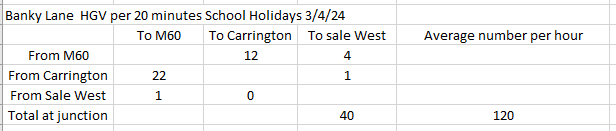
The following tables summarise the numbers of HGVs recorded during these surveys, some of which were travelling at excessive speeds.
HGVs at the Junction of Carrington Spur, Carrington Lane and Banky Lane

HGVs at the Junction of Carrington Lane, Flixton Road and Isherwood Road


We can see from these figures that the numbers of HGVs are consistent irrespective of the time of year. Also, the numbers remain consistent whether it is peak time or not, as evidenced in previous traffic surveys. Assuming a 10-hour working day (although residents will testify that these vehicles are running through the night), this is an average of 1500 HGVs a day.
You have to question why all of these vehicles pass residents, homes when there is already a road that bypasses Carrington Village? Why hasn’t this road (the A1 service road) already been improved and made available to take HGVs off the A6144 through the Village and alleviate the long suffering of local communities?
During the course of doing these traffic surveys the only congestion I witnessed was along the Carrington Spur Road and that was as a result of an accident on the M60 at Eccles.
Trafford Council’s website states
“The current route via the A6144 and Manchester Road is heavily congested by both cars and heavy goods vehicles (HGVs). Affecting the lives and journey times of people living in the area.
To provide easier and safer journeys, Carrington Relief Road will provide:
A new convenient route (Option F) to encourage HGVs to divert away from the congested A6144
Deliver improvements to make travelling by bus easier and safer
Provide new routes to enjoy when travelling by foot, bike and horse”
This statement is questionable. Firstly, the route is only heavily congested when there are issues on the surrounding motorway networks. Secondly, there is already an alternative route for HGVs that could be opened to divert HGV traffic away from the A6144. Thirdly, we already have routes to enjoy when travelling on foot, by cycle or on horseback – these public rights of way could be improved at a significantly lower cost, bringing considerable health and wellbeing benefits (which will not be generated if residents are walking, cycling or horse riding next to a very busy major road).
The truth is this road is not being built improve the lives and journey times of people living in the area. As Trafford Council’s own ‘Carrington Relief Road Environmental Impact Scoping Report’ states
“1.2. The key objective of the new Carrington Relief Road is to provide sufficient capacity within the transport network to deliver growth of housing and employment in the wider New Carrington masterplan area, and realise the socio-economic benefits of the future development. The redevelopment of this Site provides an opportunity to deliver a new link road for Trafford that will facilitate future phased development of c.5,000 new homes and 360,000sqm employment floorspace”.
So, Trafford Council admit that this relief road is not about improving the lives of existing communities but it’s to give the green light to build the biggest housing and industrial development in Greater Manchester. Once again, the communities of Carrington, Partington, Sale West and Warburton have been failed.
That Environmental Impact Scoping Report also recognises that through traffic will be induced into the area
“Traffic flows are likely to increase due to the improved desirability of the route” (paragraph 14.46)
and, if the 5,000 new homes and 360,000sqm of warehousing are built, it will not be long before the new relief road is at capacity and nothing has been gained but so much will have been lost (a 335 hectare peat moss, Grade 2 agricultural land, woodlands, wetlands, biodiversity, endangered species).
Trafford Council has failed to deliver on their promises of good public transport in successive Local Plans.

Instead of spending in excess of £76million on a short-sighted plan, other options should be seriously considered and pursued, such as opening the train line linking Partington with Irlam and Timperley. Long term prosperity and equality needs a public transport network that provides connectivity, reliability and sustainability for everyone and this is Trafford Council’s opportunity ensure our communities get this, at long last!
 Friends of Carrington Moss
Pingback: Concerned about traffic? Email your Councillors about the Carrington Relief Road! | Friends of Carrington Moss
Pingback: Risk to your local peatmoss – YOU can help! | Friends of Carrington Moss
Pingback: Poor Public Transport for the New Carrington Allocation Area | Friends of Carrington Moss