Monthly Archives: Nov 2021

Betrayal of the North – an opportunity for change?

The HS2 Integrated Rail Plan (IRP) for the North and Midlands has rightfully resulted in a furious backlash from Northern politicians, of all colours, for many reasons, most of which will be the subject of countless commentary over the coming weeks.  There’ll be analyses on the relative spend between the “North” and the “South”, the broken promises, how this decision fits with the “levelling up” agenda and much, much more.

But let’s not talk about the Government’s fixation with journey times, nor about the routes that will (or will not) be delivered, or whether guidance from experts has been ignored. 

Blah, Blah, Blah

Let’s talk about how they feel, those Northern leaders, who are, justifiably, very, very angry, about this “betrayal of the North3”!

Like the brochures produced to justify unsustainable development, there is lots of blah, blah, blah in the IRP about the benefits to commuters and communities of the Government’s “woefully inadequate1” plan.

Transport for the North (TfN) have asserted that the leaders of the North, from across the party-political divide, “have worked hard to come up with an evidence-led plan to help reverse the chasm of under investment1”.  

Many campaigners have done that too, putting lots of effort into developing evidence-based Alternative Strategies for our areas (one example from the Friends of Carrington Moss can be found at this link), and many of us have had those inputs, that are created in our own time, with our own money, totally ignored.

Cutting out local people

But the slashed route plans are not all.  My reading of the document suggests that the Government plans to exclude the Northern leadership from decision making and programme direction.  

The report states that:

One key lesson from other projects of this scale is the vital importance of leadership, clear accountabilities and simple client relationships. Splitting these roles in delivery risks failure. TfN is also a relatively small and young organisation with no experience of clienting a project of this scale through detailed development or delivery, and little or no ability to bear financial risk”.2

A stark stigmatisation of the capability of TfN, something residents from the vast talent pool involved in the planning ecosystem face regularly from a range of commentators who do not value contributions from citizens, whatever expertise they may have.

The document goes on to say the HS2 delivery partners will be managed by a single team, answerable to the Secretary of State, to whom Northern leaders will continue to have “direct and regular access”! 2 

A huge blow for those who feel (quite rightly) that Northern leaders should be driving the initiative in their area.  They are, though, still considered to be a sponsor, albeit with very little power and, seemingly, no influence.

Community groups feel the same

We, who don’t even have a seat at the table in local discussions, totally understand their frustration.  In our areas, we are the ones with local knowledge, we are the ones who fully comprehend the impact (both environmentally and economically) and we are the ones who will be most affected by the plans. 

Yet some politicians have repeatedly denied we are key stakeholders, have refused to engage with residents in a genuine and meaningful way, denying us the opportunity to input to plan-shaping and relegating our role to reading and reviewing copious documents, filled with jargon, misleading information and missing data. We are lucky to even get a response to our emails and our pleas to be involved are continuously ignored.

Comments from politicians of all Parties confirm how “bitterly disappointed3” they are, how “completely shortchanged3” they feel.  With academics also suggesting the revised plans leave the North with “the worst of all worlds3”, the echoes of our own protests are bellowed back at us in remonstration.  Greater Manchester’s Mayor stated “what about the people’s grandchildren and great grandchildren4”.  What indeed?  The Save Greater Manchester’s Green Belt group has been asking exactly that question given his plans to unnecessarily release over 2,430 hectares of green belt in the region.

Absolute Power – it isn’t just a northern problem!

So, it is clear, we within the Community Planning Alliance, comprising more than 530 community groups, all campaigning against inappropriate development, can fully empathise with the emotions of these enraged politicians.

But, will the experience of this, the opposite of localism, help THEM recognise the trauma and torment we feel every single day, exhausted by the lack of power, influence and voice citizens have within the planning ecosystem?

More importantly, will it make any difference?  

The Community Planning Alliance hopes they are listening and will continue to lobby for change!

Links:

  1. Councillor Louise Gittins, Interim Chair of Transport for the North (TfN newsletter 19/11/21)
  2. Integrated Rail Plan for the North and Midlands page 150
  3. Guardian article 18th November 2021 Betrayal of the North
  4. BBC article 19th November 2021 HS2: New plan a betrayal of the North, say critics

Will GM’s planned new developments impede their carbon emissions target?

Well, the answer is ……………………

GM does not know!  Neither the GMCA nor the Local Authorities themselves have calculated the impact of the change of land use and their documents seem to be focused on how carbon neutral the construction of new buildings is!

Of course, that is important, but it is not the whole story. 

Greater Manchester’s Places for Everyone (PfE) strategy sets 2038 as GM’s target for achieving carbon neutrality, and GM Mayor, Andy Burnham, says he has ambitious plans to decarbonise, including removing 1 million tonnes of carbon over the next three years through retrofitting homes and buildings, smart energy and overhauling the public transport system. 

But, whilst the PfE plan requires new development to be net zero carbon from 2028, there appears to be no information about the carbon emissions that result from the changes to land use set out in any of the documents.  This includes the change in emissions that happens because a location that was agricultural land becomes a housing estate, for example.

With this in mind, residents from across GM joined the Friends of Carrington Moss and Steady State Manchester’s Mark Burton to find out more about how to calculate the carbon emissions that will accrue from the numerous planned new developments set out in the PfE documentation.

Mark said “this is a complex area; we should have clear information from the GMCA and the Authorities themselves but this has not been provided and responses to our Freedom of Information Act requests have not been informative”.

Mark’s presentation used the New Carrington development in Trafford as a case study.  He highlighted the characteristics of the site, the sources of data that can be used to support these assessments, and the limitations of the high level estimate he had undertaken.  For this particular site, he used data from the UK Soil Observatory and the British Geological Survey to understand the scale of the peat on Carrington Moss and to explore what may be under the surface of the land. 

Mark continued “the figures in the P4E documents had huge gaps in the emissions data that should have been considered.  The development of strategic locations should be supporting our journey to carbon neutrality, not increasing emissions or closing the door on sequestration opportunities.”

Paul Beckman, Landscape Architect, was very concerned, “Why have the GM leadership approved this plan if they do not know how it will affect the achievement of the 2038 target?  It is clear that those making the decisions do not fully understand the carbon sources and the lost opportunities for sequestration in these plans”

Attendee Lorraine Eagling from Trafford said, “Carbon emissions have a huge impact on our health and Mark’s presentation was really interesting, I’ll be requesting more data from Trafford about the carbon emissions set out in the Carrington Relief Road options report, which do not make any sense

Evelyn Frearson from Woodford Neighbourhood Forum said “Mark’s presentation has highlighted the wide range of calculations that need to be made in order to assess the total impact on carbon emissions when changes in land use are proposed”.

Mark confirmed that he has created a toolkit that can be used by others to create high level estimates of the carbon implications of new development.  This will be an invaluable tool for community groups such as ours. You can find links to the toolkit here.

For more information, Mark can be contacted here.

Steady State Manchester’s work can be found here.

You can watch a recording of the meeting here.

Join our Walk for Wildlife

And enjoy one of the songs we’ve written to celebrate Carrington Moss

Every decision being made by those who purport to act on our behalf MUST have the climate emergency at heart to ensure we can counter the catastrophic effects that are becoming so frequently reported (wildfires, floods, biodiversity loss – to name but three).

Yet, it is clear from the decisions being taken across GM, and here in Trafford, that the impact of climate change on future generations is NOT the priority and it seems that unnecessary accelerated economic growth takes precedence over the health and wellbeing of existing residents. 

Why unnecessary? Well do remember, GM Authorities state (in the Places for Everyone plan) that they have existing land supply for 170,000 dwellings BEFORE releasing green belt. That is sufficient homes for 400,000 people, against a predicted population increase of 158,200! And these figures do not include an estimate of potential windfall sites (schemes that are currently not known about, but historical trends suggest will come forward). They do not include estimates of permitted development schemes or what may happen to the massive over-supply of office space across the region (over 3.1million m2 available against demand for 1.9million m2).

The climate crisis will not be solved if those taking decisions do not prioritise the nature and climate emergency!  Like COP26 participants, our local politicians are making long-lasting choices that will affect our day-to-day lives, where we live and the biodiversity we rely on.  The decline of nature affects us all and threatens the survival of future generations.

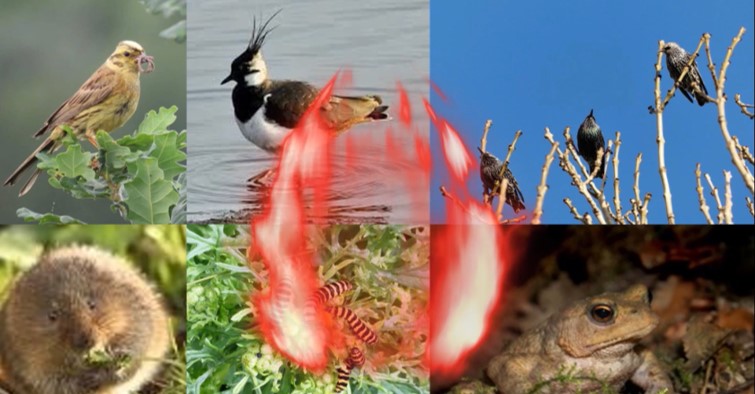
So, why have they decided to release green belt sites that are essential for combatting climate change? Land that alleviates air pollution, that soaks up surface water flooding, that is home to red listed birds and endangered wildlife? Here at Carrington Moss, 169 hectares is now under threat because of the decisions made by our Local Authority. An area comprising GM’s best and most versatile grade 2 agricultural land (that could provide locally grown food to meet the needs of local people – sustainable, low carbon footprint, local produce), carbon sequestering woodlands and irreplaceable peat moss/wetland habitats.

These decisions have been made despite resident opposition, despite alternative options (including those put forward by ourselves and the impacted Parish Councils) and, most importantly, despite the declaration of a climate emergency, which Trafford Council made in November 2018, almost 3 years ago!

The existing ecology and biodiversity will be all but destroyed by the plans to construct 4 major new roads, and build 5,000 houses and 350,000 m2 employment space on and around Carrington Moss. The so-called green corridor that remains incorporates over 80 hectares of land that is used by businesses, so is not accessible to the general public and is certainly not going to become alternative wildlife habitats. This local decision means we (and future generations) are facing more frequent and more serious surface water flooding, significant increases to air, noise and light pollution – and do get ready for an invasion of rats and other pests because their nests on the moss will be disturbed once the construction starts. 

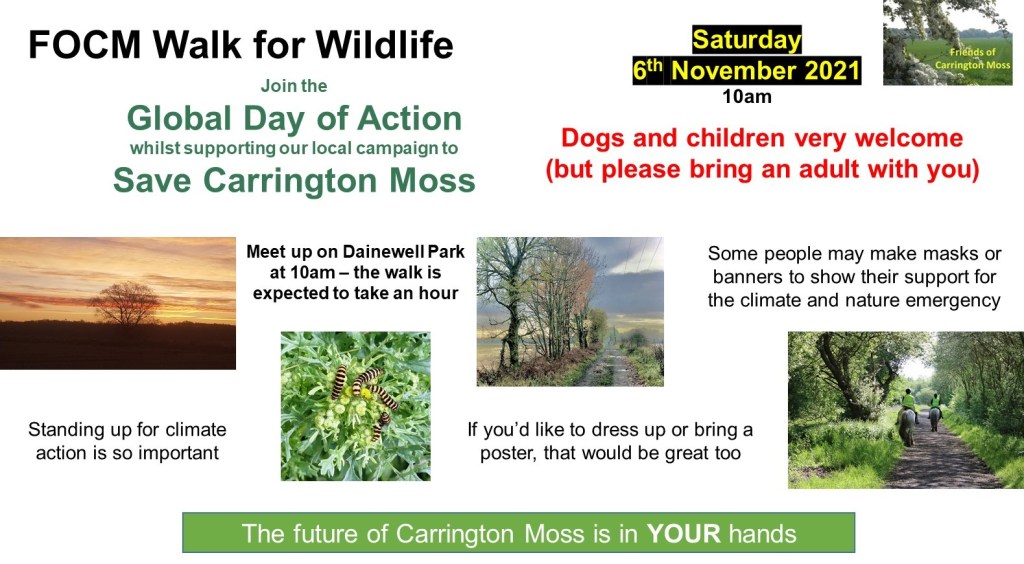
Come along on 6th November to show your support for action today not regrets tomorrow!

Along with many other groups, we are taking part in the Global Day of Action on 6th November 2021, a historic moment in the worldwide campaign for nature and climate justice.

As a Friends group, we have always conducted a very positive campaign, so with that in mind, we have written a number of songs to celebrate Carrington Moss.  We’re sure you will recognise all the tunes. As a starter for 10 (although we have only written 5 songs so far), we have chosen this song to support the Walk for Wildlife (click here for the words and some great photographs taken by various members of our group). Please share it with your friends and families. 

This next video (click here) shows various community members and groups singing a verse of the song, both young and old, local residents and users of the Moss, walkers, cyclists and horse riders.  Look out for the special effects and the outtakes at the end.

If you’d like to download the words to the song, they are available here.

So, please come and join us in this unique opportunity to stand with millions of other people from around the world, to focus on the impact of these decisions at a local level.  It’s YOUR chance to give nature a voice. 

By way of background, COP26 is the annual United Nations climate change conference (COP stands for Conference of the Parties).  It runs from Sunday 31 October 2021 to Friday 12 November 2021.

As has been widely reported, the science shows much more needs to be done to achieve the previously agreed aims.  World leaders need to take robust action because, if we continue as we are, temperatures will carry on rising, bringing even more catastrophic flooding, fires, extreme weather and destruction of species. 

The world needs to halve emissions over the next decade and reach net zero carbon emissions by the middle of the century.

Local politicians need to take action too.  Nature-based solutions, such as the restoration of our peat mosses, would help achieve the Region’s and the district’s carbon goals, efficiently and effectively.  Find out more here.