
What is the point of Local Development Plans?
In a recent Parliamentary statement, the Minister of State for Housing and Planning (Matthew Pennycook MP), suggested that “Planning is principally a local activity. It is local plans that set out a vision and a framework for the future development of any given area, addressing needs and opportunities in relation to housing, the economy, community facilities and essential infrastructure – as well as a basis for conserving and enhancing the natural and historic environment, mitigating and adapting to climate change, and achieving well designed places. Local plans are the best way for communities to shape decisions about how to deliver the housing and wider development that their areas need”.
The theory is that if a local authority doesn’t have a Local Development Plan (LDP), it can leave greenfield (land that has never been built on before) vulnerable to speculative schemes from the big developers. The converse should, therefore, apply. Having an LDP should increase the amount of development that is based on local need, rather than on corporate greed.
If only this were true!
An investigation by the Competition and Markets Authority (CMA) recently revealed that around “60% of all houses built in 2021 to 2022 were delivered by speculative private development”, and that “the country’s reliance on this model has seen the gap widen considerably between what the market will deliver and what communities need”.
The CMA also found evidence during the study which indicated some housebuilders may be sharing commercially sensitive information with their competitors, which could be influencing the build-out of sites and the prices of new homes. The Community Planning Alliance responded to a consultation about this issue, stating that the suggested remedy is so insignificant (in both financial and process terms) that it will not deter similar breaches in the future (from these and other providers).
Currently local development plans are not shaped by citizens; they are manipulated by developers. Resident input is neither welcomed, nor taken into account, as can be seen by the previous lack of effort to involve Trafford residents in either the LDP or the Places for Everyone (PfE) planning processes, nor to address the feedback they gave.
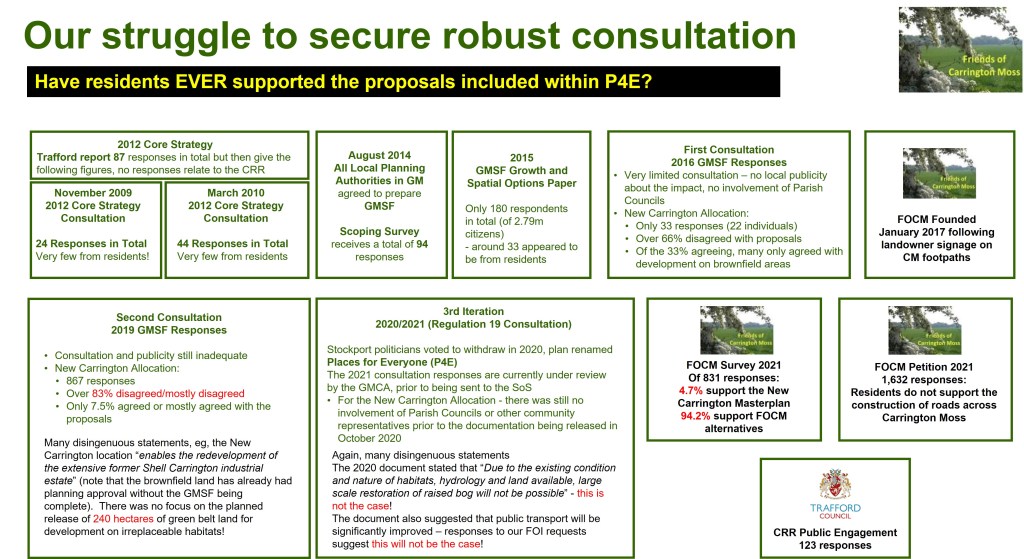
Despite analysis confirming that over 80% of those responding to the PfE consultation in 2019 either disagreed or mostly disagreed with the New Carrington proposals, the outcome was not to remove this unnecessary, environmentally destructive allocation or reduce it to just the brownfield land. No, Trafford continued with the developer proposals to damage or completely destroy a 335 hectare irreplaceable habitat (a restorable deep peat moss), productive Grade 2 agricultural land, woodland and wetland habitats, impacting 15 sites of biological importance and a site of special scientific interest, along with populations of red listed birds and endangered wildlife.
In their letter to the planning inspectors, Natural England confirmed that “the combination of the location and the extent of development proposed for this allocation mean the proposed development could not be accommodated without at least causing the deterioration of this deep peat irreplaceable habitat at the site, if not its loss”.
These damaging proposals were only adopted with PfE in 2024, yet already its policies are being ignored, and the principles upon which the PfE consultation was based, are not being upheld.
The PfE planning inspectors introduced specific policy criteria for the New Carrington Allocation (now known as JPA30 in the adopted PfE Plan).
Policy criterion 1 (page 447), for example, states that development of this site will be required to be “in accordance with a masterplan that has been developed in consultation with the local community and approved by the local planning authority”. The criterion continues “Central to the masterplan shall be the consideration of opportunities to restore habitats, strengthen ecological networks, and manage the carbon and hydrological implications of development, having regard to the presence of peat on parts of the site”.
Policy criterion 24 (page 450), requires that developments “Undertake hydrological and ground investigations as necessary to inform the comprehensive masterplan and use of suitable construction techniques to ensure any loss or deterioration of irreplaceable habitat, and adverse impacts on the hydrology of undeveloped areas, is minimised. Where loss or deterioration is unavoidable, a suitable compensation strategy should be identified and delivered, including the potential restoration of lowland raised bog and complementary habitats elsewhere within the site”.
It seems that the word ‘requires’ in a planning context should be interpreted as ‘required if the developers or the Council want it to be required’!
When taking the PfE plan through the modifications process, the planning inspectors were very deliberate in their choice of wording, adapting policy criteria as they felt necessary. Where policy criteria are to be subject to ‘get out clauses’ such as ‘where possible’ or ‘where appropriate’ or even where ‘it is not practicable or financially viable’ they included these terms within the criteria. In fact, several of the JPA30 policy criteria are subject to these limitations.
Criterion 1 has no such restrictions. Yet, despite the masterplan NOT being developed, AND a ‘suitable compensation strategy’ NOT being in place Trafford has approved a planning application (115160) on 19.9 hectares of very deep peat!
The approval of this planning application has set a number of dangerous precedents, with the interpretation of policy criteria now subject to the whims of specific schemes. Dismissing the “be required to” means that other criteria can also be disregarded or interpreted in a way that is contrary to general perceptions, in current and future planning applications.
Furthermore, the consultation for PfE was based on the premise that it would “avoid 10 districts proposing further amendments to the Green Belt in Local Plans” and that PfE would be “the only opportunity to make changes” to the Green Belt (see PfE document 07.01.25 Green Belt Topic Paper and Case for Exceptional Circumstances to amend the Green Belt Boundary). Despite this, the planning inspectorate has since approved development on Trafford’s retained Green Belt and Trafford consider that incursions into retained Green Belt on Carrington Moss for temporary road building “is an appropriate form of development in the Green Belt”.
Thus, not only are the policies within the PfE plan ineffective, but the basis on which the consultation was undertaken was flawed, as the GMCA and the participating districts are not in a position meet their stated commitment. This means that the expenditure incurred on examining the policies is also wasted.
One could ask what was the point of spending huge amounts of public money (multiple millions of pounds), over a 10 year period, to agree a spatial plan with careful policy wording that can just be ignored (unless that abhorrent waste of public funds was simply to enable developers to access 2,400 ha of Green Belt land across Greater Manchester, when there was sufficient brownfield to more than meet housing and employment requirements)!
Finally, unlike developers, communities cannot appeal a planning decision, even when NPPF and/or LDP policies have not been complied with. This is a gross inequity within the planning system. It means that citizens ONLY have the option to request a judicial review (JR). Not only is this an avenue that the government wishes to curtail, it also requires the communities themselves to fund the action (they cannot use public funds, like a local authority, nor can they use a corporation’s funds, which developers can take advantage of). Given that communities must request donations from the personal pockets of citizens, there is no such thing as a ‘frivolous’ JR from a community perspective (despite this government’s rhetoric suggesting otherwise)!
All in all, if the policies in the NPPF and an LDP can be cherry-picked to meet the needs of Councils and corporations, they are not providing good value for public money, nor are the associated decisions made in the public interest. Sadly, what we are seeing demonstrated here is a gross betrayal of current and future generations!
If you’d like more detail, read on!
Quick background for those who are unaware
A Local Development Plan (LDP) comprises all the documents that guide development and land use within a specific local authority area, providing a clear set of planning policies that should determine where and when development can and cannot happen to ensure transparency and consistency. Once adopted, these documents become statutory, they are supposed to be legally binding and must be taken into account when making planning decisions.
When planning applications are submitted, they are assessed against the policies in the LDP and also against the policies set out in the government’s National Planning Policy Framework (NPPF).
If an LDP is out-of-date, there is a presumption that the Local Planning Authority (LPA) will grant planning permission for sustainable development. This is called ‘the presumption in favour of sustainable development’ and is set out at paragraph 11 of the current NPPF.
The term ‘sustainable development’ is not clearly defined (probably deliberately, as successive governments have been keen to ensure developments are approved no matter what harms they cause). Some authorities, developers and planning inspectors appear to only consider the materials a building or road is constructed with, and do not (for example) take into account whether an irreplaceable habitat will be damaged, whether there is sufficient social and economic infrastructure to support the scheme or whether there will be other environmental impacts (increased air, noise, light, vibration or water pollution, increased carbon emissions, increased risk of flooding, for example). New Carrington certainly cannot be considered to be a sustainable development but its allocation for development has been approved by the planning inspectorate!
As an aside, there is also Permitted Development, which means that some specific types of development do not need a planning application (such as the conversion of offices and shops to housing). These schemes could, potentially, override agreed LDP policies.
What about Trafford’s LDP?
LPAs should develop their LDPs in consultation with their local communities, to ensure the plan reflects local needs and aspirations. Back in May 2025, FOCM responded to Trafford’s latest consultation on its new Local Plan. A quick review will show that we made lots of comments. We await the next iteration to see if any of them have actually been taken into account.
We certainly do not feel that our previous inputs were taken seriously. It is clear that Trafford’s proposals for New Carrington were fixed and firm BEFORE the public consultation. Whilst there has been some reduction in scale, this was not at the same level as in other districts. Given that Natural England also objected to the harms proposed to what they describe as a 335 hectare restorable and irreplaceable deep peat moss, it is astounding that the development was not restricted to brownfield land (there is plenty of it in the area).
The consultation process for PfE was abysmal. Residents were not made aware of the environmental and ecological harms proposed, nor of the size and scale of the proposals (which were originally 16,000 houses and 7m m2 employment space). In the 2019 consultation, there were over 150 documents (comprising over 14,000 pages) to review. These documents were full of factually incorrect and/or disingenuous statements. The Friends of Carrington Moss was actually constituted following the introduction of signage on the public rights of way that stated ‘Trespassers will be prosecuted’. A clear indication that the developer considered the allocation to be a done deal!
What actually happens?
Well, there is an immediate ‘get out’ clause in the government’s guidance, which states that there is “a requirement set in law that planning decisions must be taken in line with the development plan unless material considerations indicate otherwise”.
And there’s the rub!
Material planning considerations are the things an LPA must take into account when deciding whether to approve or decline a planning application. It is assumed that these considerations help to ensure that planning decisions are rational and are based on established policies and evidence.
Can it really be considered rational to:
- build on an irreplaceable habitat, in an area that hosts 15 sites of biological importance and a site of special scientific interest?
- develop in an area that hosts significant surface water flooding every year?
- significantly increase air, noise, light, vibration and water pollution, for populations of humans and endangered wildlife and birds?
- put even more pressure on local resources (such as schools and health services), especially in an area that Trafford considers to be poorly served by public transport?
- destroy woodland, wetlands and productive Grade 2 agricultural land when there are a significant number of brownfield sites in Trafford and elsewhere in Great Manchester?
Maybe those who have a short term, increase my wealth agenda, think it is rational? We disagree!
The planning officers consider what is known as ‘the planning balance’. This is a process of supposedly weighing the benefits and harms of a proposed development. In determining whether the potential benefits of a development outweigh the negative impacts, or vice versa, the planners use their ‘judgement’.
In the Officer Report for planning application 115160 (Battery Energy Storage System adjacent to the Shell Pool Reserve and the Flare Stack), Trafford set out which documents represent the LDP:
- The Places for Everyone Joint Development Plan Document (PfE), adopted on 21st March 2024
- The Trafford Core Strategy, adopted 25th January 2012
- The Revised Trafford Unitary Development Plan (UDP), adopted 19th June 2006
- The Greater Manchester Joint Minerals Plan, adopted 26th April 2013.

Trafford decided that the application should be approved, despite:
- The ground investigation reports revealing that the land was very deep, restorable peat
- The application not complying with the LDP policies, including the requirement for a Masterplan and a ‘suitable compensation strategy’ for the harms to be caused to the peat (the lack of a final Peat Management Plan agreed with Natural England)
- Pitiful compensation (via Biodiversity Net Gain) of just 1.15 hectares
- The visual impact on nearby residents (especially given the flat mossland landscape)
- No calculation of the carbon impact of removing or piling the peat (despite Trafford’s Carbon Neutral Action Plan and the Greater Manchester aim to be Carbon Neutral by 2038)
- The document confirming that this “site is allocated for employment use within the New Carrington Allocation”, yet the development will not result in a single local job being created and using the site for this purpose will reduce the potential for employment opportunities for local residents (its previous use as productive Grade 2 agricultural land did provide jobs for local people), another indication of unsustainable development
That the planning officer suggested the application proposals are unique is bizarre. There are now 3 BESS within Carrington and a further 2 elsewhere in Trafford. Another rather surprising conclusion reached by the planning officer is that the Friends of Carrington Moss represents a single household and, due to written objections being limited to just “5 addresses, including Friends of Carrington Moss”, they did not meet Trafford’s threshold (10 addresses) for raising the application with the Planning Committee.
In relation to the New Carrington Masterplan, the planning officer did not consider the need for mitigation of the environmental and ecological harms to be caused, both within the site and across the allocation in general but limited their assessment to whether the scheme would be impacted by one of the 4 proposed new roads!
To date, there has been no consideration of how the harms to, and losses of, natural capital assets will be addressed across the allocation area (either in PfE or through the Masterplan discussions). So, how does the planning officer know that premature planning applications, such as this one, will not conflict with the eventual requirements.
In fact, the planning officer states that, in relation to this planning application, “it is considered that the site itself is not needed immediately to contribute to the site-wide green and natural infrastructure strategy”. Given that this 19.9 ha site comprises deep restorable peat, this suggests that decisions have been made about the natural infrastructure strategy in advance of any collaboration with local residents!
Interestingly, their ‘judgement’ was that there was “no fundamental conflict with the emerging masterplan, that would preclude this development from coming forward ahead of it. Nevertheless, this approach can only be supported if the application makes the appropriate financial contribution set out in the Council’s latest Interim Planning Strategy (IPS) for New Carrington (February 2024)”. In other words, if the developer pays towards the Carrington Relief Road, approval could be granted, if they didn’t it could not.
We fundamentally disagree with this premise. Whilst we believe developers should fully contribute to infrastructure requirements, their contributions should not determine whether a scheme meets other policy needs, including the impact on natural capital assets! It should be noted, however, that Trafford has recent lost an appeal where they refused a development because the applicant (Peel) did not agree to fund the infrastructure requirements according to Trafford’s formula.
The planning inspectors held a specific hearing during which Natural England confirmed that the 335 hectare peat moss at New Carrington (then JPA33) was irreplaceable and restorable. Yet, in their final report (paragraph 235), having taken NPPF guidance about irreplaceable habitats into account when considering whether the allocations were ‘sound’, the planning inspectors determined that, despite there being sufficient brownfield land to exceed housing ‘targets’, they were content that the GMCA was entitled to make the judgement that an allocation that could completely destroy a 335 hectare irreplaceable habitat (paragraph 635) met the wholly exceptional reasons test (now NPPF 193c). This decision was strongly challenged by Natural England at the hearing and local communities also disagree that the public benefit clearly outweighs the loss or deterioration of the habitat given the amount of brownfield land available across the urban areas of Greater Manchester.
The benefits the planning inspector’s refer to in their decision are also set out at paragraph 635, which suggests that “The allocation would make a very significant contribution to Trafford’s housing and employment needs, as well as contributing to the strategy of sustaining the competitiveness of the southern areas. It would also involve substantial regeneration of previously developed land, bringing with it associated social and environmental benefits”.
Local communities must monitor that these so called ‘benefits’ are actually achieved (no one else will do that). If they are not delivered, Trafford has sacrificed our much-used local green space, irreplaceable habitat and other natural capital assets for huge developer profits, with no mitigation or compensation for communities or the many local populations of red listed birds and endangered wildlife!
 Friends of Carrington Moss
You must be logged in to post a comment.