Tag Archives: housing

Are decision-makers tackling housing need and affordability?

Will building more homes reduce house prices?

For far too long our politicians have been listening to lobbyists for the big construction companies and have been closing their eyes and ears to genuine evidence (even that produced by the Office for National Statistics).  They have certainly ignored feedback from their own citizens.

The Community Planning Alliance (CPA) Homes for Everyone report debunked many of the myths around market housing land supply, confirming that there are 1.5 million empty homes that could be renovated, there is planning permission to build over 1 million homes that have not yet been started, and sufficient brownfield land to build more than 1 million homes.  In addition, CPA proposed some novel options to incentivise those with (around 26 million) empty bedrooms to rent them out and to repurpose the more than 165,000 empty commercial premises to support housing need.

The government should be making it easy for Councils and developers to maximise these routes to meet their housing aspirations.  Instead, Ministers are intent on changing planning rules and weakening the regulations that protect our important natural capital and ecosystem services.  

As CPA highlighted in their Veering Off Plan report, despite purporting that their policies will boost housing affordability, the government is neither directing supply nor improving confidence in demand, leaving all stakeholders uncertain and under pressure!

One of the main reasons housing affordability has rapidly declined over the past 20 years is the lack of focus on genuinely affordable homes (social housing), with construction of this essential element of our housing toolkit reducing from over 50,000 per annum in the 1990s to less than 10,000 per annum in 9 of the last 12 years.
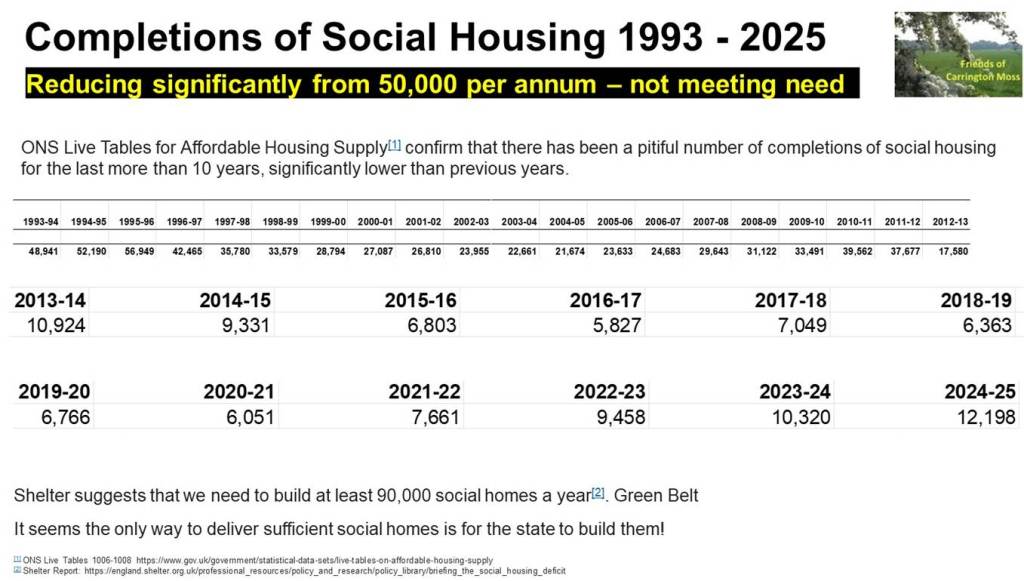
Given the Right to Buy scheme, which, along with the lack of new builds, has seen availability of social housing more or less collapse during that 12 year period, successive governments have missed a trick.  The focus on developer-led market housing has not only resulted in huge increases in house prices (for the reasons set out in the recent IPPR report), it has significantly reduced choice for those who cannot (and some may never be able to) afford to buy, with rental costs exceeding £1,000 a month “in more than half of British neighbourhoods“.

Had there been less lobbying and more emphasis on need, governments would have introduced policy to maximise social housing supply, significantly increasing the number of homes available at an affordable rent.  This would increase competition for private landlords, bringing down all rent levels (and enabling those who could get onto the housing ladder to save up for their deposits).  It would provide security and stability for families, significantly decrease homelessness and would also reduce the costs to the public purse, releasing funding for other priorities.

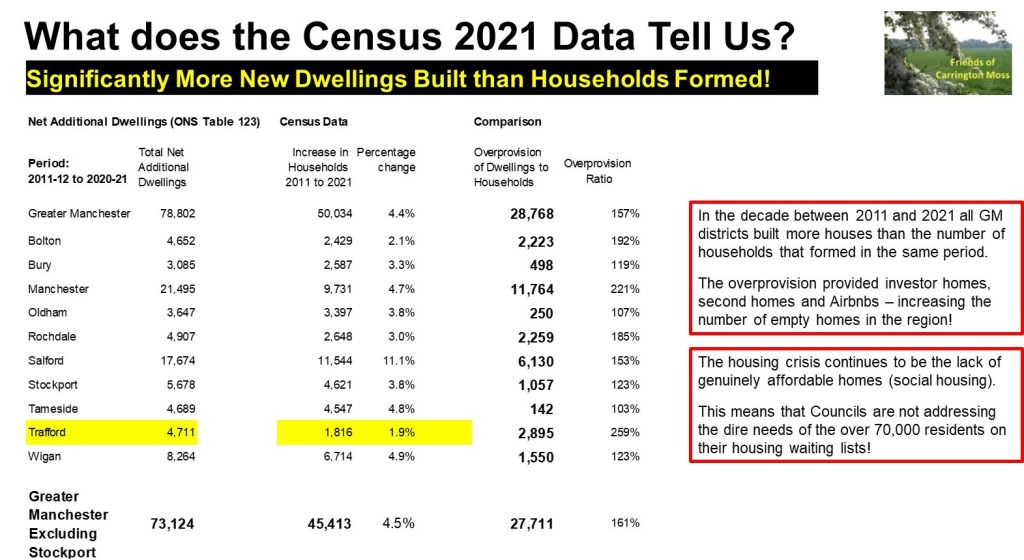
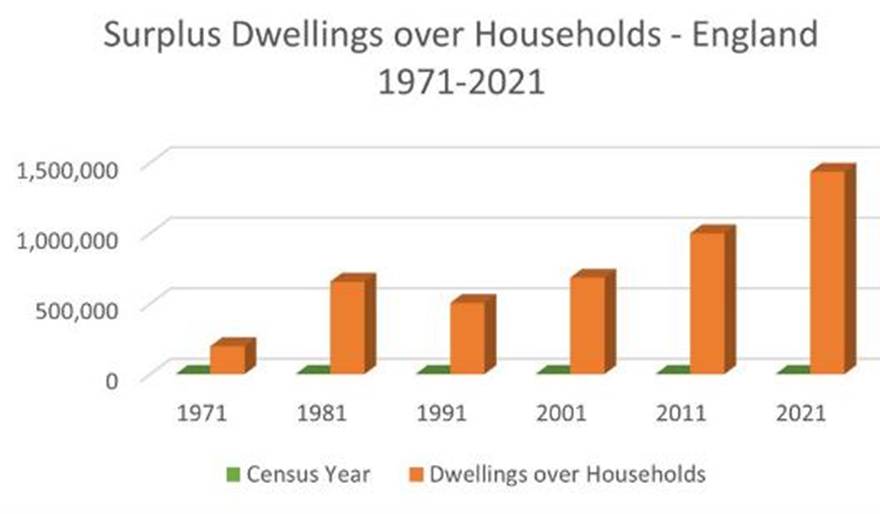
Well, the narrative that we have a market housing crisis and that housing is so expensive because there are not enough homes to go around is pushed by developer lobbyists and is extremely misleading – overall housing stock levels have consistently risen at a higher rate than population growth, meaning that there must be a huge number of second homes, holiday homes, airbnbs and empty homes.
Many new homes are purchased by investors, landlords and speculators, which does not increase supply for those who need them most and does keep house prices high (as they are viewed as a way of making money through financial speculation, rather than just being a place to live).

The IPPR report, mentioned above, highlights that “recent governments have focussed on boosting market housing supply through a combination of changes to planning rules, liberalising access to mortgage finance, stamp duty land tax cuts and holidays, and other demand-side measures like help to buy equity loans”.  They also identify a number of challenges, such as resourcing concerns for statutory agencies, the dependence on the speculative model of development, and the focus on market housing, rather than local need.

There is significant evidence that the typical supply/demand approach does not work for market housing (and let’s be clear, if it did, there would be a lot of very unhappy homeowners, who would see their asset fall in value and possibly negative equity on their mortgages).  Another issue to consider is that, if additional housing supply was to cause sharp declines in house prices, this might raise concerns about the financial stability of mortgage lenders (mortgages are based on the value of a house and if an owner defaults, the lender should be able to recover their money via the asset underpinning the loan – if its value decreases then the banks would not be able to secure a return on their investment).

This excellent blog from Alternative Cornwall discusses the relationship between housing, its status as an asset (as well as a place to live), deregulation and the divergence of wage growth, compared to house prices.  The argument in the blog is supported by this article from Bank of England researchers, effectively confirming that one of the key issues is that houses are now considered to be assets, with prices being determined by the role of finance (ie the Bank of England, historically low interest rates, credit availability, investor demand, etc).  Other articles say similar things, this one, for example, highlights that “the rise in real house prices since 2000 can be explained almost entirely by lower interest rates“.

So, increasing market housing supply is unlikely to significantly reduce house prices, in fact, at a local level, they could cause house prices to rise (because of perceived gentrification, for example).  But – the government’s policies have been great for the asset-wealthy few, who have seen house prices go in only one direction – UP!

Current policies do nothing for the most vulnerable in our society, or for those who are enduring the current cost of living crisis and, of course, the recent increases to interest rates have radically affected affordability for a typical homeowner.

Those policies also do nothing for the environment or nature, which have been attacked and scapegoated to facilitate market housing permissions, which will only be built out when the developer can achieve their desired profit margins.

Even with the government’s recent investment in social and affordable housing (£39 billion), they are only scratching the surface of the issue following decades of decline. Those big corporations will build what they want, when they want, where they want – but they are not focused on what is needed in our communities and authorities should be doing much more to prioritise community participation!

The Greater Manchester Green Belt Lie!

There has been lots of commentary about Stockport’s withdrawal from the Greater Manchester Spatial Plan (Places for Everyone, or PfE) since they made the decision in 2020, especially about the consequential risk that being out of the plan will lead to more Green Belt release and speculative development.  The same threats are being made to those who, more recently, want to remove Oldham from PfE, with some Councillors suggesting the arguments in favour of withdrawal are misleading residents and that this approach “would lead to further developments on the greenbelt”.

Breaking News!

It doesn’t matter whether you are in or out of PfE that risk is still there.  Trafford’s rejection of a Battery Energy Storage System (BESS) on retained Green Belt has been approved on appeal by the Planning Inspectorate, despite participation in PfE that supposedly gave protection to that land!

Given the £millions of public money spent on Places for Everyone over the more than 10 years it took to bring the plan to fruition, why hasn’t the media picked up on this issue and who is auditing this failure to achieve even the basic aims of the plan?

Places for Everyone is supposed to be a brownfield first plan, it is supposed to protect retained Green Belt from development, it is supposed to help resolve the housing crisis in Greater Manchester. 

Green Belt allocations are coming forward across the region (much reported in local press and the MEN) and are being approved in advance of all the swathes of brownfield land available for development (despite huge amounts of public money being made available to regenerate that previously developed land).

Retained Green Belt is not protected by participation in the PfE plan. In the particular case mentioned above, the Planning Inspector used the Government’s ‘Grey Belt’ rules to assert that it is appropriate development.  There were no concerns raised about the number of fires that have occurred on such developments, including the BESS fire in Liverpool that burned for 59 hours, or more recent fires in Essex and Aberdeen.  At least there will be plenty of water available from the River Mersey should a fire break out, but All Saints Catholic Primary school is just down-wind of the site, so alarms should be raised to alert the school and local residents if a fire or the associated toxic fumes are released.  Nothing was mentioned about this by the Planning Inspectorate, which seems to be blindly allowing as much development as possible to support the Government’s war on nature and communities.

There are many ways to resolve the housing crisis, none of which require the release of Green Belt.  These are outlined in the Community Planning Alliance Homes for Everyone Report

The Government and Greater Manchester’s leadership are explicitly ignoring the data that shows:

  • There is sufficient brownfield land available to deliver at least 1.2m homes nationwide
  • There are 1.55m empty homes across England and Wales (including 70,000 homes owned by councils and housing associations)
  • There are an estimated 165,000 empty commercial properties that could be turned into houses and/or flats
  • More innovative solutions could also be looked at, such as promoting the 26m empty bedrooms in the UK that could provide income for the householder and a place to live for someone on a waiting list.

Shockingly, there are many sites which have been granted planning permission but have not been developed that could provide over 1m new homes – yet there is no impetus from the Government to ensure these sites are brought forward BEFORE any Green Belt is released.

Finally, the biggest issue with the housing crisis is the lack of genuinely affordable homes (social or Council housing).  This is an issue that has been disregarded for many years and the current Government has not even set a target to ensure Councils increase the number of these homes to address the huge and growing waiting lists.  Places for Everyone should have been renamed ‘Places for those who can afford to buy’ because the target for all affordable housing was removed from policy during the modifications process and the target for social housing was removed from the plan altogether!

We have frequently highlighted the impact on nature’s recovery, climate mitigation and our future food security when Places for Everyone was adopted by the Greater Manchester leadership in March 2024.  The consequence of the loss of environmentally and ecologically rich Green Belt land which provides all these benefits, along with the other issues set out above, shows the extent of the betrayal of future generations that is now becoming increasingly obvious.

The Planning and Infrastructure Bill (published by the Government on 11th March 2025) intensifies the Government’s war on nature and communities by reducing democracy and weakening protections for flora and fauna.  It introduces Spatial Development Strategies, similar to Places for Everyone, but without the consultation previously required.  We’ll say more about this in a future blog, but it appears to be yet another Developer’s Charter, as someone else succinctly put it – another Government initiative providing

Developer Net Gain!

Trafford has available sites for affordable housing, so why are they not being built?

by Lorraine Eagling

The New Carrington Masterplan will result in the loss of a 335-hectare peat moss, Grade 2 agricultural land, woodlands and wetlands which will have dire consequences for local biodiversity and Trafford Council’s ability to be net zero by 2038.  These important habitats are to be concreted over and replaced with 5,000 houses and 350,000sqm of warehousing.

There is no doubt that there is a crisis in the availability of genuinely affordable housing (that is social/council housing) but Trafford and Greater Manchester appear to be planning to continue to build for investors, second home owners and airbnbs!

Building on a peat moss is not the solution to the affordable housing crisis.  Research from CPRE has shown that there are enough ‘shovel-ready’ brownfield sites in the UK for 1.2 million new homes, which will make a significant contribution to Labour’s goal of 1.5 million homes.

The Labour Government recently published five golden rules for house building which were articulated in their proposals for the updated National Planning Policy Framework.  They propose a sequential test which makes it clear that schemes must look to brownfield first, prioritising the development of previously used land wherever possible.

There are numerous suitable, local, brownfield sites, some of which are Council owned, that could be developed in advance of concreting over land that contributes to climate mitigation, nature’s recovery and our future food security.  These brownfield sites could provide much needed social housing, which is not what is proposed for the former Green Belt land on Carrington Moss. 

Here are some examples of such Council-owned sites, that are ready to be developed and are in locations that are serviced by good public transport links and local amenities (unlike the isolated area that is Carrington Moss, which the Council acknowledges is poorly served by public transport).

  • The former Depot on Higher Road, Urmston – this site has been lying empty for a number of years.  Following a freedom of information request, Trafford Council confirm this site was sold to a private developer.  To date, there have been no planning applications submitted for this site. 
  • The former Woodsend Primary School, Flixton – this site has been lying empty for a number of years.  Following a freedom of information request, Trafford Council confirm that they are looking at options to deliver homes on this site and would expect to make a decision within the next 12 months. 
  • Sale Magistrates Court, Sale – this building was demolished a number of years ago and the land sold to a private developer who submitted a planning application in December 2020.  To date, no building work has commenced.

In addition to these Council-owned sites, there are many other brownfield sites in Trafford awaiting development, as identified in the Council’s own Strategic Housing Land Availability Assessment (known as a SHLAA for short).

In response to our freedom of information request Trafford Council said

‘Delivery of homes including affordable homes is a priority for the Council. The Council is prioritising the delivery of homes at Council owned sites including Tamworth (Old Trafford), Former Sale Magistrates Court, Chapel Road (Sale) and Stretford Town Centre.

We also have a need to invest in other assets and services that benefit our communities. For example the Council is investing in its leisure portfolio which includes improvements at Urmston, Altrincham and Partington Leisure Centres. The receipts from land sales such as Higher Road Depot are part of the funding for these activities.’

We await progress with interest but, given that planning applications are already coming forward on former Green Belt and greenfield land, there is no doubt that the Brownfield First policy is NOT what is being pursued in Trafford!