

Are decision-makers tackling housing need and affordability?
Will building more homes reduce house prices?
For far too long our politicians have been listening to lobbyists for the big construction companies and have been closing their eyes and ears to genuine evidence (even that produced by the Office for National Statistics). They have certainly ignored feedback from their own citizens.
The Community Planning Alliance (CPA) Homes for Everyone report debunked many of the myths around market housing land supply, confirming that there are 1.5 million empty homes that could be renovated, there is planning permission to build over 1 million homes that have not yet been started, and sufficient brownfield land to build more than 1 million homes. In addition, CPA proposed some novel options to incentivise those with (around 26 million) empty bedrooms to rent them out and to repurpose the more than 165,000 empty commercial premises to support housing need.
The government should be making it easy for Councils and developers to maximise these routes to meet their housing aspirations. Instead, Ministers are intent on changing planning rules and weakening the regulations that protect our important natural capital and ecosystem services.
This will not make housing more affordable!
As CPA highlighted in their Veering Off Plan report, despite purporting that their policies will boost housing affordability, the government is neither directing supply nor improving confidence in demand, leaving all stakeholders uncertain and under pressure!
One of the main reasons housing affordability has rapidly declined over the past 20 years is the lack of focus on genuinely affordable homes (social housing), with construction of this essential element of our housing toolkit reducing from over 50,000 per annum in the 1990s to less than 10,000 per annum in 9 of the last 12 years.
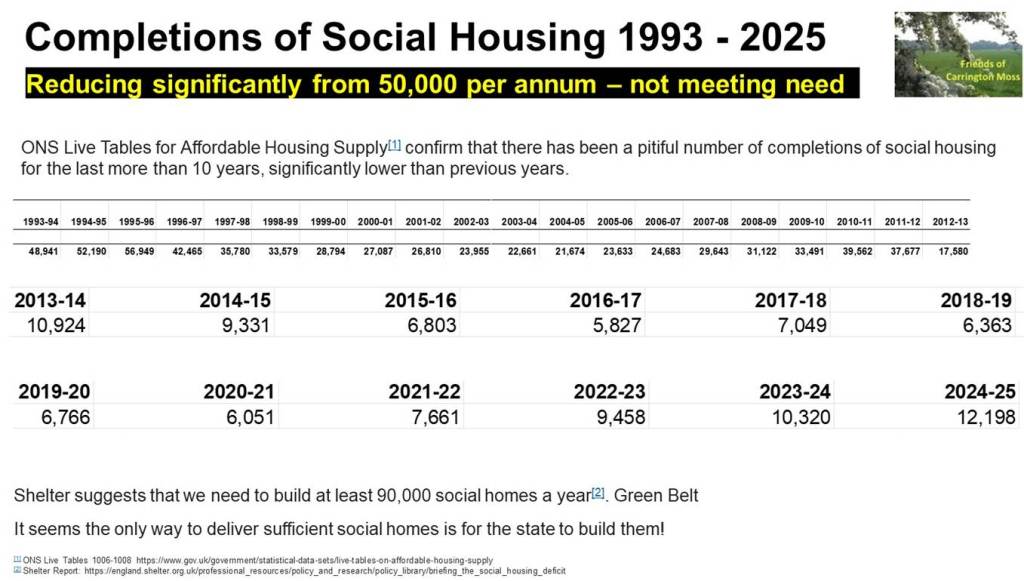
Given the Right to Buy scheme, which, along with the lack of new builds, has seen availability of social housing more or less collapse during that 12 year period, successive governments have missed a trick. The focus on developer-led market housing has not only resulted in huge increases in house prices (for the reasons set out in the recent IPPR report), it has significantly reduced choice for those who cannot (and some may never be able to) afford to buy, with rental costs exceeding £1,000 a month “in more than half of British neighbourhoods“.
Had there been less lobbying and more emphasis on need, governments would have introduced policy to maximise social housing supply, significantly increasing the number of homes available at an affordable rent. This would increase competition for private landlords, bringing down all rent levels (and enabling those who could get onto the housing ladder to save up for their deposits). It would provide security and stability for families, significantly decrease homelessness and would also reduce the costs to the public purse, releasing funding for other priorities.
But that did not happen, so where are we now?
Well, the narrative that we have a market housing crisis and that housing is so expensive because there are not enough homes to go around is pushed by developer lobbyists and is extremely misleading – overall housing stock levels have consistently risen at a higher rate than population growth, meaning that there must be a huge number of second homes, holiday homes, airbnbs and empty homes.
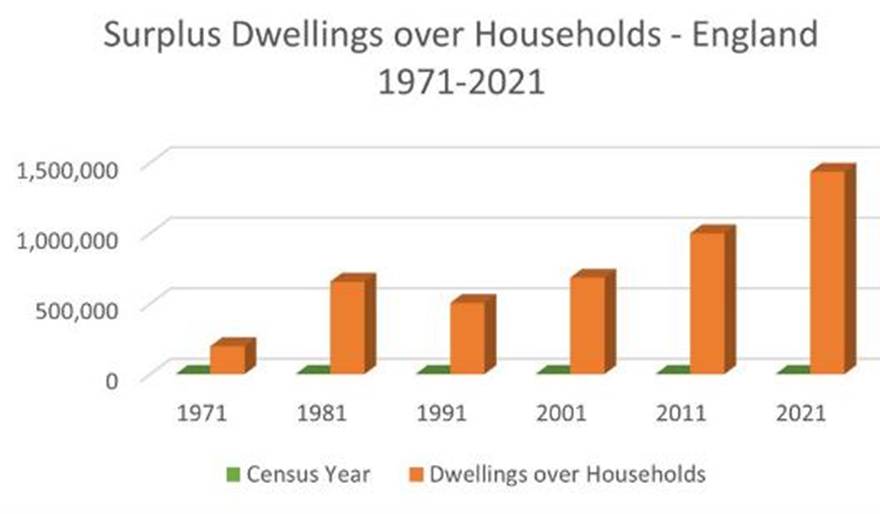
Many new homes are purchased by investors, landlords and speculators, which does not increase supply for those who need them most and does keep house prices high (as they are viewed as a way of making money through financial speculation, rather than just being a place to live).
The IPPR report, mentioned above, highlights that “recent governments have focussed on boosting market housing supply through a combination of changes to planning rules, liberalising access to mortgage finance, stamp duty land tax cuts and holidays, and other demand-side measures like help to buy equity loans”. They also identify a number of challenges, such as resourcing concerns for statutory agencies, the dependence on the speculative model of development, and the focus on market housing, rather than local need.
There is significant evidence that the typical supply/demand approach does not work for market housing (and let’s be clear, if it did, there would be a lot of very unhappy homeowners, who would see their asset fall in value and possibly negative equity on their mortgages). Another issue to consider is that, if additional housing supply was to cause sharp declines in house prices, this might raise concerns about the financial stability of mortgage lenders (mortgages are based on the value of a house and if an owner defaults, the lender should be able to recover their money via the asset underpinning the loan – if its value decreases then the banks would not be able to secure a return on their investment).
This excellent blog from Alternative Cornwall discusses the relationship between housing, its status as an asset (as well as a place to live), deregulation and the divergence of wage growth, compared to house prices. The argument in the blog is supported by this article from Bank of England researchers, effectively confirming that one of the key issues is that houses are now considered to be assets, with prices being determined by the role of finance (ie the Bank of England, historically low interest rates, credit availability, investor demand, etc). Other articles say similar things, this one, for example, highlights that “the rise in real house prices since 2000 can be explained almost entirely by lower interest rates“.
So, increasing market housing supply is unlikely to significantly reduce house prices, in fact, at a local level, they could cause house prices to rise (because of perceived gentrification, for example). But – the government’s policies have been great for the asset-wealthy few, who have seen house prices go in only one direction – UP!
Current policies do nothing for the most vulnerable in our society, or for those who are enduring the current cost of living crisis and, of course, the recent increases to interest rates have radically affected affordability for a typical homeowner.
Those policies also do nothing for the environment or nature, which have been attacked and scapegoated to facilitate market housing permissions, which will only be built out when the developer can achieve their desired profit margins.
Even with the government’s recent investment in social and affordable housing (£39 billion), they are only scratching the surface of the issue following decades of decline. Those big corporations will build what they want, when they want, where they want – but they are not focused on what is needed in our communities and authorities should be doing much more to prioritise community participation!
Change is crucial because it is very clear that decision-makers are NOT taking radical action to tackle housing need or affordability – they are just continuing to pander to the powerful!
 Friends of Carrington Moss
You must be logged in to post a comment.