
Category Archives: SGMGB

Confusing Green Belt messages from our politicians!

Communities are delighted that the Conservative Party continues to pledge to retain the Green Belt, despite Sir Keir Starmer’s recent vow to concrete it over! 

But …….

That pledge does not secure actual protection for our Green Belt. 

Despite the National Planning Policy Framework (NPPF) paragraphs 140 and 141 suggesting that ONLY WHENexceptional circumstances” are “fully evidenced and justified”, together with a demonstration that “all other reasonable options” have been considered, can Green Belt boundaries be amended, frequent approvals of Green Belt developments occur (including in our region). 

Clearly those “exceptional circumstances” are not a hard test to meet!

Many communities nationwide are campaigning to protect Green Belt sites which comprise irreplaceable habitats (peat moss), Grade 1, 2 or 3 agricultural land, woodlands and wetland habitats.  Our politicians are unnecessarily putting them under threat of development and the current environmental protections are just not robust enough, with the requirement to make “as much use as possible of suitable brownfield sites and underutilised land” (paragraph 141) a mythical aspiration rather than an objective of the NPPF!

Just one example of those poor environmental protections is the risk to Greater Manchester’s peat mosses (many of which are allocated for significant development in the Places for Everyone Plan). 

The Government is taking a very slow pathway to protect peatland soils, despite the increasing recognition of the ecosystem services peat provides.  Since 2009, there has been a commitment to Safeguarding our Soils, recognising that soils play a huge role in the fight against climate change (and helping us manage its impacts).  In the 2011 Defra Natural Environment White Paper, the Government recognised the natural capital asset of soils.  The 25 Year Environment Plan (published in 2018) restates the aspiration to manage our soils sustainably by 2030, including improving soil health and restoring and protecting our peatlands.  More recently, the England Peat Action Plan (2021) sets out the Government’s vision to reverse the decline of our peatmosses.  The aim is to prevent further loss of peatland habitats, to restore more peatland landscapes and the document recognises that rewetting peatland areas and returning them to their natural state could make a significant contribution to achieving our targets for reducing carbon emissions, as well as having other benefits for water quality, nature and flood mitigation.

Yet, there is still no moratorium on builds on peat mosses and no commitment to change in the recent NPPF consultation. 

There have been many interventions from Natural England (which have been summarily dismissed by the GMCA).  Yet, even though there is no actual NEED to build on these precious, irreplaceable habitats and despite every district declaring a climate emergency, some of Greater Manchester’s most important natural capital assets are at risk of destruction!

What about Sir Keir Starmer’s commentary?

The Labour Party position is not a surprise to those of us based in Greater Manchester.  The Save Greater Manchester’s Green Belt Group wrote to Sir Keir in January 2023, copying members of his Shadow Cabinet, GM’s Labour Mayor and Labour MPs (you can read our letter at this link).  To date, we have received no acknowledgement nor a reply from any of the recipients. 

Clearly engagement with communities is not a priority for them.

In fact, as a member of a recent Question Time panel (27th April), Lisa Nandy confirmed (in a discussion about housing), that the Labour Party are working with developers, investors, Councils and planning authorities.  She made no mention of working with communities. 

In this Times article Sir Keir says “Labour would give councils and residents more power to build on green belt land to meet local housing need”.  He continues “It’s important for local areas to have the power to decide where housing is going to be”. 

In fact, as mentioned above, Local Authorities are already able to make changes to, or build on, land designated as Green Belt.  Conversely, residents have NO power within the planning ecosystem!

Sir Keir suggests (in this Guardian article) that the Green Belt “should be built on “where appropriate” to make housing more affordable”, yet there are many articles which confirm that house prices are not impacted by building more homes (and certainly not by building them on Green Belt), including this one, in which Bank of England researchers suggest that high house prices are determined by finance, not supply and demand.

Research by CPRE highlights that only 1 in 10 homes on the Green Belt are classed as affordable (using the current NPPF definition).  The same report suggests that the density of homes built on the Green Belt land has remained at just 14 dwellings per hectare.  This is a quarter the density of developments outside of the Green Belt. 

In Labour controlled Greater Manchester, 27,000 residents opposed Green Belt development in the first consultation for the spatial plan in 2016.  What is now the somewhat disingenuously named Places for Everyone is currently being examined by Planning Inspectors and aims to release 2,430 hectares of Green Belt. 

Residents still oppose it but our Labour Councils, the Labour Mayor and Labour MPs are not listening! 

As mentioned above, and, as outlined in our letter to Sir Keir, there is no actual NEED to build on the Green Belt, not just here in Greater Manchester but the nationwide picture reflects a similar story.
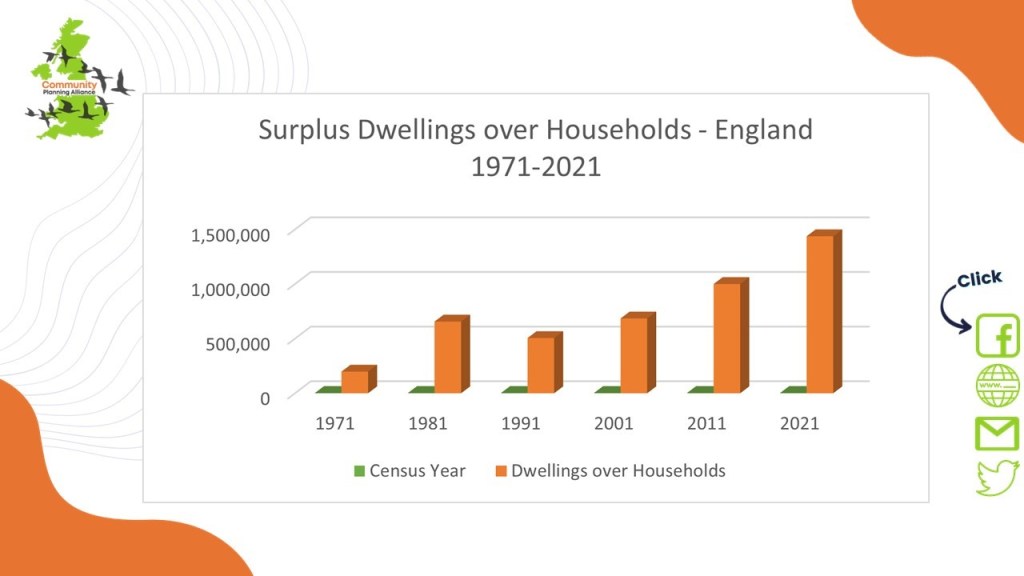
Graphic: Community Planning Alliance

Community Confusion!

Communities are confused by the commentary from politicians and others in relation to land use.  The assertion that there is a backlog of 4.3 million homes is typical, yet the facts do not bear out misleading statements such as this.  Political rhetoric repeats these fictional assertions, yet as the following infographic shows, there is not only a surplus of market homes, brownfield is not being prioritised, homes are allowed to remain empty, despite over 1.2m people on the housing waiting list and developers are allowed to hold on to land with planning permissions without building the approved developments.
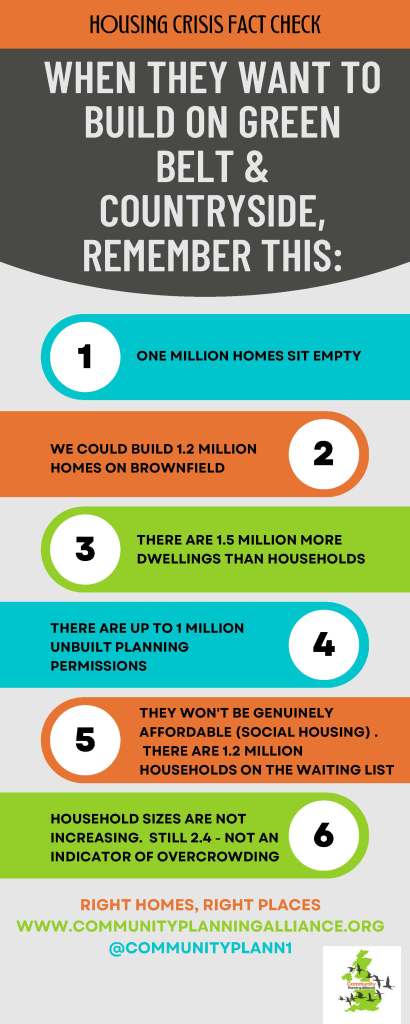
Graphic: Community Planning Alliance

What we need is more facts and honesty in the housing debate, instead of pandering to the developer lobbyists who make huge profits building what they want but not what we need!
Is Green Belt release in GM premature?  The latest Census data suggests it is!

Government data tells us that since 2013/14 England has lost over 25,110 hectares of green belt – equivalent to over 35,000 football pitches of highly valued land, with various attributes and community benefits, that are now forever lost to future generations.

Here in Greater Manchester, the Places for Everyone (P4E) Spatial Plan Examination in Public has begun, and GM’s leaders are hoping the Planning Inspectors will approve the unnecessary release of 2,430 hectares of our precious green belt (equivalent to over 3,400 football pitches).

We have already argued in our responses to the Plan that GM’s leadership has NOT proven the need for this unwarranted reduction in our green belt but what does the recent publication of Census data provide in the way of justification for their proposals?

Well, actually, quite the opposite.  The Census data supports our contention that the exceptional circumstances required to release green belt have not been demonstrated!

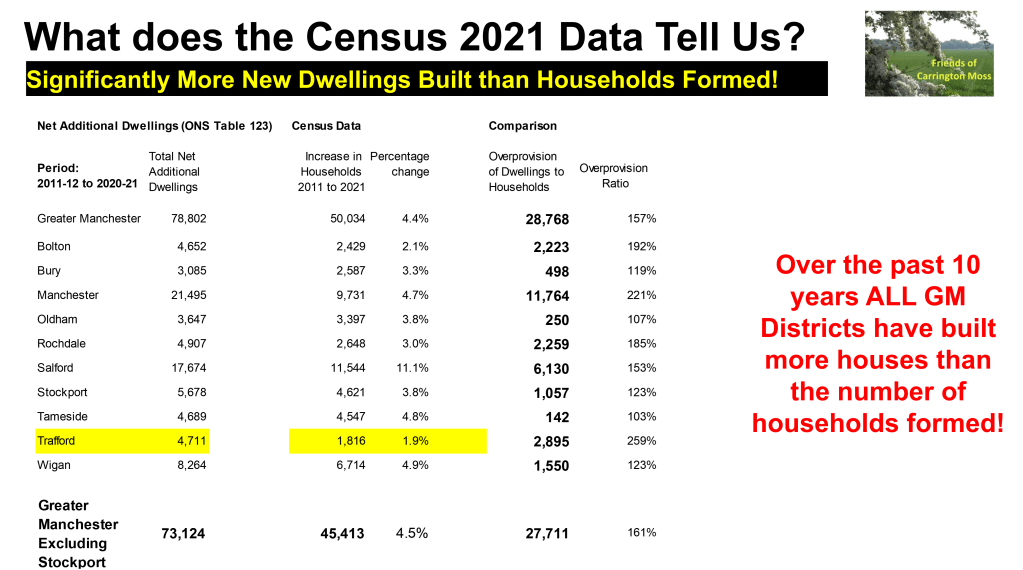
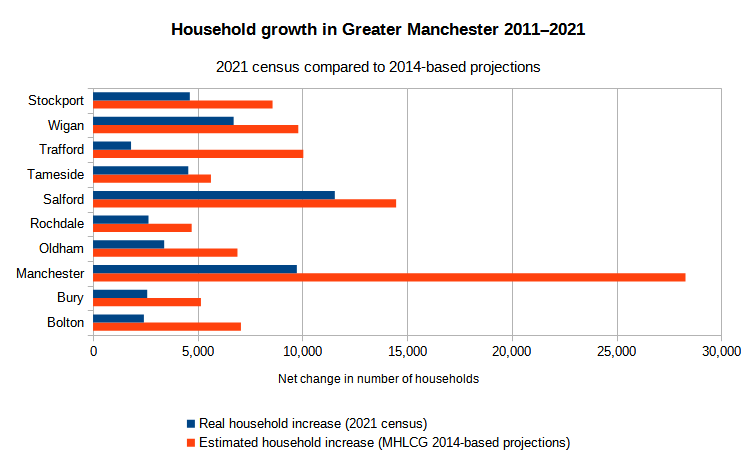
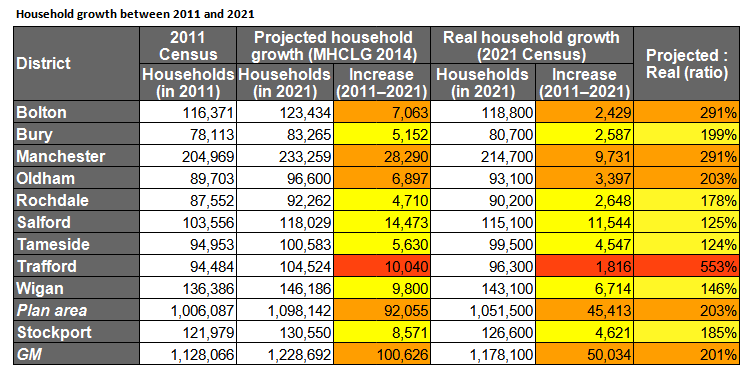
Our fellow campaigner, Matthew Broadbent, of the Save Royton Green Belt group, has looked at the Census data in some detail and his analysis reveals that, in terms of Household growth, the 2014 data set (which is used in the Government’s standard methodology for calculating housing need) has significantly over-estimated household growth in Greater Manchester.

Graphic credit: Matthew Broadbent (Save Royton’s Green Belt)

Looking at the figures themselves, it is clear that ALL Districts are impacted by the Government’s standard method (and this is before the Affordability Ratio is added to the calculation).  Trafford’s data is particularly shocking given their record on minimal reductions in green belt take in the various iterations of the Plan and Trafford has the highest Affordability Ratio in GM which is added to these erroneous numbers.

What the table below does tell us is that housing need across Greater Manchester has been significantly inflated and that there is clearly no justification to release green belt to supplement the land available in urban areas. 

The 2014 data, calculated by the Ministry of Housing, Communities and Local Government, projected significantly higher levels of household growth than has actually been the case.  The latest data available in the Census demonstrates what has been shown in previous ONS data – population projections have been noticeably reducing over the last decade.

Graphic credit: Matthew Broadbent (Save Royton’s Green Belt)

Over the coming months the Office for National Statistics will use the Census data to re-calibrate their Household Projections and hopefully this information will lead to a long-awaited change to the source data required by the Government’s standard methodology, which is clearly resulting in Local Authorities sacrificing vital green belt land that the Government suggests it attaches “great importance to” (National Planning Policy Framework, paragraph 137)!

As mentioned above, it is clear from this data that growth for Greater Manchester CAN be achieved WITHOUT releasing green belt. 

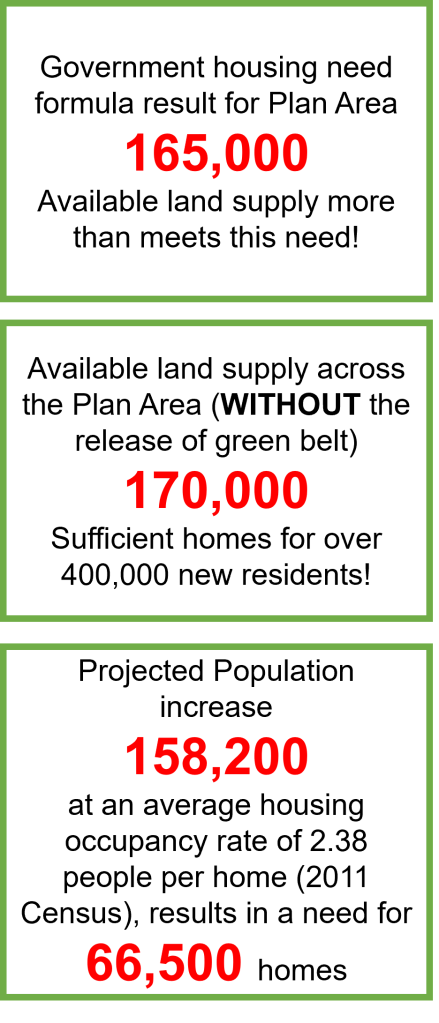
This is endorsed further in P4E itself, which reports that the Government’s standard methodology for calculating housing need creates a requirement to build 164,880 homes within the Plan area (Housing Topic Paper, page 18) and the 9 Districts are able to provide land supply that exceeds that figure (170,000 homes – Housing Topic Paper, page 20). GM’s population in the Plan area is projected to increase by 158,194 between 2021 and 2037 (paragraph 7.14).  This equates to a need for around 66,500 homes, which demonstrates that there is clearly sufficient flexibility and choice within existing urban areas to meet GM’s housing needs (and there are various brownfield land funds that can be applied for).

What should also be considered is how the number of Net Additional Dwellings over the past 10 years (ONS reports that over 73,000 net additional homes were constructed in the Plan area during that period), compares to the Census data (which shows that only 45,000 households have formed in the Plan area).  The graphic below highlights that each District in GM has built more houses than the number of households formed!

Again, the figure for Trafford is astounding, with the construction of dwellings being more than two and a half times the number of new households!  This means that it is not under-provision that is holding back household formation.  If data about vacant housing stock (empty homes) is added to the above numbers, the over-provision figures are increased even further, but let’s keep it simple. 

The Census identifies a household as a property where there is “at least one usual resident”, so do the figures above suggest that a large proportion of the dwellings being built in GM are second homes? investment properties?  More investigation is needed but these figures certainly leave our friends at the GMCA and in our Local Authorities with a number of questions to answer in relation to their plans to unnecessarily reduce our green belt (see our previous blog for more information).

Whose Plan is it anyway?

Given the Examination in Public has already begun, we hope the Planning Inspectors seriously consider our inputs and arguments, but we are aware citizens have very little influence in the Planning Ecosystem and that developers have submitted responses proposing that more green belt is released! 

A Plan that unnecessarily releases green belt, preventing future generations from accessing its recreational value, seeing its landscape views, benefiting from the best and most versatile agricultural land, the abundance of species, the carbon capture capabilities, the flood water storage areas, the woodlands, the wetlands and the irreplaceable habitats, is NOT our plan!

Friends of Carrington Moss

Greater Manchester is overspending its carbon budget and Places for Everyone will make it much worse

Guest blog:
by Mark Burton (Steady State Manchester)
and Matthew Broadbent (Save Greater Manchester Green Belt)

We are delighted to link specifically to this blog that has been created by our colleagues in Greater Manchester.

Mark and Matthew have assessed:

  • the carbon budget GM’s Combined Authority commissioned from the Tyndall Centre (University of Manchester)
  • the advice given by the Tyndall Centre about the pathway to reaching net zero
  • the alarming lack of progress that has been reported this month
  • the impact and importance of the separate category of Land Use, Land Use Change and Forestry (LULUCF).

They specifically highlight that the Regional plan, known as Places for Everyone (P4E), will involve significant levels of construction on green spaces.  This means that the Region’s capacity to reduce the impact of additional emissions will decrease significantly, severely affecting GM’s aspiration to be carbon neutral by 2038!

In looking at the scale of planned development set out in P4E, much of which will result in green belt release across the Region, Mark and Matthew emphasise the loss of carbon capturing opportunities, as well as the huge level of carbon emissions generated.

Their findings suggest it is highly likely that, on housing alone, the P4E proposals will be disastrous for the Region’s ambition to be carbon neutral.  Different choices could be made to meet housing need, options that do not rely so heavily on new construction!  Here in Trafford, there are also alternatives to constructing new roads across the green belt too.

It is clear from Mark and Matthew’s research, however, that the GMCA has not fully assessed the carbon implications of the P4E Plan, and they believe that the Strategic Environment Assessment (SEA) has not been conducted to an appropriate standard, especially given the conclusions reached by the Authorities.

The lack of information provided by the GMCA about the carbon implications of their strategic plan is astounding, particularly as there were so many P4E documents (more than 150, with 14,000 pages to review), but, as we pointed out in our own response, some of those pages include evidence that is very dated and some, like the carbon emissions data, is not provided at all. 

Mark and Matthew actually found that other Authorities do provide the data required to robustly assess the carbon emissions.  Their example from the Cambridge Local Plan is enlightening.

We totally agree that one of the most shocking omissions from the SEA is the absence of GM’s key objective, the 2038 target for carbon neutrality.  It must be remembered that it is this P4E strategic plan that must secure that target!

If you are interested in finding out more about the Tyndall Centre’s view of Trafford’s carbon emissions targets, you can find an interesting summary here. You will note that the final paragraph states “We also recommend that the LULUCF sector should be managed to ensure CO2 sequestration where possible. The management of LULUCF could also include action to increase wider social and environmental benefits“. Constructing roads, housing and employment space on a peat moss, grade 2 agricultural land, wetland and woodland will not support the achievement of that recommendation!