
Developer Contributions Consultation
What is it? What are the key issues? and Why is it important for residents to respond?
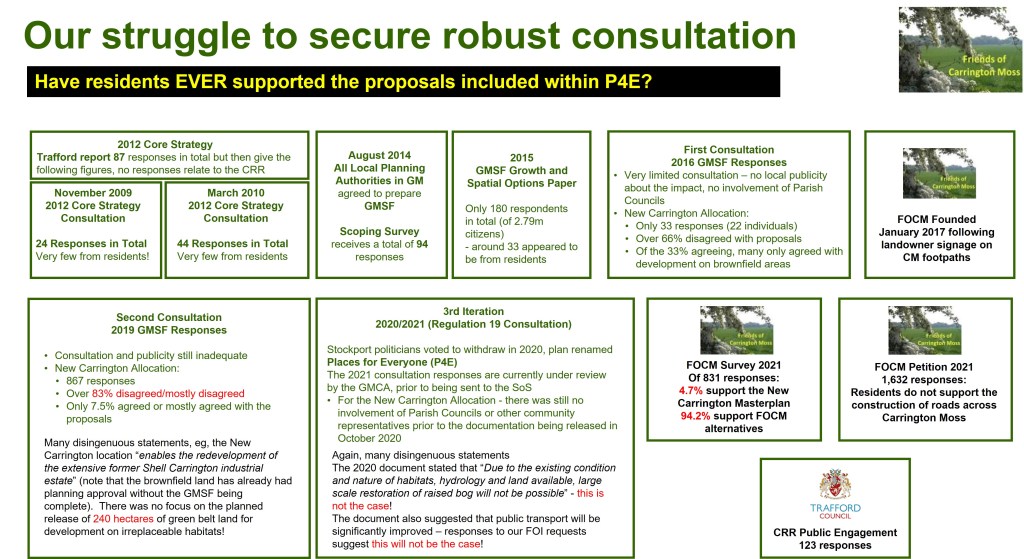
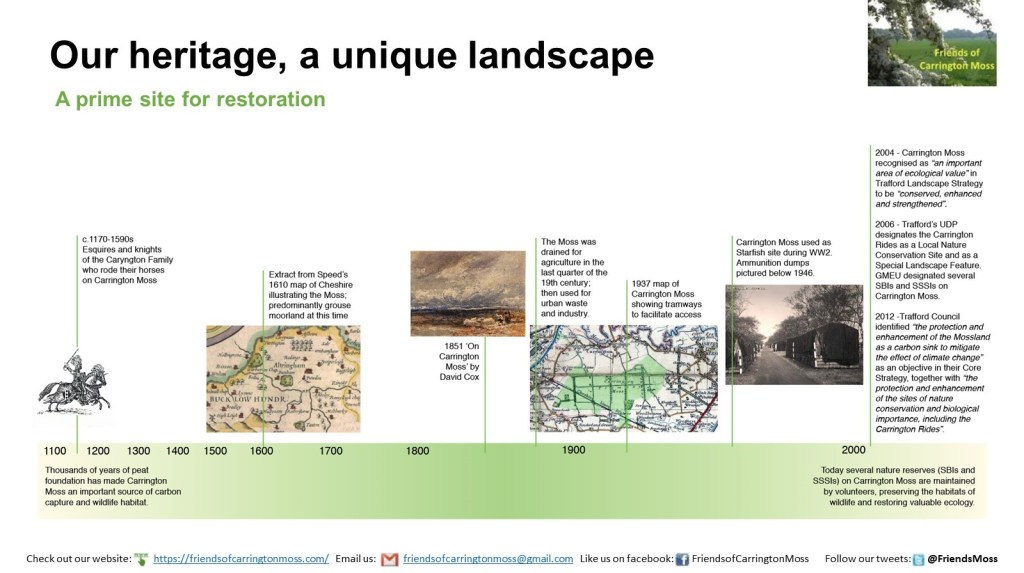
As you know, the proposed developments on and around Carrington Moss are huge! 5,000 houses, 350,000m2 employment space and 4 major new roads, all threatening the 335 hectare peat moss (restorable irreplaceable habitat), the productive Grade 2 agricultural land, the woodlands and the wetlands, and all impacting 15 sites of biological importance and a site of special scientific interest, to say nothing of the populations of numerous red listed birds and endangered wildlife species.
Because of the size and scale of the proposed schemes, in addition to the typical costs that would be incurred when they put forward a planning application, developers will be required to contribute to the strategic requirements (such as roads, buildings to support education and healthcare, and utilities), which Trafford describes as ‘hard’ infrastructure. These costs would not have been required had the development been focused on previously developed (brownfield) land, rather than on former Green Belt and greenfield land in an isolated, unsustainable location.
The consultation documentation aims to set out the proportionate financial contributions for schemes that have not yet secured planning permission.
The strategy focuses on those so called ‘hard’ infrastructure items and supposedly prioritises the delivery of New Carrington “in a comprehensive and coordinated manner”. The document confirms (figure 19) that almost half of the identified ‘hard’ infrastructure costs will be funded from developer contributions, and the other half will be funded by the public sector and other sources.
Balanced? Sadly not!

Developer contributions are limited by government guidance. This means that, for a scheme to be considered viable, developers must achieve a certain level of profit. The contributions developers pay cannot be increased to the extent that the scheme would be considered unviable (ie they do not make the necessary level of profit). So, if there are any excluded or missing costs not incorporated within the calculations (and there are a lot of them), the proportions shown in the graphic above are very misleading.
The total contributions to be paid by the public sector should be explicitly and transparently shown, rather than covertly hidden in an appendix or not included at all! It is vital that communities understand the full cost of destroying our essential natural resources to facilitate building in such an unsustainable location.
The biggest issue is the lack of consideration of harms to, or destruction of, natural capital assets.
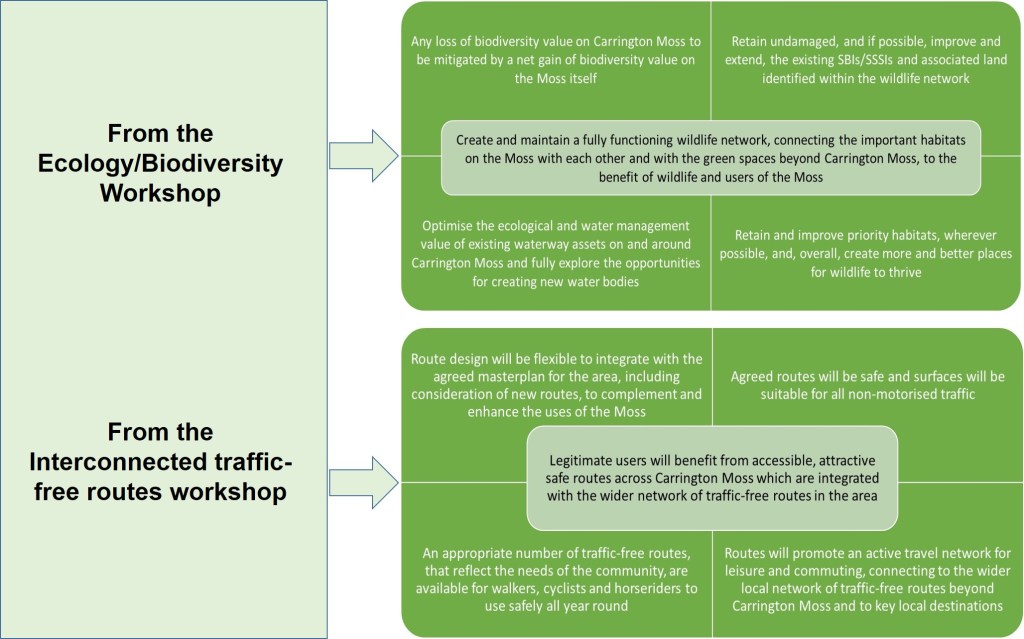
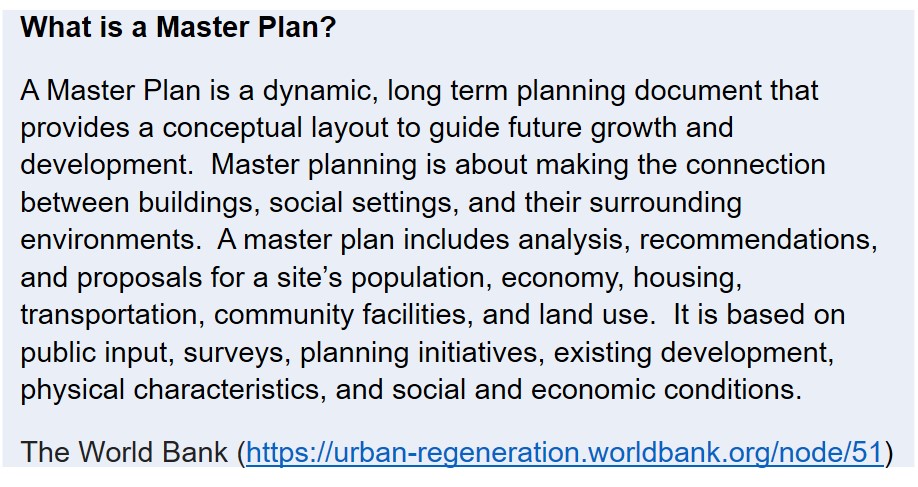
Given the extensive environmental and ecological harm/destruction to be caused as a consequence of Trafford choosing this location for development, the calculations should include the costs related to the mitigation of, or compensation for, the loss of Green Belt, the cumulative harm to natural capital assets (such as, for example, the peat moss, the woodlands, and the farmland). These have been explicitly excluded from the costs and subordinated to a future phase of the masterplanning work.
This means that the information provided in the documentation is incomplete and does not reflect the actual costs to be incurred if all the proposed developments go ahead.
Effectively, in omitting what we are calling the ‘Natural Infrastructure’ strategy from these calculations, the harms can be caused but funding may NEVER be available to provide the obligatory mitigation and compensation.
Why are we concerned?
Take a look at our response (here), but, in summary, not only have the natural infrastructure requirements been shelved to some point in the future, but our suggested amendments to the proposals have been summarily dismissed, resulting in unnecessarily inflated costs for the public purse.
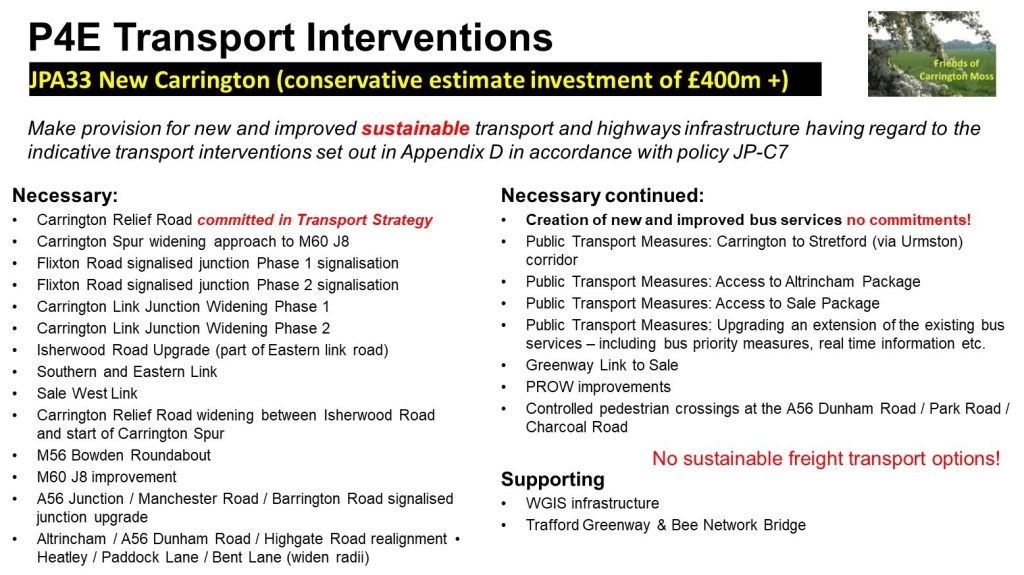
The cost of the road schemes, for example, would be significantly reduced if our alternative proposals were accepted.
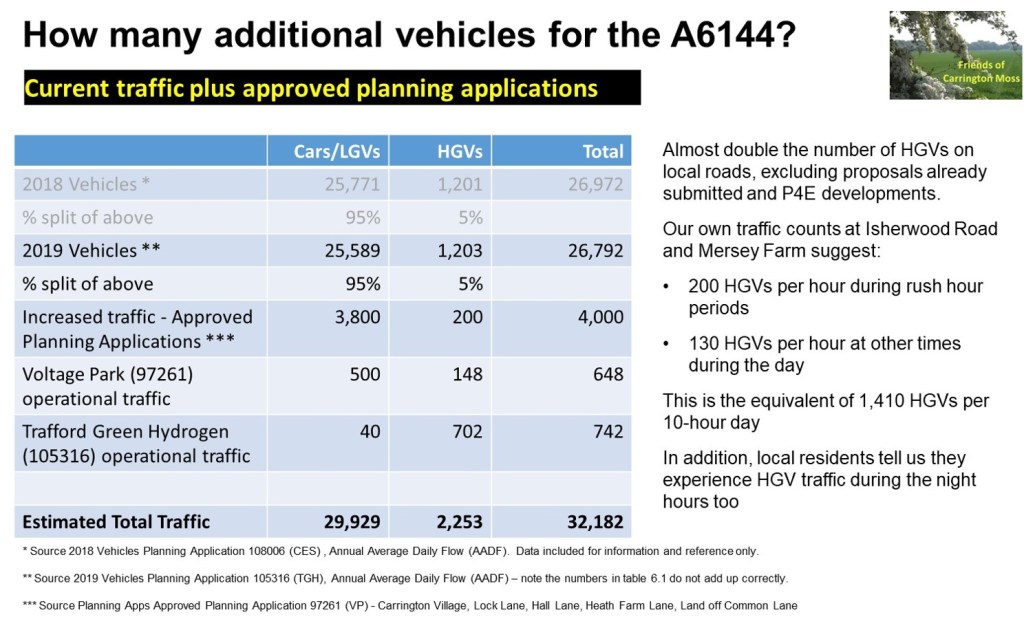
The eastern part of the Carrington Relief Road (CRR), across the moss, could be replaced with upgrades to existing active travel routes and improvements to existing roads (A6144 and Sinderland Lane). This would encourage modal change to walking, cycling and wheeling (it will be far more pleasant, safe and healthy to use active travel modes in a countryside setting, rather than next to a major road, with hundreds of HGVs hurtling along it every hour). It would also discourage the huge levels of induced traffic that will use this road, travelling between motorways and significantly impacting Partington and Warburton. The western part of the CRR, the A1 road, should be upgraded and opened to general traffic as planned to relieve the current issues in Carrington Village. The plan for the A1 should be amended to take HGV traffic away from the homes that have been built on Isherwood Road. This would require a very short road to run in parallel with Isherwood Road/Ackers Lane, rather than a new road all the way to the Carrington Spur.
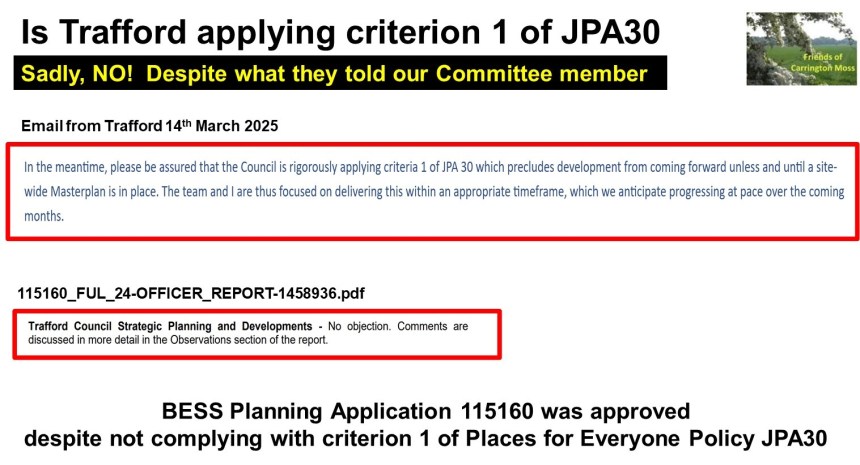
The latest information received from the CRR team[1] shows that the current road (A6144) is much safer than an average road of the same type and that there is ZERO capacity to increase traffic on the Carrington Spur. Trafford should, therefore, not be proposing a new road that will allow traffic to travel at much higher speeds (particularly given the hazardous materials carried by some of the HGVs), or encourage more through traffic into the area.
Because it includes the eastern part of the road, the current CRR proposal unnecessarily inflates the cost of construction and ongoing maintenance (including for the attenuation ponds needed to capture all that water[2] currently stored on the moss), and the costs of the mitigation needed to address air, noise, light, vibration, dust and water pollution, along with other environmental enhancements. Costs will also increase for the NHS and other emergency services because of increased pollution and traffic accidents/incidents, and there is likely to be an upsurge in the requirement for mental health services due to the stresses caused to local residents because of construction, congestion, the loss of green spaces, and, possibly, future flooding!
Facilitating vehicle access onto Firsway from the new Sale West developments (1,500 homes) will significantly increase traffic and will result in that road becoming a rat run from the M60. It will require the felling of hundreds of trees, drastically affecting the wildlife and birds and impacting the dark skies in this area. It will also increase safety concerns on Firsway and, consequentially, the costs to the NHS/emergency services of dealing with any resulting pollution related health conditions and accidents/incidents on the road network. Limiting access through the Firs Plantation to active travel users only, would not only reduce the costs of constructing the Sale West Link Road, it would also reduce the cost of mitigating or compensating for environmental/ecological harms and the costs to the NHS.
For all the same reasons, we suggested that the Eastern and Southern Link Roads should not connect with each other, as this will result in huge levels of increased through traffic from the M60 and other motorways, particularly impacting Warburton. The proposed approach will also cause extensive damage to the very deep peat that will need to be compensated for. As with the other schemes, it will also significantly increase pollution and will impact the dark skies in this area, with consequential costs for the NHS and other agencies.
All the current proposals for these roads result in the need for higher contributions from the public purse, whilst our alternative options reduce the cost of constructing, the cost of mitigation/compensation for environmental/ ecological harms and the consequential costs to the healthcare sector and the emergency services.
The Healthcare costs included in the calculations seems to be limited to primary healthcare (which comprises doctors, dentists, pharmacists, and opticians), not mental health provision, not hospital provision (known as secondary healthcare) and not other emergency service provision. All of which will significantly increase as a result of the proposed developments. Furthermore, the Council does not recognise the impact on the need for increased social infrastructure because of the employment development (our objection to this is explained in our response).
Sustainable Development
The documentation repeatedly suggests that the ‘hard’ infrastructure is of the utmost importance to the sustainable delivery of New Carrington. Yet, given the definition of sustainable development this is hugely misleading.
The government’s National Planning Policy Framework (known as the NPPF[3]) defines sustainable development as “meeting the needs of the present without compromising the ability of future generations to meet their own needs”.
Given the proposed harms to, or destruction of, irreplaceable habitat, food producing cropland, woodland and wetland, it seems ‘sustainable development’ has a much narrower definition in this suite of documents.

With that definition in mind, it is clear that the New Carrington allocation cannot be ‘sustainable’, even with the proposed ‘hard’ infrastructure investment, because development here is dependent on considerable harm to, or the complete loss of, a number of essential natural capital assets that future generations will not be able to reverse.
And, what is worse, as mentioned above, the costs of mitigating and/or compensating for those cumulative harms is not even included in the calculations set out in this consultation and no information has been provided about how such funding requirements will be addressed, or when!
We would encourage you all to respond to the consultation. You do not have to go into the detail we have in our response, but it is important that the community voice is heard, particularly given that there will be future consultations related to the masterplan. Send your feedback to newcarrington.masterplan@trafford.gov.uk
What should you be asking for (in your own words)?
The masterplan project priorities should be reviewed to ensure that there is a comprehensive understanding of the costs of all elements of these proposals. The Natural Infrastructure Strategy should be considered a prerequisite to finalising the contributions scheme. It should be progressed with urgency, with its evolution including extensive engagement with communities. The land to be used for environmental and ecological mitigation or compensation should also be identified as a matter of urgency.
The documentation provided in this consultation should be updated and implemented when the full costs of the impact of development are known.
No environmental or ecological harms/destruction should be allowed to be caused until it is confirmed that funding for the mitigation and compensation for the loss of Green Belt and those extensive cumulative harms to the environment and ecology will become available. We also need confirmation of where any agreed mitigation or compensation will be located – it is possible that, because of the size and scale of the developments proposed here, enhancements will be implemented elsewhere, which means our local communities suffer all the health, wellbeing and traffic consequences of these plans, and others will benefit from environmental and ecological improvements in their areas!
[1] https://www.youtube.com/watch?v=L3uG5SzmzjA
[2] https://friendsofcarringtonmoss.com/carrington-lake-2/
[3] https://assets.publishing.service.gov.uk/media/67aafe8f3b41f783cca46251/NPPF_December_2024.pdf







 Friends of Carrington Moss
You must be logged in to post a comment.