Category Archives: Green Belt

Is it necessary to build on green belt in Trafford (or elsewhere in GM)?  The short answer is NO!

At Trafford’s Scrutiny Committee on 12th January 2022, members were given a presentation about the Carrington Relief Road, providing some background to the initiative along with some information about the Option Appraisal for the preferred route, the engagement with the public and the next steps. 

A member of the Scrutiny Committee requested a more balanced representation of the facts.  The Carrington Relief Road documentation does seem to be plagued by the sheer volume of misinformation (see our letter to Trafford’s Chief Executive in February 2020 about the Outline Business Case document).

This is the second in our series of blogs which addresses the gaps in the information given at the meeting, providing further details to help members of the Scrutiny Committee and others, when reviewing the proceedings.

This blog focuses on the Places for Everyone Plan and the specific New Carrington Allocation.


The presentation given to Scrutiny Committee appeared to suggest that the proposal for the Carrington Relief Road in the 2012 Core Strategy instigated the huge development known as New Carrington.  This does not seem plausible because, as noted in our previous blog, the road proposed in the 2012 Core Strategy was clearly much less intrusive than the current scheme and did not intend to decimate local green belt.

The presentation continued with information about the number of homes and employment space to be constructed in the area but failed to mention that 169 hectares of green belt will be released to make way for these plans.  That is the equivalent of over 236 football pitches of peatland, wetland, woodland and grade 2 best and most versatile agricultural land that will no longer be available for future generations, not a sustainable solution! 

It should be noted that the Places for Everyone proposals have NOT yet been approved, including the New Carrington Allocation, and will be subject to an Examination in Public later in 2022.  Given this, questions should be asked about why Trafford are incurring expenditure through the acceleration of a project for a Relief Road, at this time of huge challenges for the public purse, when the primary aim (see GM Transport Strategy 2040) of that project is to support growth plans that have not yet been approved.

The Proposals

Whilst we welcome the reductions made to the New Carrington Allocation by Trafford’s leaders, we believe the development in Carrington, Partington and Sale West remains excessive. 

The proposals for this one Ward (Bucklow St Martins) equates to over 20% of Trafford’s planned housing development for the next 16 years! 

With a population increase for Partington of almost 72%, this is not a sustainable approach, but before we dig deeper into the plans for New Carrington, let’s look at this Regional Strategy now known as Places for Everyone. 

Is the decision to release 2,430 hectares of green belt (the equivalent of 3,403 football pitches) across the Region necessary? 

We don’t think so – read on to find out why.

GM’s leaders had the opportunity to choose from a number of spatial options for the Region, some of which did NOT require the release of green belt. 

The Region is planning to build homes to meet the needs of an additional 450,000 people against an estimated natural population increase of 158,200.  Of course, some growth would be expected but this rapid expansion of GM’s population is disproportionate, damaging and unsustainable.

It should be noted that ONS recently issued the latest population statistics (12th Jan 2022), which confirmed that the downward trend in projected UK population growth since 2016 is continuing.  It is no surprise that the 2020-based population growth is, once again, slower than in the previous projections.

The available land supply across the GM Region (without the release of green belt) equates to 170,000 homes (which could meet the needs of over 400,000 people), more than sufficient to provide growth, along with flexibility and choice for both developers and customers.  It is also adequate to meet the Government’s mandated housing need figure (without releasing any green belt land).

With these figures in mind, it is clear, there is NO justification to release green belt land anywhere in Greater Manchester.

So, why didn’t our leaders choose a spatial strategy aligned with their declarations of a climate emergency (made by all GM’s public bodies)? Did they fully understand the implications of all the options on the table?
The Public Transport Max spatial option is a better fit for GM’s contemporary needs.

What is in the New Carrington Masterplan?

The brownfield land in Carrington already has planning approval, as do the plots shown as PR4A in the graphic above (Heath Farm Lane). 

Trafford has continued to commit to overdeveloping the area, granting planning applications despite resident concerns (particularly about the number of HGVs on local roads) and the lack of sustainable transport options. 

Trafford acknowledges there is a major problem with HGV traffic in the area, yet, given their very positive approach to growth,

it is hard to understand why Trafford has not, OVER THE PAST 10 YEARS, progressed ANY option for passenger and freight transport other than the Carrington Relief Road.

Trafford’s officer mentioned that it had taken 100 years to become reliant on road transport.  Does Trafford plan to take 100 years to start working on some sustainable solutions for the area, or is the aim to force residents to accept the need for a new road because of imprudence and inaction? We’ll examine the Option Appraisal for that new road in a future blog in this series.

Impending decisions are all about building on the 169 hectares of green belt!

As we set out in our open letter to all Trafford Councillors in advance of their decision to approve the Places for Everyone Plan, there are a number of inequities for Trafford residents and particularly for those who live in Carrington, Partington and Sale West, as a direct consequence of agreeing these proposals. Not least of which is the loss of access to green space and, therefore, to nature.  There is also (for example) lack of access to affordable homes (only 15% in total for New Carrington), to local schools (where are they?) and to a diverse range of jobs (only industrial and warehousing on this site).  And then there are the risks, such as exposure to harm from hazardous businesses, flooding, vermin infestation and increased air, noise and light pollution.  We’ll say more about these issues in a future blog.

Given its location, these plans will see Carrington become a traffic island in a sea of air pollution and the current green lungs of the area, Carrington Moss, will no longer be there to help disperse all that polluted air. 

During the presentation, Trafford’s officer suggested that the Carrington Relief Road would take traffic away from the very narrow and congested A6144. This is not the case. As was pointed out by one member of the Scrutiny Committee, new roads bring new traffic. This was acknowledged in the P4E documentation in relation to the Carrington Relief Road (Transport Locality Assessment paragraph 11.2.3). Based on what has happened in other locations, it is highly likely additional traffic will be attracted to use both the new road AND the existing A6144!

It should be recognised that there is no dispute about opening up the A1 road (end to end), and that could be explored immediately. HGV and through traffic should be prevented from using the A6144 through Carrington Village but Trafford has NOT committed to this, which means residents will suffer the harmful effects of traffic on both roads. This approach will not achieve the desired aim of improving the reliability of public transport timetables either.

Like most other major roads in Trafford, and beyond, the A6144 is only busy during rush hour. So, instead of introducing sustainable passenger and freight transport solutions, that would benefit the whole community, Trafford are progressing a £30m scheme which will only replace a very short section of the A6144, benefiting some drivers for a very short time (see this video for an explanation of this example of Jevons Paradox in action).

This new section of road is close to the Carrington Spur, so we are at a loss to understand the benefits to Partington residents that Trafford has suggested will be transformational! The road will cause significant air, noise and light pollution to the residents of Sale West, affecting the children at All Saints Catholic Primary School, the users of Carrington Moss and, of course, the red listed birds and endangered wildlife that breed and feed here.

What Trafford’s Masterplan says about Transport in New Carrington

Carrington and Partington suffer from relative isolation from the wider urban area of Greater Manchester. New Carrington provides the opportunity to make strategic highway interventions, for both the car and bus; significant upgrades to public transport; and enhancements for pedestrians, cyclists and horse riders resulting in a much more sustainable community for established and new residents”.

It might provide “the opportunity” but there are NO planned upgrades to public transport. 

The only commitment is to the Carrington Relief Road, despite the promises made in previous Local Plans.  No trams, no trains (despite the former railway line running right into Carrington and Partington) and no water-based transport (despite the proximity of the Manchester Ship Canal). 

Trafford insist the road is “not the only show in town” but for passenger and freight transport, it certainly is! 

In fact, in relation to public transport, what Trafford’s document says is that“improving bus accessibility to New Carrington, Altrincham, and Sale should be encouragedand the response to our FOI request said:

“There are currently no committed schemes to improve public transport in this area.”

Residents have been waiting for public transport enhancements for 15 years! Isn’t it time our Council did more than “encourage” provision and makes those improvements a priority, and a reality, along with sustainable freight options?


What are our asks?

We set out our key asks in our previous blog.  Without the information we request, we do not believe the Scrutiny Committee can undertake an adequate review of the current proposal. 

For more information about our previous analysis relating to the Carrington Relief Road, please check out the Carrington Link Road page on our website.

Is Places for Everyone/GMSF2021 the right plan for Trafford and GM?

Open Letter to All Trafford Councillors

Dear Councillor

Before you vote on the Places for Everyone (P4E) Spatial Plan for Greater Manchester (previously known as the Greater Manchester Spatial Framework – GMSF), we’d like you to consider the following significant concerns about its acceptability as the spatial plan for GM for the next 16 years:

  • We understand that Labour Councillors across GM will be whipped on this decision, which is an odd approach if there is confidence that it is the right plan, setting out the right future, with the right balance of economic, social and environmental goals, making the right decisions for the residents of GM, and, in our case, Trafford.  Why is it not possible for Councillors to be persuaded by the evidence that adopting this plan is demonstrably the most appropriate, necessary and commendable option for the P4E Councils?
  • All GM Councils, including Trafford, and the GMCA itself have declared a climate emergency, therefore, all decisions made should reflect this commitment to your current and future residents – we do not believe the plan, as currently articulated, has sufficient focus on tackling climate change
  • Despite there being no evidence that the proposed release of green belt is justified, anywhere in GM (in fact quite the opposite, as explained below), 2,430 hectares of GM’s green belt will be released for development immediately following plan approval (P4E reports a net loss of 1,754 ha as the Plan proposes adding 675 ha of new green belt)
  • Whilst the plan demands that residents must accept a loss of green belt, and the consequent impact to their health and wellbeing, there are no policies that incorporate demands on developers (for example, to build those properties that already have planning permission), there are no policies to prevent developers securing planning permission on what is currently green belt land, yet not delivering against that approval, possibly resulting in yet more green belt land being proposed for release in the future
  • Greater levels of division and inequity will be driven by this plan, not just in terms of access to local green belt but also in access to schools, affordable homes (the New Carrington allocation, for example, will now only provide 15% affordable, due to viability issues) and public transport (New Carrington, for example, with 5,000 homes planned within P4E and a further 1,000 homes in the area with recently granted planning permission, has no trams, no trains and no commitment to new bus services – we have checked this via an FOI request)
  • Residents will suffer the health impacts of increased air, noise and light pollution and constructing 4 major roads across a peat moss will also significantly affect the populations of red listed birds and endangered wildlife that breed and feed in the New Carrington area
  • The New Carrington Masterplan conflicts with many key policies and strategies, not just those set out in P4E but also with the objectives outlined in, for example, the 5 year Environment Plan for GM and the spirit of a number of clauses in the National Planning Policy Framework
  • The GMSF has repeatedly been published with flawed, misleading or disingenuous statements, which should not be necessary if there is confidence in the benefits of the plan
  • There has been an unprecedented volume of responses from residents objecting to the planned builds on green belt across GM in the previous consultations (2016 and 2019), yet the GMCA continue to propose this!

Available Land Supply:

The documents tell us that the P4E plan area has a projected population increase of around 158,200, and housing occupancy rates averaged at 2.38 people per home (according to Census 2011, latest information from ONS puts occupancy levels at 2.4 but as this would reduce the figures further, we have used the Census figure).  This results in a housing need of 66,500 homes for the P4E plan area.  This figure can be compared to an available land supply of over 170,000 homes, as set out in Table 7.1 (excluding green belt allocations).  Given that this figure is over 2.5 times the need for homes, there is sufficient leeway for larger numbers of single occupancy houses, should this become a requirement of future trends.  In fact even without the (20,000) green belt allocations (see Table 7.1), there is more than sufficient land supply (170,000) for every single expected additional member of our population (the increase of 158,200) to have their own home! 

It is clear that there is NO justification for the release of green belt. 

The P4E document itself states that there is sufficient housing land supply to meet the overall identified need in the Government’s formula/algorithm.  The green belt allocations appear to have been made in case developers do not deliver.  We believe this issue should be addressed with policies that make demands of developers, not policies that result in the release of our green belt land.

We have heard the mantra “the Government is making us do it” quoted.  We recognise that there is mixed messaging, which is unhelpful.  The Government has confirmed, including specifically in relation to GM, that the housing need figure is not a target (in both Parliamentary debates and in writing).  The recent MHCLG blog (25th May 2021) seems to be pretty clear:

The Local Housing Need is simply a measure of need and we recognise that not everywhere will be able to meet their housing need in full – for example, where available land is constrained due to the Green Belt and an area therefore has to plan for fewer new homes.”

Given the implications of the climate emergency, Brexit and the pandemic, the GMCA could, and should, have concluded that the sufficiency of housing land supply did not need to be supplemented by a release of green belt at this time.

Green Belt Release:

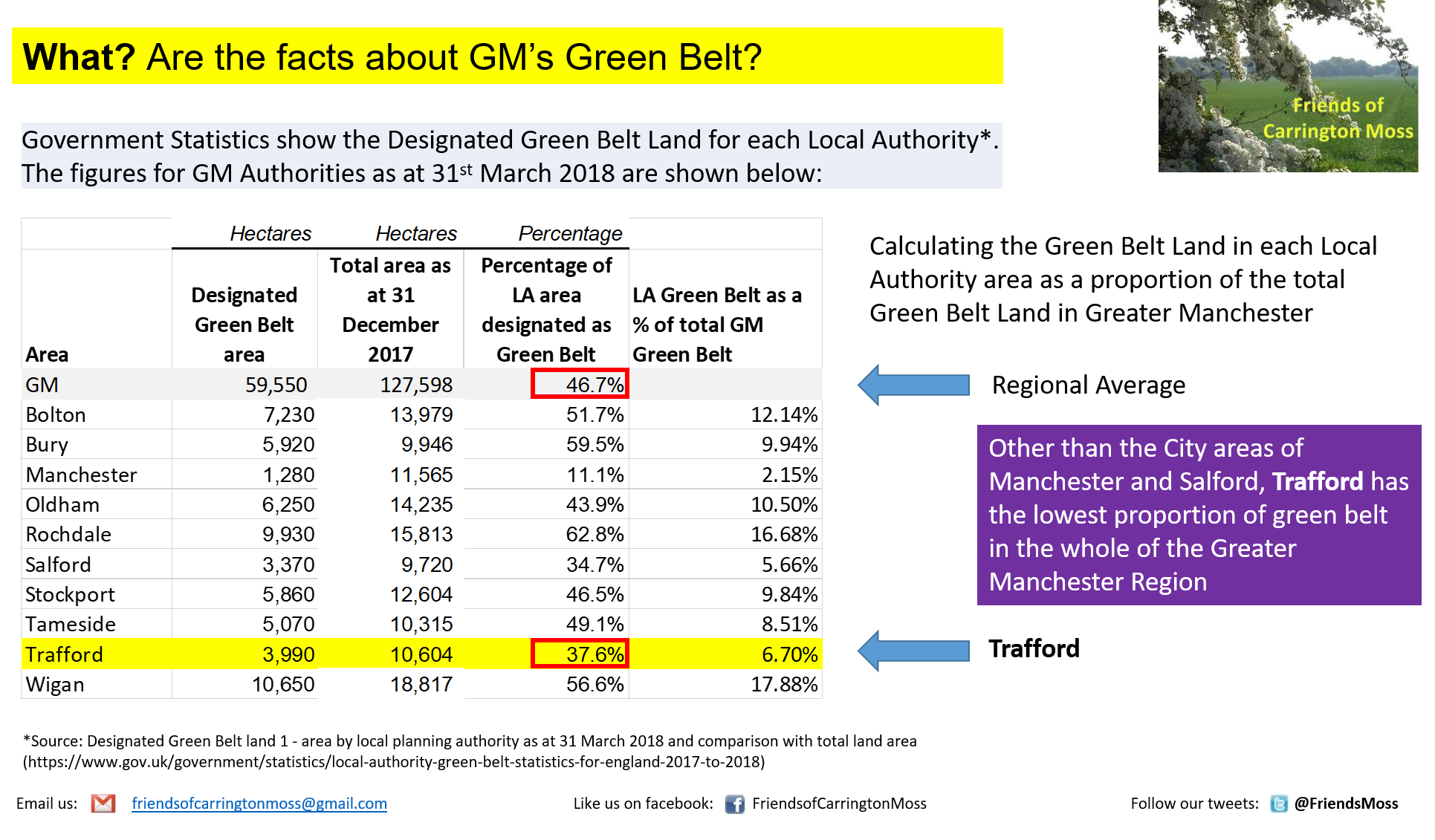
Yet, despite these numbers, green belt will be released as soon as the plan is approved and P4E proposes a significant loss of green belt across GM – 1,754 hectares in total, equivalent to 2,456 football pitches.  For Trafford, at 269 hectares, our loss of green belt represents over 15% of this figure (the equivalent of 376 football pitches).  Trafford enters this plan with significantly less green belt land (37.6%) than the GM average (46.7%) and will exit it with a much larger (6.7%) net loss of green belt than the GM average (3.27%).  Leaving Trafford residents with even greater inequity of access to local green belt than previously available, with our post plan green belt figure being just 35% of Trafford’s land area against a GM average of 45%.

There are alternative approaches.  Oldham, for example, proposes (North-East Growth Corridor) that land will be retained in the green belt “until such time that a review of this Plan and / or the Oldham Local Plan can demonstrate that it is necessary”.  All GM Authorities, including Trafford, could adopt similar wording to create a policy that ensures green belt land continues to be protected and is not released whilst brownfield sites are still available for development.

Misleading Statements:

The history of misleading statements that have permeated previous iterations of the GMSF has, disappointingly, continued into P4E, with, for example, the New Carrington Allocation Topic Paper stating (paragraph 12.2) that “Carrington Moss is a former peat bog”.  It then goes on to contradict itself by confirming “initial investigation indicates a maximum thickness of peat of 3m, which thins towards the perimeter”.  That is 9 feet of peat deposits, which are regularly under significant surface water flooding for at least 6 months of the year (see our website page Carrington Lake).  We have requested clarity about this statement from Trafford officers as a recent presentation to residents by the GM Wetlands Project (LIttle Woolden Moss) confirmed that peat can be restored where deposits are as low as 15cm.

The graphic below highlights some of the disingenuous statements included in previous iterations of the plan, along with a summary demonstrating the consistent lack of resident support for the New Carrington Masterplan.  As we are not considered to be major stakeholders (the New Carrington Masterplan defines these as landowners and developers), this plan does not consider the views of local residents.  This is not the approach the Labour administration has taken on strategic plans for other parts of the Borough.  Why are the views of the residents of Carrington, Partington, Sale West and Warburton not considered to be as important as those of Crossford Bridge, Flixton, Stretford and Turn Moss?

There are many other points that we could raise and we will share these over the coming weeks, but for the reasons set out here, and others, we firmly believe the plan will be found to be unsound when examined by Planning Inspectors. 

If you would like to discuss any of these points further, please do not hesitate to contact me.

Kind regards

Marj Powner (Chair)

Friends of Carrington Moss

Why we do not support the GMSF in its current form

We have sent the following feedback about the Greater Manchester Spatial Framework to all Trafford Councillors in advance of their discussion about the GMSF on 30th November.

Summarising the issues!

Whilst we totally support the principle of the GMSF, concur with its ambitions, and recognise the considerable effort that has gone into drafting it, we cannot support the current iteration because it still advocates the unnecessary removal of Green Belt land across Greater Manchester, when there ARE clear alternative approaches. 

The issued documentation declares that Local Authorities are able to make “adequateprovision to meet housing need numbers WITHOUT releasing Green Belt land.  It must also be remembered that, back in 2015, a GMSF Option was considered which required NO use of Green Belt land and a decision was specifically made NOT to take this forward.  This suggests that the decision to release Green Belt in GM is a desire of the leadership, NOT a requirement.  This assertion is further reinforced by the recognition that, whilst a lot of effort has been made to create exceptional circumstances which support the release of Green Belt land, NO attempt has been made to identify exceptional circumstances to reduce the housing need number to ensure all development is focused on brownfield land. 

Given that Local Authorities have identified “adequate” sites to meet housing need numbers, together with the expected changes to working practices post-Covid (which we believe will lead to the availability of windfall sites across GM), the extensive feedback from residents against the release of Green Belt land, and the emphasis of all political parties on nature-led recovery and the climate emergency, the only reasonable approach for the GMSF is NOT to release Green Belt land for development.  The GMSF could have been prepared within that constraint and should, if confidence in developer delivery is low, also have proposed that an extensive post-Covid review be undertaken during the GMSF period to determine whether further analysis is needed.  The current approach is likely to lead to Green Belt being built on, whilst a huge number of windfall (brownfield) sites are left unused.  

Furthermore, at a local level, whilst we welcome the work that has been undertaken to reduce Green Belt release in New Carrington, Trafford’s overall reduction in Green Belt take is significantly lower than that of other boroughs in GM.  In addition, the plans as documented are NOT plans that are underwritten by local residents.  The New Carrington Masterplan talks about the intensity of discussions with landowners and developers, yet there have been NO workshops about the Trafford allocations with residents or Parish Councils prior to issuing the documentation.  It is certainly a very strange type of democracy that has Local Authorities working on secret plans which significantly impact the local communities they are accountable to, despite a Statement of Community Involvement which suggests, in its introduction, that the Council should be “providing opportunities for active participation and discussions with the community as early in the plan-making and planning application processes as possible.”

With this in mind, the Friends of Carrington Moss are working with local Parish Councils and other community groups to develop alternative proposals for the area.  There is a lot of talent in our communities and a large number of ideas have been proposed.  These alternative options further demonstrate that the release of Green Belt is NOT necessary.

Unnecessary Release of Green Belt Land for Development

We believe that the GMCA is making a deliberate and conscious decision to unnecessarily release Green Belt land for development.  Once this precious resource is released, it is irretrievable for the vital purposes it performs.  In our view, this approach is unsound because it is neither justified (given the confirmation of adequate housing supply) nor sustainable (given the selective implementation of GMSF strategic policies). 

For clarity, the GMSF paragraph 7.12 states that “in numerical terms, the existing supply of potential housing sites identified in the districts’ strategic housing land availability assessments, small sites and empty properties is adequate to meet the overall identified need”.  This means Green Belt land is being released to cover a “buffer”, just in case it is needed.  This is not justifiable and any buffer required should have been covered by a case for exceptional circumstances, as set out below.

The release of Green Belt will have a particularly severe impact on Trafford as we have the lowest proportion of Green Belt land in the whole of Greater Manchester, other than the city areas of Manchester and Salford.  In addition, St Marys Ward has the lowest proportion of Green Space in Trafford, with Bucklow St Martins Ward close behind.  These are the two Wards most affected by the plans for New Carrington.  Many of our residents are not affluent and have valued free access to this local green space more than ever since the pandemic began.  Whilst you may see a corridor coloured green on the New Carrington map, it should be recognised that much of that “green” space is not green and it is not accessible to the public.  This reduced green area will be further diminished if Trafford’s planned roads across the Green Belt go ahead, bringing significant air and noise pollution to residents, sports participants and school pupils.  The community has developed alternative proposals which make these roads and the release of Green Belt unnecessary.

GMSF 2020 could have determined not to release Green Belt and could have proposed a post-Covid review, within the GMSF period, to verify whether developer delivery is on target and, if not, whether sufficient windfall sites are available to meet any shortfall.  Should that review ascertain that Green Belt release could be necessary, this should be considered further and agreed at that time.

Case for Exceptional Circumstances in calculating Housing Need

We believe insufficient effort has been made by the GMCA to present the case for exceptional circumstances to justify a reduction in the housing need numbers calculated using the Government’s National Formula.  This standard method for calculating Housing Need is NOT mandatory.  This has been confirmed, both in writing and verbally, by Ministers, on several occasions over the last few years.  In a recent example, the Hansard transcript for the GMSF and Green Belt Parliamentary Debate of 18 March 2020 confirms the Minister for Housing’s statement that “It is worth noting that the standard method is not mandatory; in exceptional circumstances, an alternative approach can be used, provided that that reflects the current and future demographic trends and market signals. If my hon. Friend the Member for Altrincham and Sale West cares to check paragraph 60 of the NPPF, he will find reassurance in that paragraph” (Hansard: 18/3/20 Parliamentary Debate).

In addition, it has been demonstrated in responses to previous drafts of the GMSF that a 15-year plan would generate sufficient available brownfield land to meet housing need requirements across the Region, totally removing the need to release Green Belt.  A 15-year plan would also allow more flexibility to adapt to the, as yet unforeseen, changes required due to climate change and the current global pandemic (some rethinking of our lifestyles and economy is likely to be required, which will have a direct impact on planning).

So, there are a number of potential exceptional circumstances that do reflect demographic trends and market signals, that could be cited to ensure all development is concentrated on brownfield land.  Some examples include utilising the most up-to-date (2018) ONS figures (to determine more accurate local housing need predictions), limiting the GMSF to a period of 15 years (which is all that is required by the NPPF) and confirming a commitment to the post-Covid review (mentioned above).  In addition, funding of £81m is now available to tackle the more challenging brownfield sites across the Region. 

Addressing the Climate Emergency

We do not believe the plans to release Green Belt in Trafford are consistent with the declaration of a Climate Emergency, made by the Authority in November 2018.  The protection of our Green Belt land is now more important than ever as we experience the increasing impact of climate change.  As an example, large areas of Carrington Moss were extensively flooded between October 2019 and March 2020 (see our website for photographs and videos), including areas now suggested for housing developments. 

The release of Green Belt is also inconsistent with GM’s aim to be “a place at the forefront of action on climate change, with clean air and a flourishing natural environment”.  As part of the preparations for the GMSF, GM commissioned The Environment Partnership (TEP) to assess the current state of the natural environment.  TEP undertook a review to estimate how many Biodiversity Units (BUs) there are in each of GM’s 10 boroughs.  Trafford (at 41k BUs) is the second lowest in the Region, just above Manchester City itself, significantly behind the leading Authority, Oldham (with 139k BUs), and not even comparable to Tameside (95k BUs), which is a similar size in terms of area and population to Trafford. 

Releasing the Green Belt in Trafford will reduce our BUs further.  The local community has developed an alternative strategy for Carrington Moss which would utilise the area as a carbon and biodiversity bank to “sell” carbon and BUs to businesses and urban developers to help them meet their carbon targets and biodiversity net gain figures and to increase Trafford’s BUs at the same time.  Whilst it is impossible to put a price on our green assets, we are seeking to create a viable alternative to the current plans.

All the political parties have a focus on nature-led recovery and the climate emergency.  Labour’s Green Economic Recovery paper, for example, quite rightly, suggests that “Future generations will judge us by the choices we make today”.  How will a decision to unnecessarily release Green Belt be judged by those who no longer have access to nature and green space, who can no longer see the willow tit and the skylark in their local area (because their breeding and feeding grounds have been destroyed), who can no longer see relatives and friends who have succumbed to illnesses caused by increased air pollution. 

That Green Economic Recovery paper also highlights the importance of not only solving the decarbonisation challenge but also in igniting the “broader preservation, enrichment, and protection of the UK’s natural ecosystems and biodiversity”.  The Labour document also mentions the importance of restoring peatlands and we agree that significant action is “needed in order to accelerate the benefits of nature restoration and recovery” and that there is “an abundance of natural restoration projects that could begin right now”.  The plan for New Carrington is NOT an example of how we can achieve these great ambitions, it also directly contradicts many of the environmental policies set out in the GMSF.

In addition, the 2020 GMSF proposes to expand Manchester airport.  It is already a source of considerable air pollution, noise nuisance and contributes to greenhouse gas emissions.  Until green aviation fuel has been developed, which is not likely within GMSF period, there should be no further expansion of the airport or increase to the agreed number of flights (a reduction would be more sensible to align with the GMSF stated aims for carbon neutrality and clean air).  

Other points to consider

Whilst the GMSF incorporates a number of aims and ambitions that are laudable, somewhat summarised in paragraph 1.6, which states that “Our ambitions to be carbon neutral by 2038 have never been more necessary – we need to support the creation of resilient, liveable places where walking and cycling are the obvious choice for shorter journeys, where facilities and services are accessible and close at hand and where the past dependency on the car is superseded by a reliable and responsive public transport system.”, the selective adoption of the policies and strategies encompassing the GMSF means that the desired equality objectives cannot be achieved. 

One equality objective is to “Prioritise development in well-connected locations” and another is to “Deliver an inclusive and accessible transport network”, which will improve air quality across GM.  Paragraph 5.50 states that “The most significant role which the GMSF will play in this respect [improving air quality] is to locate development in the most sustainable locations which reduce the need for car travel, for example by maximising residential densities around transport hubs”.

The New Carrington development is NOT currently a sustainable location and we do not believe it will be transformed to a sustainable residential and industrial location.  Public transport improvements have been promised to Carrington, Partington and Sale West in the 2006 UDP and the 2012 Core Strategy but in fact, bus services have reduced in these areas.  The GMSF does NOT COMMIT to increasing public transport, instead, the Masterplan suggests “improving bus accessibility to New Carrington, Altrincham, and Sale should be encouraged” and the TfGM Transport Delivery Plan 2020-2025 states that “In the next five years, we aim to complete business cases for early delivery of… New bus services to support the New Carrington and Sale West allocations”.   That is not reassuring given residents have been waiting for over 15 years for improvements to public transport.

Furthermore, it is unsustainable to consider the use of Green Belt land for warehouses and industrial with the clear aim of using road transport.  The community has developed an alterative Transport Strategy which proposes a new bridge across the Ship Canal, to provide access to Irlam Wharf and Port Salford for businesses in Carrington.  This approach, which we have discussed with local businesses, would mean HGV traffic can be significantly reduced and that there is no requirement for a Relief Road across Carrington Moss.

The GMSF 2020 places great emphasis on economic growth, appearing to give this a higher priority than the well-being of residents, yet the importance of access to green spaces and nature for physical and mental health is now well documented.  It is recognised that the impact of Covid and economic uncertainty will hit our most vulnerable residents the hardest, yet the GMSF, despite acknowledging the “state of flux”, does not address the inequities that will inevitably follow. 

There is also an equality objective to “Strengthen the competitiveness of north Greater Manchester”, yet the largest residential allocation is in Trafford.  This means that Trafford residents do not have equity of access to Green Belt areas, they have their access to green space further reduced and for residents of North Manchester, growth is not being prioritised as suggested in the GMSF.

Finally, there are issues about the heritage assets in the area (including the peat moss itself, of course), the harm to be caused by the loss of Green Belt (which is acknowledged in the Masterplan) and the loss of income to local businesses (including riding centres and farmers), which of course impacts Trafford’s local economy too.  The New Carrington allocation remains unsound for the many reasons that have been vigorously expressed by local residents in the previous consultation. 

We would be delighted to share our alternative proposals and/or more information about our analysis of the GMSF.

How big is 240 hectares – our green belt loss on Carrington Moss?

Can you visualise how big the 240 hectares of green belt Trafford plan to release at Carrington is?  I was finding this tricky, not being familiar with hectares at all, to be honest.  So, for those of you coming along to the kite flying on Dainewell Park tomorrow, here is something to think about.

Dainewell Park is around 51.8 square metres in size.  This is just over 5 hectares (there are 10,000 square metres in a hectare). 

How big is Dainewell Park?

So the 240 hectares of green belt Trafford plans to release is the equivalent of over 46 (yes, 46) Dainewell Parks!

And when you add the green belt at Timperley Wedge, the total green belt loss for Trafford is 354 hectares – the equivalent of over 68 Dainewell Parks!!!

As an aside, the planned industrial and warehousing area in the GMSF for New Carrington is between 410,000 square metres and 900,000 square metres.  We believe this is floor space, rather than land mass but, nevertheless, it is interesting to note that, despite all the other industrial/warehousing units in the area (Trafford Park and Manchester Airport, to name but two), there is an expectation that the site can accommodate units (and the associated additional traffic) equivalent to between 7 and 17 Dainewell Parks.

If you don’t manage to join us at the kite flying tomorrow and are not familiar with hectares or Dainewell Park, I have my friend Dave to thank for showing me this feature on google maps.  If you right click you will see one of the options is to Measure Distance.  You can measure any area that you know and then, assuming you use the square metres measurement, divide the results by 10,000 to arrive at the number of hectares for the area you are considering.  This will give you an idea of the land mass being considered for green belt release.

Remember, just revising the GMSF to a 15 year plan would mean NO release of green belt anywhere in Greater Manchester.  Remember, we have a housing waiting list figure of 3,325, and even if this has doubled since the publication of the Trafford Housing Strategy, we do not need to release any green belt to satisfy those figures. 

So, when it comes down to the vote to approve the GMSF in Trafford, which of our politicians will be supporting the release of green belt the size of over 68 Dainewell Parks? 

And, even more importantly, will any of our politicians have taken strong action to protect our green belt before that vote?

Given they are OUR elected representatives, maybe we should ask them!

When is a “target” not a “target”?

There are so many reasons why we should not be looking to reduce the land designated as green belt – anywhere in the country – not just in Greater Manchester, and especially not in Trafford.  We already mentioned in our previous blog that, in Trafford, we have the lowest proportion of land designated as green belt in the whole of Greater Manchester (with the exception of the city areas of Manchester and Salford).   So why are we even considering reducing the land designated as green belt?  Well it is the choice of our politicians folks! 

We have a developer-led national policy and associated methodology defined by the Government and a developer-led regional policy and spatial framework determined by the 10 Councils across Greater Manchester.  Both are driving all the wrong behaviours and are certainly not addressing the housing crisis in any way, shape or form!

Let us consider a few examples of what is happening out there in Greater Manchester!

We have huge numbers of apartments being built in the centre of Manchester that are focused on the non-UK market (ie on buyers from other countries).  How does that help our housing crisis???

The world of business is changing.  Many people now work from home.  For many organisations, premises are a luxury not an essential.  Yet offices are still being built in our towns and city centres, and they lie empty.  How does that help our housing crisis???

Land which already has approval for development is “banked”.  Why is this even allowed and how does it help our housing crisis???

We will pick up on the use of brownfield land in a future blog, but for now let’s just mention that the Campaign for the Protection of Rural England (CPRE) highlight in their annual State of Brownfield report (https://www.cpre.org.uk/resources/housing-and-planning/planning/item/5086-state-of-brownfield-2019) that “there is enough suitable brownfield land available in England for more than 1 million homes across over 18,000 sites and over 26,000 hectares”.

Then, of course, we have this little thing called Brexit going on (and on and on and on).  Much of our green belt land is agricultural, certainly in Carrington it is grade 2 which makes it ideal for growing crops.  We should not even be considering building on land that we may need for food production in the future.

So something needs to change otherwise our green belt will continue to be decimated and our housing crisis will not improve. 

What we really need is a target that is focused on the actual housing crisis, underpinned by a strategy and associated policies that drive achievement of that target. 

“Isn’t the housing need target already focused on the housing crisis then”?  I hear you ask!  Errrrrr NO!

It is currently based on the household projections (which are calculated by the Office for National Statistics).  We will talk about the difference between the 2014 ONS projections and the 2016 ONS projections in a future blog, suffice to say for now that the difference between the two adds yet another uncertainty into the housing need figures.  Those ONS household projections are uplifted for an “affordability ratio”, which, in Trafford is very high (8.94% against a regional average of 6.13%).   This “affordability ratio” aims to flood an area with new homes to bring down the prices in that area (due to oversupply) and, therefore, make it more affordable to live in that location.   This might work elsewhere but we all know that in Trafford, many people from outside the borough will be looking to move here because of our selective schools system. 

So, in essence, what this means is that the Government’s standard methodology calculates a housing need target for Trafford of 25,000 homes.

Yes, 25,000 homes!  

How does that compare to actual housing need (ie people without a home) in Trafford?  Well the Trafford Local Plan was issued for consultation last Summer (2018).  It stated, in relation to Unmet Affordable Housing Need, that Trafford had a “shortfall of 1,096 dwellings”.   In the same set of documents, the number of empty homes in Trafford was over 2,300, with over 700 properties being classified as long term empty.  Trafford’s Housing Strategy 2018-2023, states that Trafford’s Housing Register has a waiting list of 3,325 people. 

Even assuming the waiting list has gone up a little, and that there are no empty homes that can be brought back into use, there is a phenomenal difference between that waiting list figure and the 25,000 homes we are targeted to build!.

In Greater Manchester as a whole, the GMSF states that there are 85,000 households on the waiting list for a home.  Yet there are NO policies in the GMSF that prioritise those homes for build in the first three to five years.  Why not?  After all, this waiting list figure IS the housing crisis. 

We are not suggesting that no other homes are built at all.  What we are saying is that the Government’s housing target should be focused on real housing need – not on the homes the developers want to build!  

Assuming you are still awake and want to continue reading, let’s just go back to that figure of 25,000 homes calculated by the Government’s methodology for Trafford.  In the current iteration of the GMSF, the Trafford allocation “target” is 19,000 homes because neighbouring authorities have agreed to build 6,000 of our homes.  If we remove the planned builds on green belt (Carrington Moss and Timperley Wedge), Trafford still has plans to build between 6,600 and 10,500 homes (not on green belt) in unspecified developments.  These other, non-specified builds will more than satisfy Trafford’s actual housing NEED and those builds should be focused on reducing the waiting list for homes in Trafford!

Trafford’s allocation in the Greater Manchester Spatial Framework (GMSF)

Finally, there is significant confusion about the status of the housing need target, which officials regionally (Greater Manchester Combined Authority) and locally (Trafford) seem to believe is an absolute requirement, yet Ministers nationally have now confirmed is not actually a target at all.  We have received letters (via correspondence through Sir Graham Brady, MP) from Jake Berry MP, Kit Malthouse MP and officers from the Ministry of Housing’s Planning Policy and Reform Division, which confirm this.

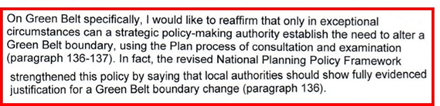
Additionally, the letters specifically state that the green belt boundary should only be altered in exceptional circumstances.  We cannot have “exceptional” circumstances in Trafford (or Greater Manchester) when, just by revising the GMSF to a 15 year plan would mean that NO builds on green belt would be required anywhere in Greater Manchester!

Excerpt from Kit Malthouse MP letter dated 4th April 2019

We’ll talk about the 15 year plan in a future blog, but given all the uncertainties, the lack of an appropriate national strategy and associated policies, and the general confusion about whether the housing need target is a target, we proposed a 15 year plan in our response to the GMSF.  We also suggested that the strategy should be focused on real housing need and await the outcome of the consultation with interest. 

Here in Trafford, we hope to persuade our politicians that our builds should be focused on reducing the waiting list for homes, not on reducing the land designated as green belt! 

Looking under the covers of the GMSF (Part 1)

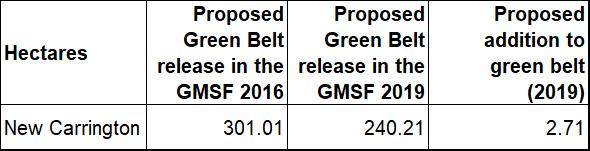
There is still a lot of misinformation being circulated about the plans for Carrington Moss and the justifications for those plans.   Some people are mentioning that the net loss of green belt since the 2016 iteration of the GMSF has been reduced by over 50%. This is indeed great news.  But not for Trafford!!!   In Trafford the reduction of net loss of green belt is only 22% and in New Carrington it is only 20%.   What? 

To achieve an average reduction in net loss of green belt of 50% across Greater Manchester means that other Authorities in the region reduced their net loss of green belt by much more than 50%.  Is this fair?  Well, maybe it would be if Trafford had a higher than average proportion of green belt to start with.  But we don’t!  Trafford currently has the lowest proportion of green belt in the whole of Greater Manchester (other than the city areas of Manchester and Salford).  The Regional average of land designated as green belt is almost 47%, whereas Trafford’s designated green belt is only 37%.  So much for equity across the Region!

The GMSF states that, once approved, nearly 45% of Greater Manchester’s land will be Green Belt but not in Trafford!  We will have only 34.3% Green Belt.  

Whilst we recognise it would be impossible to arrange an even split across all the districts, there was an opportunity over the last two years, whilst the GMSF was under a detailed review, to at least redress the balance – instead Trafford languishes significantly below its peers at the bottom of the table.  For the citizens of Greater Manchester, many of whom live in an increasingly polluted urban environment, the countryside on their doorstep is essential.  It is the place where they go to ‘chill out’, to escape the stresses and strains of modern life, whether walking, cycling or horse-riding, whether nature-spotting, bird-watching or just giving their mind a break.  For the residents of Trafford, reducing the green belt by over 350 hectares (which includes the Timperley Wedge reduction) significantly impacts the space available for these health and well-being activities and, of course, also decimates the breeding and feeding grounds of red listed (globally threatened) birds and endangered wildlife species.

Recent Entries »