

Public Money (ie YOUR money) wasted as Trafford ignores its own policies!
By Lorraine Eagling
Trafford Council has approved the development of a Battery Energy Storage System on Carrington Moss (the third in Carrington, with more elsewhere in Trafford). This scheme will not only result in the loss of productive Grade 2 farmland (essential for food security), and the food and foraging corridor of 79 red and amber listed bird species (which the applicant notes are utilising the adjacent site of biological importance), it will also necessitate the removal of up to 192,000 cubic metres of peat moss, which will release tens of thousands of tonnes of carbon into our atmosphere.
The approval is contrary to Places for Everyone (PfE) policy, which specifically states that no development can take place on Carrington Moss until the New Carrington Masterplan is in place. The PfE plan was only adopted in March 2024, after 10 years in the making. At barely a year old, and despite the millions of pounds of public money spent on its development, its policies are now being disregarded by Trafford Council!
The scheme is also contrary to the brownfield first policies in PfE, which has Strategic Objectives for both housing and employment sites that confirm Greater Manchester WILL “Prioritise the use of brownfield land“. There are acres of vacant brownfield land adjacent to the site in question, so why isn’t this land being used for this development?
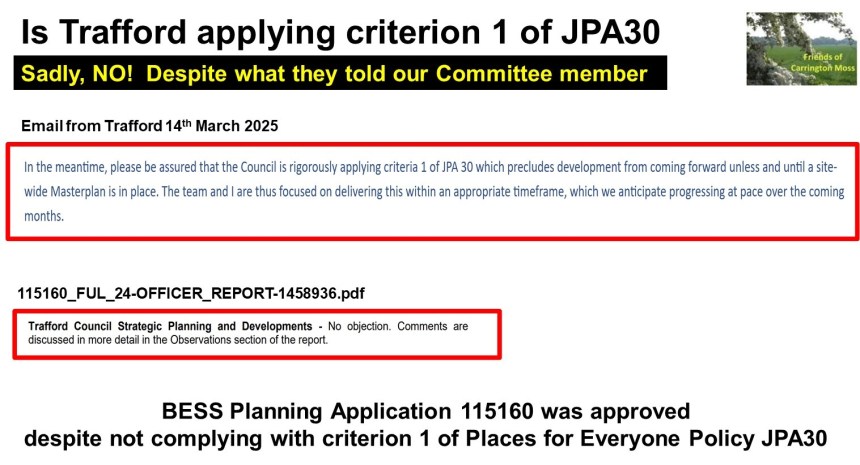
Despite past reassurances, from Trafford Council’s Strategic Planning and Development Department, that policies will be ‘rigorously’ applied and no development will take place until the Masterplan is in place, the same department did not object to this planning application.
Even more concerning, this controversial application did not go before the planning committee, which would have allowed local residents to raise their concerns to Councillors. Despite repeated objections, including in relation to the health and safety of residents, and the lack of compliance with policies in the development plan, this planning application was approved by a Council Officer, with needless haste.
I have written to the Council (copy below) requesting an explanation as to why this decision has been made, contrary to policy. Local Councillors have been copied into the email and I have invited them all to come along for a walk across the moss, so they can see first-hand, the impact this and future developments are going to have to this unique habitat.
Letter to Trafford Council’s Strategic Planning and Development Department:
Thank you for your response. I fully appreciate that this is not a simple or straightforward process. I too get bogged down with the paperwork and reading. It is no wonder that very few members of the general public have the time to read the masses of paperwork in order to fully understand the implications of The New Carrington Masterplan.
I did receive your email of 22nd May with the updated schedule. My subsequent email was in response to the approval of the BESS, despite it being contrary to criterion 1 of JPA 30 and your reassurances that the council is ‘rigorously applying’ criterion 1.
For the sake of those reading this email trail for the first time, criterion 1 states ‘Development of this site will be required to be in accordance with a masterplan that has been developed in consultation with the local community and approved by the local planning authority. The masterplan must include a phasing and delivery strategy, as required by policy JP-D1. Central to the masterplan shall be the consideration of opportunities to restore habitats, strengthen ecological networks, and manage the carbon and hydrological implications of development, having regard to the presence of peat on parts of the site. It should also have regard to the anticipated Hynet North West Hydrogen pipeline (as relevant). The masterplan will be prepared in partnership with key stakeholders to ensure the whole allocation is planned and delivered in a coordinated and comprehensive manner with proportionate contributions to fund necessary infrastructure‘
I fully support green energy and understand it’s role in achieving net zero, but apart from this approval being contrary to the above policy, the destruction of a peat moss to develop a BESS is illogical. The release of carbon during construction will outweigh the carbon benefit of the facility. The development will involve the excavation of up to 192,000m3 of peat which will release at least 35,000 tonnes of carbon.
This development is certainly not sustainable, (‘a development that meets the needs of the present without compromising the ability of future generations to meet their own needs’) as it will not only destroy premium agricultural land that provides food security for future generations, but will negate the ability to restore the precious carbon capturing peat that is one of our best defence against climate change.
It should also be noted that of all the boroughs in Greater Manchester (with the exception of Oldham and Rochdale who were unable to provide me with the information) Trafford will lose the most agricultural land (481 hectares) under Places for Everyone. At no point in the development of this plan, has the livelihood of the tenant farmers been mentioned.
I understand that this decision was made by the planning officer, but I have to express my deep concerns that despite the fact that the Masterplan has not been developed, according to the officer’s report, your Strategic Planning and Development Department made no objection to the application.
Why didn’t this application go to the Planning Committee when it is such a highly sensitive application? Also, what was the burning platform that made it impossible for this application to wait for the Masterplan to be agreed? The Places for Everyone Plan took years to develop at a cost of tens of £millions to the public purse, but within months of its adoption, the policies therein are not adhered to.
This approval calls into question just how ‘robust’ the masterplan will be if applications are already being approved. Once a precedent is set, it is unlikely the plan will able to ‘withstand challenge and scrutiny’. This is played out in the officer’s statement ‘It is noted that there have been two recent appeal decisions in Trafford for BESS applications where the Battery Energy Storage System compounds were in the Green Belt – Land Off Golf Road APP/Q4245/W/24/3343250 and Land at Wild Fowl Farm, Carrington Lane, APP/Q4245/W/24/3354822. The Inspectors concluded in both cases that Green Belt and any other harm was clearly outweighed by the very significant benefits in supporting the transition to net zero and in helping to secure stability and security in energy supply. Although not directly comparable, these cases are material in terms of the recent approach taken by Inspectors.’
It is hard to understand why the officer has approved this application when they themselves state ‘‘The NPPF, at paragraph 11, introduces ‘the presumption in favour of sustainable development.’ For decision-taking purposes, paragraph 11c explains that ‘the presumption in favour’ means approving development proposals that accord with an up-to-date development plan without delay’.
This application does not accord with the most up to date plan (Places for Everyone) as the Masterplan is not yet in place.
The officer also states ‘Where a planning application conflicts with an up-to-date development plan, planning permission should not normally be granted, paragraph 12 of the NPPF explains. The Places for Everyone Joint Development Plan was adopted on 21 March 2024. As development plan policies in Places for Everyone are very recently adopted, they are up-to-date and should be given full weight in decision making’.
With reference to factors that must be weighed in the balance, the officer’s report states that ‘The supporting documents states that the planning application is located on this land due to its close proximity to the Daines National Grid substation. The Applicant holds a grid connection agreement with NGET to connect the proposed BESS project to this substation’.
Whilst this is true, this site is grade 2 agricultural land that is constantly used for growing crops and is home to land nesting birds. However, there is 27 hectares of vacant hard standing brownfield land directly North of the site which is equidistant to the Daines National Grid substation and would be suitable. Why wasn’t this fact weighed in the balance when making the decision, particularly when one of the Government’s Golden Rules is ‘Brownfield First’ and one of the Places for Everyone’s Objectives is to put brownfield first for both housing and employment.
It should also be noted that some of the Officer’s knowledge of the New Carrington Allocation is incorrect as they state that there will be ‘major investment in public transport’. Sadly, this is not the case. Even though New Carrington is the largest allocation in Places for Everyone, there is no commitment for investment in public transport infrastructure. Furthermore, despite the Governments recent announcement of a £2.5 billion funding boost for public transport in Greater Manchester, Carrington, Partington and Sale West have not been earmarked for any of this.
As you appreciate, my main concern is the loss of green and natural infrastructure. The Officer states ‘Taking all of these factors into account, it is considered that the site itself is not needed immediately to contribute to the site-wide green and natural infrastructure strategy. That strategy and the subsequent JPA 30 compliant masterplan is capable of being produced and implemented without the application site in the first instance, as it will be able to have regard to its longer-term availability.
Here the officer is referring to the long-term plan to restore the peat at this site once the BESS is decommissioned. This raises two questions that should have been taken into account; a) the removal of 192,000 m3 of peat will limit what can be restored in future, b) why isn’t the peat being restored now to protect future generations, in twenty years time it will be too late? Another consideration is, if this development does go ahead, who will be responsible and has the expertise to ensure the peat extraction will be in accordance with the Peat Management Plan?
The officer goes on to say ‘However, since the application proposals are not in accordance with Criterion 1 of Policy JPA 30, any approval must robustly secure the compensation, so that it can contribute and link to the site-wide green and natural infrastructure’.
Already, the ability to robustly secure the compensation is compromised, as Manchester United have built a car park on land which is designated as the green corridor in JPA 30. I await the findings from your planning enforcement officers regarding this car park.
In the New Carrington Ecological Assessment which was in your last email, the Greater Manchester Ecology Unit states ‘GMEU has not itself carried out large-scale, detailed field-based ecological assessments of the entire allocation. Such a level of survey is regarded as beyond the scope of the assessment, generally carried out at the masterplanning or planning application stage of the land-use planning system’.
Is this large-scale, detailed field-based ecological assessment underway as part of the Masterplan, to ensure any approval will robustly secure the compensation, so that it can contribute and link to the site-wide green and natural infrastructure’? This is urgently needed to ensure a holistic approach, to not only help in the fight against biodiversity loss and climate change, but to ensure that existing communities are protected from flooding, air pollution, noise pollution and a loss of having access to open green spaces for mental well-being.
At one of the drop-in events for the Carrington Relief Road, the information boards said, in relation to BNG measures, “the scheme aims to transform what is currently unused land for the better with planting proposed on what is currently a brownfield site”. When questioned where this brownfield is located, the staff at the session pointed to the green belt agricultural land. When this was highlighted, they admitted that they were not entirely sure where this unused land will be.
In an attempt to clarify where these BNG measures will be, the question was sent directly to the team at Amey in February, together with a number of other questions, including ‘In relation to the attenuation ponds, are these being constructed to mitigate the impact of the road alone or are they expected to also mitigate the impact of other development in the eastern part of New Carrington?
Unfortunately, we had no response from Amey, so a freedom of information request was done to which we had a reply this week. The response to the BNG question was ‘The brownfield land is the Shell Carrington Estate’. The response to the attenuation ponds was ‘These are designed based on highway drainage, not relating to developments’.
Clearly describing the brownfield land as the Carrington Estate is very vague, and the response to the attenuation ponds demonstrates the ad-hoc nature of the planning applications for this site. Without a holistic approach, there is greater risk of flooding and a greater loss of biodiversity. This is why the inspectorate set out criterion 1 and emphasised the need for a Masterplan to be in place before any applications are approved.
It begs the question, how did the officer come to the conclusion that ‘As such there is no fundamental conflict with the emerging masterplan, that would preclude this development from coming forward ahead of it’ when there has been no discussion with stakeholders regarding the natural infrastructure, no evidence that there is any site-wide plan with regards natural infrastructure and that this site may be needed for mitigation and compensation under the masterplan.
All that the community have ever asked for is to be listened to. For years the communities have put forward sustainable alternatives that would benefit the communities of Partington, Carrington and Sale West, without the need to destroy a peat moss, wetlands, woodlands and agricultural land. Unfortunately, all of the ideas and the advice of other stakeholders, such as Natural England, have been ignored. So, the promise of stakeholder meetings at which we could discuss the issues that matter the most to us, in particular the green infrastructure, was really appreciated. At the one meeting so far, which was last July, we did not get the opportunity to raise our concerns and put forward our suggestions. Instead, we were asked to submit our thoughts with the promise that there would be further stakeholder meetings. I hope that these will recommence soon, as you suggested in your previous email.
I sincerely apologise for the length of my email. I appreciate you are working hard on this project, but to be honest, I have lost faith in the whole system. Who will benefit the most from New Carrington? Not the communities or future generations. They will face more traffic, air pollution, no improvement to public transport, social isolation and inequalities, less green space, a loss of biodiversity, flora and fauna essential for well-being, a loss of identity due to urban sprawl, higher risk of flooding, the list goes on. The winners will be the developers, who’s only objective is to make as much profit as possible irrespective of the costs to humans and nature and the planning system facilitates this.
We have little influence of what happens Nationally and Globally when it comes to the destruction of the natural world. Here we have an opportunity to do the right thing, to put nature before profit, to look at the alternatives and ensure we leave a legacy that will benefit future generations. If all decision makers did this, we would not be in the middle of a climate crisis.
My invitation to you to take a walk across the Moss still stands (although cycling would be best as the site is huge), so that maybe you will understand why we feel so strongly about its destruction. I welcome Local Councillors along too.
A final thought, ‘Let’s put GDP growth aside and start a fresh with a fundamental question that is what enables human beings to thrive? A world in which every human being can live a life with dignity, opportunity and community and where we can all do this within the means of our life-giving planet’. Kate Raworth, Senior Teaching Associate at Oxford University. I believe this is possible, so I will continue to fight to protect Carrington Moss, if only so that in years to come, I can look my children and grandchildren in the eye and say that I tried my best.
Kind regards
Lorraine Eagling
 Friends of Carrington Moss
You must be logged in to post a comment.