Trafford has available sites for affordable housing, so why are they not being built?
by Lorraine Eagling
The New Carrington Masterplan will result in the loss of a 335-hectare peat moss, Grade 2 agricultural land, woodlands and wetlands which will have dire consequences for local biodiversity and Trafford Council’s ability to be net zero by 2038. These important habitats are to be concreted over and replaced with 5,000 houses and 350,000sqm of warehousing.
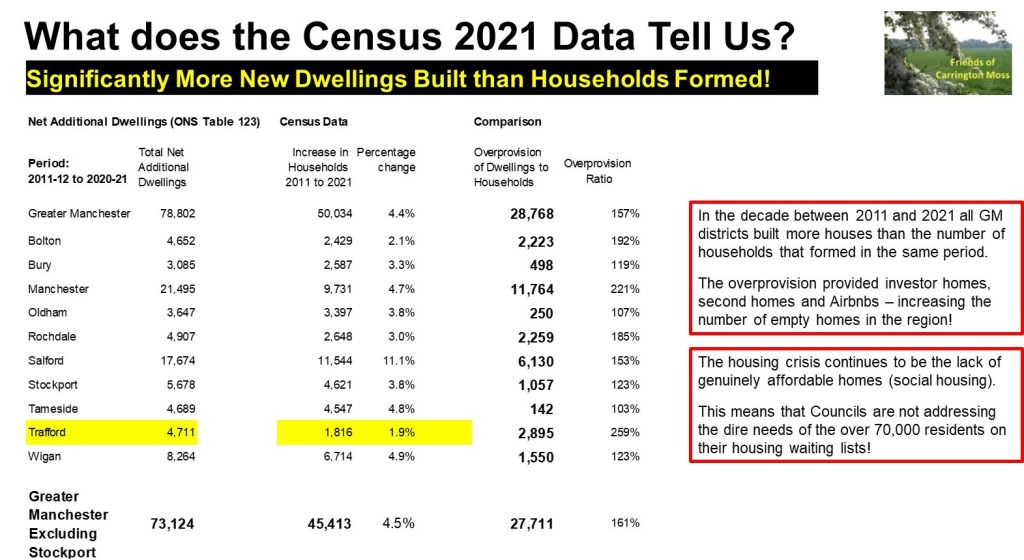
There is no doubt that there is a crisis in the availability of genuinely affordable housing (that is social/council housing) but Trafford and Greater Manchester appear to be planning to continue to build for investors, second home owners and airbnbs!
Building on a peat moss is not the solution to the affordable housing crisis. Research from CPRE has shown that there are enough ‘shovel-ready’ brownfield sites in the UK for 1.2 million new homes, which will make a significant contribution to Labour’s goal of 1.5 million homes.
The Labour Government recently published five golden rules for house building which were articulated in their proposals for the updated National Planning Policy Framework. They propose a sequential test which makes it clear that schemes must look to brownfield first, prioritising the development of previously used land wherever possible.
There are numerous suitable, local, brownfield sites, some of which are Council owned, that could be developed in advance of concreting over land that contributes to climate mitigation, nature’s recovery and our future food security. These brownfield sites could provide much needed social housing, which is not what is proposed for the former Green Belt land on Carrington Moss.
Here are some examples of such Council-owned sites, that are ready to be developed and are in locations that are serviced by good public transport links and local amenities (unlike the isolated area that is Carrington Moss, which the Council acknowledges is poorly served by public transport).
- The former Depot on Higher Road, Urmston – this site has been lying empty for a number of years. Following a freedom of information request, Trafford Council confirm this site was sold to a private developer. To date, there have been no planning applications submitted for this site.
- The former Woodsend Primary School, Flixton – this site has been lying empty for a number of years. Following a freedom of information request, Trafford Council confirm that they are looking at options to deliver homes on this site and would expect to make a decision within the next 12 months.
- Sale Magistrates Court, Sale – this building was demolished a number of years ago and the land sold to a private developer who submitted a planning application in December 2020. To date, no building work has commenced.
In addition to these Council-owned sites, there are many other brownfield sites in Trafford awaiting development, as identified in the Council’s own Strategic Housing Land Availability Assessment (known as a SHLAA for short).
In response to our freedom of information request Trafford Council said
‘Delivery of homes including affordable homes is a priority for the Council. The Council is prioritising the delivery of homes at Council owned sites including Tamworth (Old Trafford), Former Sale Magistrates Court, Chapel Road (Sale) and Stretford Town Centre.
We also have a need to invest in other assets and services that benefit our communities. For example the Council is investing in its leisure portfolio which includes improvements at Urmston, Altrincham and Partington Leisure Centres. The receipts from land sales such as Higher Road Depot are part of the funding for these activities.’
We await progress with interest but, given that planning applications are already coming forward on former Green Belt and greenfield land, there is no doubt that the Brownfield First policy is NOT what is being pursued in Trafford!
 Friends of Carrington Moss
Pingback: Unsustainable New Carrington – “Trapped Behind the Wheel” | Friends of Carrington Moss
Pingback: Risk to your local peatmoss – YOU can help! | Friends of Carrington Moss